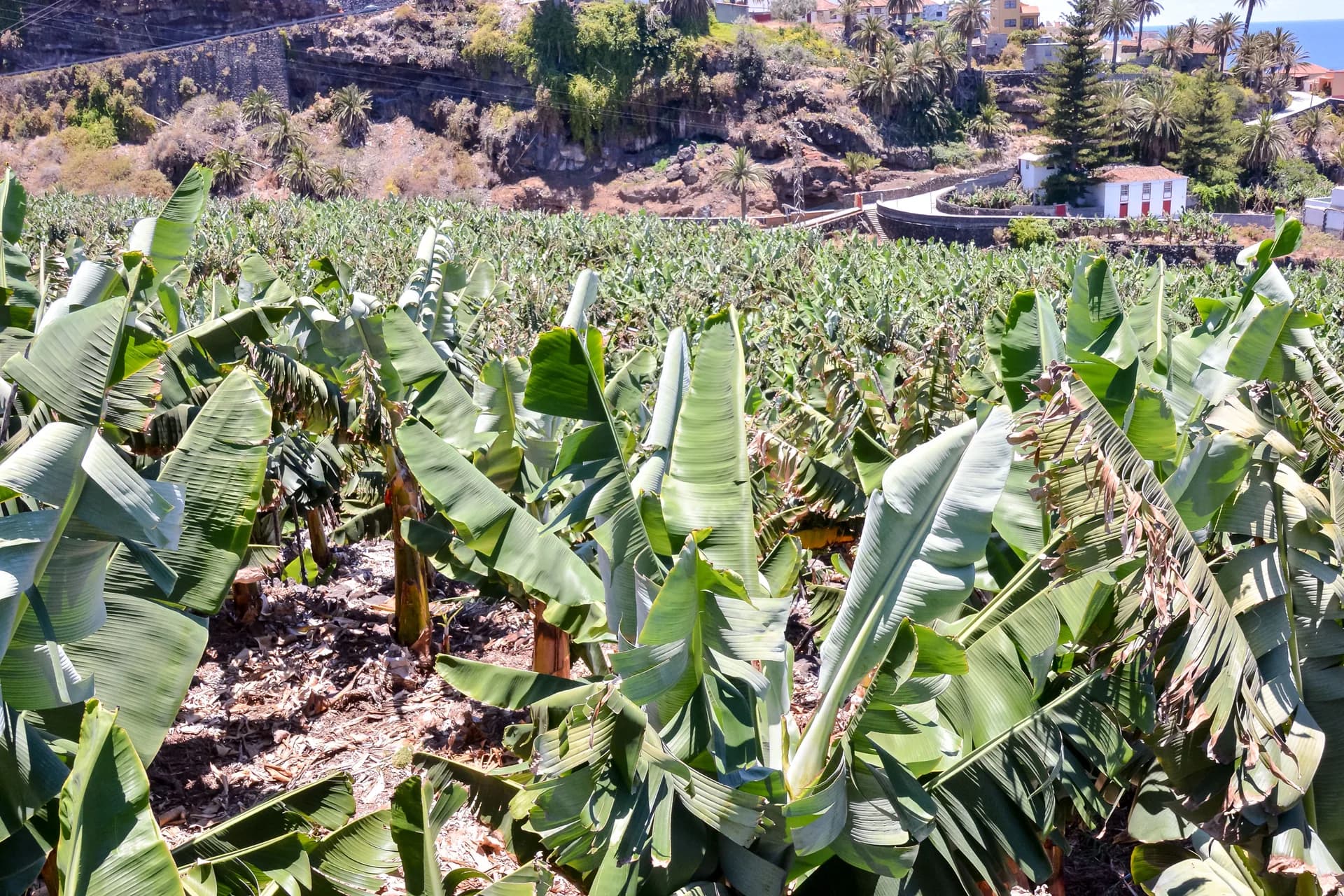

Iron chlorosis in organic bananas manifests as interveinal yellowing in young leaves and is usually associated with calcareous soils, bicarbonates or poor drainage. Before applying iron chelates, it is advisable to confirm the deficiency with soil and leaf analysis, correct the pH and choose an iron source authorised for organic production. Nutritional management of organic bananas requires distinguishing a genuine iron deficiency from other imbalances that produce similar symptoms.
Why does iron chlorosis appear in organic banana?
Iron chlorosis in organic banana appears when the plant does not have enough assimilable iron, even though the soil contains total iron. In calcareous or alkaline soils, bicarbonates immobilise iron and reduce its availability; excess moisture, poor drainage and root compaction also contribute.
Banana is a fast-growing crop with a high nutritional demand. In organic production, fertilisation relies on organic matter and authorised sources, which requires closer monitoring of nutritional status. Iron participates in chlorophyll synthesis and in respiration and photosynthesis processes; when it is lacking, young leaves show yellowing between the veins that contrasts with the green of the veins. This pattern is indicative, but not exclusive: zinc, manganese or magnesium can generate similar symptoms, and excess moisture or severe compaction also alter leaf expression.
That is why, in organic farming, applying iron is not enough: the soil pH, the alkalinity of the irrigation water, drainage and stable organic matter must be reviewed. Soil organic matter contributes to micronutrient availability and microbial activity, but it does not replace the correction of an excessively high pH. In calcareous soils, iron applied as sulphate can quickly become immobilised, and foliar applications offer a rapid but temporary visual response, which requires good coverage and does not correct the underlying cause.
The strategy must combine soil improvement, control of alkalinity and the choice of a suitable iron source. In our control laboratory we measure parameters for each reference, and the chloride measured in an accredited laboratory for each product can be consulted on the website. For organic banana, the decision on which iron to apply must be taken with the technician and with the regulations of the destination market in hand.
The iron cycle in the soil and its relationship with pH
Iron is an abundant element in the Earth's crust, but its total presence in the soil says little about what the plant can absorb. Availability depends on the chemical form in which it is found: in acidic and well-aerated media, ferrous iron predominates, which is relatively soluble, whereas in alkaline or oxidising media it tends to transform into oxides and hydroxides of very low solubility. This balance is dynamic and responds to moisture, temperature, aeration and the biological activity of the soil.
In a calcareous soil, calcium carbonate acts as a buffer and keeps the pH at high values, so that the iron present in the profile remains in poorly assimilable forms even though total analysis indicates sufficient reserves. Bicarbonates dissolved in the soil solution aggravate the problem because they interfere with root absorption and with the internal transport of iron within the plant. That is why two plots with the same total iron content can behave very differently depending on their pH, their active lime content and the quality of the irrigation water.
Organic matter plays a dual role. On the one hand, its organic acids can form complexes with iron and keep it more available; on the other, excessive mineralisation or a very high pH can favour its precipitation. In organic production, where fertilisation is based on compost, mature manure and cover crops, it is advisable to ensure that the organic matter is stable and well humified, because the fresh fraction contributes little to micronutrient availability and can compete for root oxygen if incorporated in excess.
Management factors that aggravate chlorosis in banana
Beyond soil chemistry, there are cultivation practices that intensify iron chlorosis in organic banana. Excessive or poorly distributed irrigation reduces the oxygen available in the root zone and hinders the active absorption of iron; prolonged waterlogging can also favour the formation of reduced compounds that are toxic to roots. Compaction from machinery traffic, from repeated operations in the same alley or from lack of soil structure limits root development and reduces the absorption surface.
The choice of plant material and plantation management also have an influence. A banana with a shallow, poorly exploring root system is more sensitive to availability imbalances, and plantations with high densities or with little renewal of organic matter tend to show symptoms more frequently. Likewise, the use of irrigation water with high alkalinity or with high concentrations of bicarbonates can maintain the problem even when the soil has been partially corrected.
An illustrative, hypothetical example would be an organic banana farm where yellowing is observed in new leaves after a period of intense rainfall followed by abundant irrigation. Soil analysis shows a high pH and a good supply of total iron, but drainage is deficient in a low area of the plot. The correction would not consist solely of supplying iron, but of improving drainage, reviewing irrigation frequency and evaluating an authorised iron source in the affected area, always checking the authorisation of the product.
Related articles
Technical data sheets and distribution conditions
Ecoganic manufactures biostimulants and fertilisers with freshwater microalgae in Málaga. Request the technical data sheets by reference and the distribution conditions for your market.
What differences are there between iron chelates in calcareous soils?
In calcareous soils, Fe-EDDHA-type iron chelates tend to keep iron available better than Fe-EDTA, which works in less alkaline media. Agronomic efficacy alone does not determine authorisation for organic production: the list of authorised substances and the product data sheet must be checked.
A chelate is a compound that keeps iron bound to a chelating agent, preventing it from precipitating or becoming immobilised. Under alkaline conditions, Fe-EDDHA is more stable, whereas Fe-EDTA loses efficacy at high pH. However, in organic farming the choice cannot be based on efficacy alone: Regulation (EU) 2018/848 requires that fertilisers be used only when nutritional needs cannot be met through organic practices, and that they be authorised for organic production. The applicable list is set out in Implementing Regulation (EU) 2021/1165, where various iron salts appear, such as ferrous sulphate monohydrate and heptahydrate. The presence of a commercial chelated product must be checked specifically in the current annex, in its technical data sheet and in the corresponding national register. It must not be assumed that a conventional Fe-EDDHA or Fe-EDTA is automatically suitable for organic farming.
In addition, localised application in the root zone is usually more efficient than surface distribution, and it is advisable to correct zinc, manganese or magnesium imbalances when the analysis confirms them. Foliar applications can alleviate the visual expression, but they do not resolve availability in the soil.
How a chelating agent acts and why its stability matters
A chelator is a molecule capable of surrounding the metal ion and keeping it in solution, preventing it from reacting with other soil components and precipitating. The stability of this complex depends on pH, on the presence of other competing cations and on the very nature of the chelating agent. In practical terms, the more stable the complex is under the real conditions of the soil, the longer the iron will remain in a form that the root can absorb.
In calcareous soils, the less stable chelating agents tend to release the iron, which turns into poorly available oxides, whereas the more stable ones keep it protected for longer. That is the reason why the choice of chelate type conditions the agronomic result. However, stability is not the only criterion: solubility, granulometry, product homogeneity and the method of application influence the final efficacy. A very stable chelate but poorly distributed or applied in an area where the roots are not active contributes little.
It is also advisable to consider the interaction with other nutrients. An excess of phosphorus can immobilise iron, and high concentrations of copper or zinc can compete for the same absorption mechanisms. That is why foliar and soil analysis must be interpreted as a whole, not as isolated parameters.
Soil application versus foliar application
Soil application seeks to correct availability in the root zone, whereas foliar application pursues rapid relief of symptoms. Both have advantages and limitations that should be known before deciding.
Soil application, especially if localised, takes advantage of the root's capacity to absorb iron and can maintain a longer-lasting effect if the conditions of the medium are favourable. However, in very calcareous soils the iron
References
Frequently Asked Questions
How can iron chlorosis be distinguished from a magnesium deficiency in banana?
Iron chlorosis usually appears on young leaves, with green veins and a yellow blade. Magnesium deficiency usually shows first on mature leaves. Visual observation is not enough: leaf and soil analysis confirms which nutrient is lacking and avoids applying iron when the problem is something else.
Can Fe-EDDHA be used on organic banana?
Not automatically. Fe-EDDHA can be effective on calcareous soils, but in organic farming it must appear on the list of authorised substances in Implementing Regulation (EU) 2021/1165 and comply with the conditions of use. The product data sheet and the corresponding national registration must be verified.
Is foliar iron application enough to correct chlorosis?
Foliar application can give a rapid visual response, but it is usually temporary and does not correct iron availability in the soil. In organic banana it should be accompanied by improved drainage, control of water alkalinity and stable organic matter, as well as choosing an authorised iron source.
What documents must the organic operator keep when applying iron?
Records of the product, dose, plot and agronomic justification must be kept, and the labelling and compliance with European fertiliser legislation and with the requirements of the certification body must be checked. For export to the EU, the input must comply with the European framework even if it is applied in Latin America.