
Organic micronutrients for agriculture
Micronutrients are essential elements that, although needed in small quantities, play a critical role in plant metabolic processes: photosynthesis, protein synthesis, sugar transport and stress resistance. A zinc, iron or manganese deficiency can reduce yield by 30-40% without evident visual symptoms. Ecoganic micronutrients are in chelated organic form for maximum bioavailability.
The 6 products in this category
Each with the value measured at an accredited laboratory, not merely the declared one.
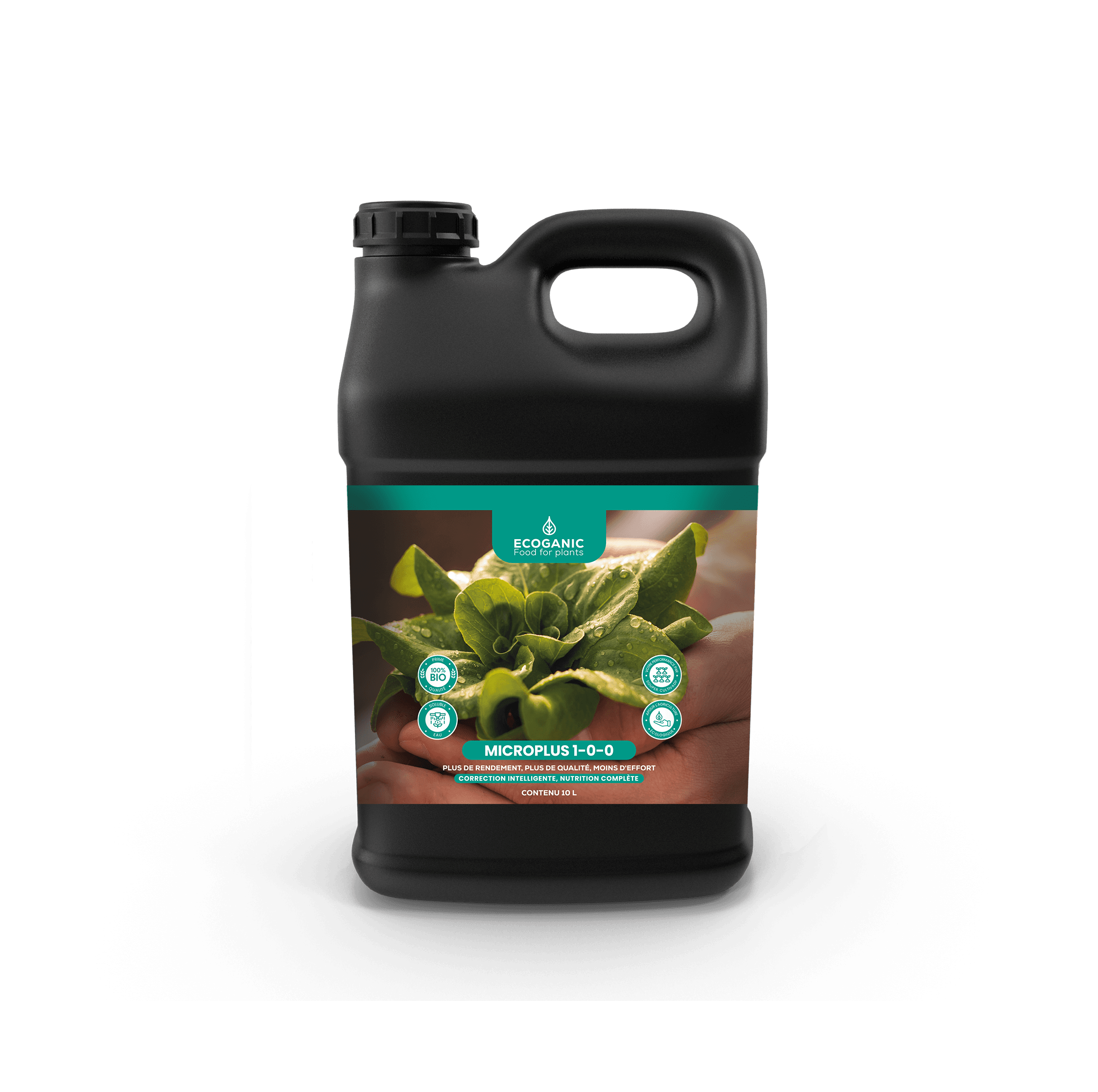
MICRO PLUS 1-0-0
Total nitrogen (N)
1,013 % (measured)
Chloride: 0,183 % (measured)
View technical sheet →BOROPLUS
Total boron (B)
5,97 % (p/p) (measured)
Chloride: < 0,05 % (measured)
View technical sheet →COBREPLUS
Chelated copper (Cu)
Presente
Chloride: < 0,05 % (measured)
View technical sheet →IRONPLUS
Total iron (Fe)
5,99 % (p/p) (measured)
Chloride: 0,0533 % (measured)
View technical sheet →NZN ENDOPLASMA ICE
Organic nitrogen (N)
60 g/L
ZINCFORCE 40
Total zinc (Zn)
26,8 % (p/p) (measured)
Chloride: < 0,05 % (measured)
View technical sheet →Essential micronutrient guide — symptoms and correction
Micronutrient deficiencies are often subclinical — yield drops before visual symptoms appear.
ZINC
Essential for auxin and chlorophyll synthesis. Common deficiency in maize, rice, citrus and fruit trees. Symptoms: small leaves, short internodes, interveinal mottling.
IRON
Key to chlorophyll formation and the electron transport chain. Very common deficiency in calcareous soils (pH >7). Symptoms: interveinal chlorosis in young leaves.
MANGANESE
Enzyme cofactor in photosynthesis (PSII). Deficiency in high-pH soils or with excess iron. Symptoms: interveinal chlorosis, similar to iron but in mid-age leaves.
BORON
Essential for cell division, fruit set and sugar transport. Critical deficiency during flowering. Symptoms: flower abortion, fruit deformation, apical dieback.
COPPER
Involved in lignification and protein synthesis, and acts as a cofactor in photosynthetic electron transport. Deficiency in organic or very sandy soils. Symptoms: chlorosis and wilting of leaf tips.
Organic vs. inorganic form
Why micronutrients in organic form?
- ▸Certified CE 2018/848, NOP USDA and JAS — suitable for certified organic farming
- ▸Chelated organic form — maximum bioavailability and absorption both foliar and root
- ▸No residues in soil or fruit — safety for farmer and consumer
- ▸5 micronutrients in one product — simplifies the fertilization program
- ▸Compatible with drip fertigation and foliar application — no clogging
MICRO PLUS 1-0-0 — composition
Zn
4,00–5,34 %
Mn
1,00–1,64 %
B
1,00–1,64 %
Cu
0,20–0,34 %
Mg
0,49–0,51 %
N
1,00 %
Frequently asked questions
Why apply micronutrients in organic form?
Micronutrients in inorganic form (sulphates, conventional EDTA chelates) can work in the short term but are not permitted in organic farming. Ecoganic's are bioavailable, compatible with Regulation (EU) 2018/848, NOP USDA and JAS, and leave no residue in the soil or the fruit.
Which micronutrient deficiencies are most common in Mediterranean cropping?
Iron and manganese in calcareous, high-pH soils; zinc in maize and rice; and boron in fruit crops during flowering. MICROPLUS 1-0-0 brings the five essential micronutrients together in a single certified product, which simplifies the correction programme.
Can they be applied alongside the rest of the fertilisation programme?
Yes. MICROPLUS 1-0-0 is compatible with the liquid and solid NPK products in the range, dissolves in cold water and suits fertigation or foliar application. Mixing with calcium should be checked pair by pair before preparing the tank.
Ecoganic
Want to correct micronutrient deficiencies in your crop?
Certified CE 2018/848, NOP USDA and JAS. Made in Málaga. Available in liquid format.