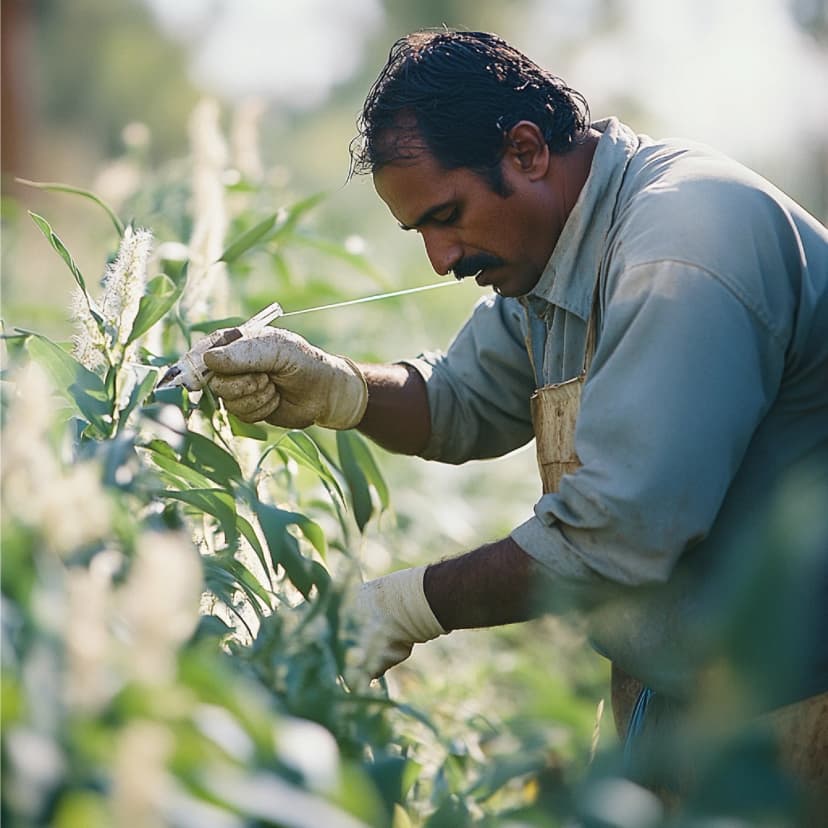
Causes of potassium deficiency in organic plantain
Potassium deficiency in organic plantain is one of the most frequent nutritional limitations in tropical and subtropical plantations, especially when the crop is managed under organic certification. Plantain (Musa spp.) is a highly potassium-demanding crop: it extracts between 400 and 600 kg of K2O per hectare per year in intensive production, a figure far higher than that of other macronutrients. In organic systems, where highly soluble synthetic salts are not used, guaranteeing this supply in a sustained form available to the plant requires planned management of the soil, organic matter and permitted mineral sources.
The most common cause of this deficiency is not the total absence of potassium in the soil, but its low availability. Potassium is a highly mobile cation that is easily lost through leaching in sandy soils or under excessive irrigation, and becomes fixed in clay soils with high cation exchange capacity (CEC) when calcium and magnesium preferentially occupy the exchange sites. In organic farming, moreover, the mineralisation of organic matter is the main vehicle for potassium release, so soils with low microbial activity or unbalanced C/N ratios release this nutrient at a rate insufficient to meet crop demand. Factors such as extreme pH, compaction, excess sodium or imbalances with calcium and magnesium aggravate the problem and explain why many organic growers observe deficiency symptoms even in soils with apparently sufficient analysis values.
A frequent field case occurs in plantain plantations established on volcanic or alluvial soils with a high content of sand and young organic matter. After the first production cycles, the continuous extraction of bunches without equivalent organic replacement depletes the available reserves. The farmer observes premature yellowing of lower leaves and lighter bunches, but soil analyses do not show critical values because total potassium remains in non-exchangeable forms. This demonstrates that in organic systems the diagnosis must integrate soil analysis, foliar analysis and phenological observation, not just a single isolated parameter.
Edaphic factors that reduce potassium availability
Soils with a coarse texture and low CEC retain little exchangeable potassium, which is easily leached into deeper layers beyond root reach. Conversely, clay soils dominated by 2:1 minerals can fix potassium in interlayer spaces, making it unavailable. pH also has an influence: in acidic soils with a pH below 5.5, competition with aluminium and manganese interferes with uptake; in calcareous soils with a pH above 7.5, calcium displaces potassium from the exchange sites. Compaction reduces root exploration and limits access to deep reserves, while excess sodium in coastal areas generates direct ionic antagonism.
Nutritional imbalances and their impact on uptake
Potassium competes with calcium and magnesium for the same root transporters. Ca/K ratios above 10:1 or Mg/K ratios above 4:1 significantly reduce the potassium uptake rate, even when potassium is abundant in the soil solution. In organic plantain, where calcareous and magnesium amendments are commonly applied to correct acidity, these imbalances appear frequently. A well-designed organic fertilisation programme must consider not only the absolute amounts of each nutrient, but also their relative proportions and the release dynamics of each source.
Soil organic matter plays a central role: every 1 % increase in organic matter can raise the CEC by 10-20 cmol/kg, improving potassium retention and its gradual release. Therefore, in organic systems the strategy cannot be limited to supplying potassium, but must build a functional clay-humus complex that retains it and releases it according to crop demand.
Symptoms and diagnosis of potassium deficiency in plantain
Early diagnosis of potassium deficiency in organic plantain is key to avoiding irreversible yield losses. Potassium is a mobile nutrient within the plant, so the first symptoms appear in the most mature leaves, especially in the lower third. The symptom sequence is relatively characteristic and makes it possible to distinguish it from other deficiencies, although in the field multiple deficiencies usually occur together, which complicates interpretation.
The first visible sign is a premature yellowing of the edge of the lower leaves, which progresses towards the midrib and can develop into marginal necrosis. Affected leaves lose turgor, bend under their own weight and show a dry, brittle appearance. In advanced stages, the pseudostem decreases in diameter, the suckers are less vigorous and the bunch has shorter, lighter fingers. Ripening is brought forward irregularly, which affects harvest uniformity and the commercial quality of the fruit.
A representative case is seen in plantain plantations in humid tropical areas with alluvial soils. After two or three high-production cycles, farmers notice that leaves 4 to 6 from the base yellow prematurely and that bunches weigh between 15 % and 25 % less than in previous cycles. Leaf analysis reveals potassium concentrations below 2.5 % in dry matter in leaf 3, a threshold considered critical for the crop. At that point, correction is already reactive and part of the productive potential has been lost.
Leaf analysis: the most reliable diagnostic method
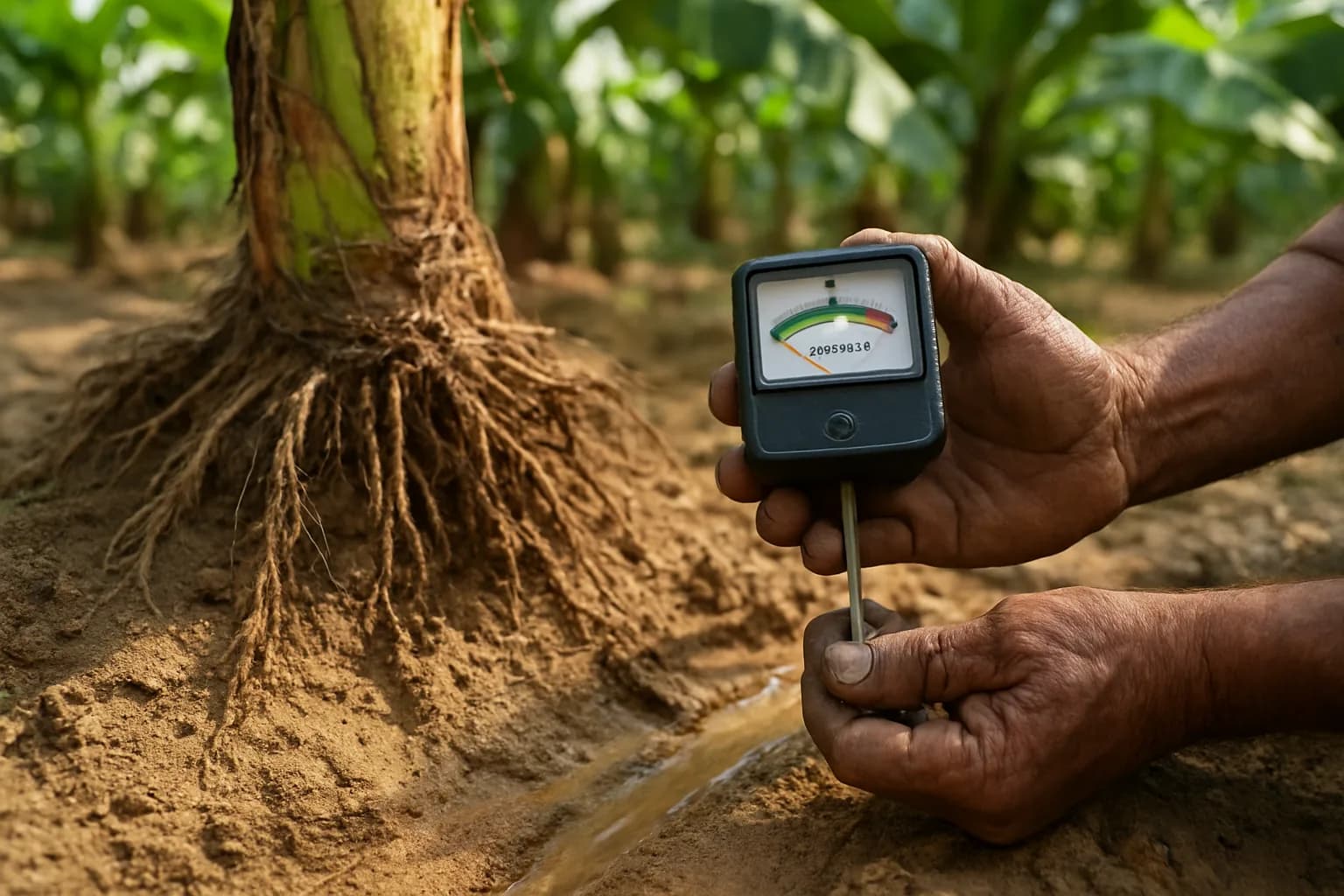
Leaf analysis is the most reliable tool for confirming potassium deficiency in plantain, provided it is carried out using a standardised protocol. Sampling leaf number 3 (counting from the base of the pseudostem upwards) in plants at the flowering stage is recommended, taking the central portion of the lamina without the midrib. Indicative reference values place the adequate range between 2.8 % and 4.0 % K in dry matter; below 2.5 % is considered deficiency, and above 4.5 % may indicate luxury consumption or an imbalance with calcium and magnesium. It is advisable to complement this with soil analysis to assess actual availability and with irrigation water analysis to detect inputs or interferences.
Differential diagnosis from other deficiencies
Potassium deficiency can be confused with magnesium deficiency, which also yellows lower leaves, but in this case the symptom begins in the centre of the lamina between secondary veins and spares the edges. Nitrogen deficiency produces more uniform and generalised yellowing, whereas zinc deficiency generates chlorotic bands and narrower leaves. Marginal necrosis due to salinity toxicity or excess boron can also be confused, so diagnosis should be supported by analyses and by the management history of the plot.
The role of potassium in banana physiology
Potassium is the most abundant cation in the plant cytoplasm and performs essential functions in banana physiology. It acts as an enzyme activator in more than 60 enzyme systems, regulates the cellular osmotic potential, participates in stomatal opening and closing and is decisive in the transport of photoassimilates from the leaves to the storage organs, in this case the bunch. Its adequate presence improves stomatal conductance, water use efficiency and tolerance to water stress in tropical crops.
During the bunch filling stage, potassium demand soars: more than 60 % of the total potassium absorbed by the plant accumulates in the fruit during the 8-10 weeks prior to harvest. This nutrient directly influences bunch weight, the number of fingers per hand, finger length, soluble solids content and post-harvest shelf life. A deficit at this stage reduces fruit calibre, increases susceptibility to mechanical damage and shortens the commercial life of the banana.
From a biochemical point of view, potassium regulates membrane ATPase activity, essential for the absorption of nitrates and phosphates, and participates in protein and starch synthesis. Its deficiency causes accumulation of soluble nitrogenous compounds, a reduction in net photosynthesis and increased respiration, which translates into lower biomass accumulation. In addition, potassium is involved in resistance to biotic stress: well-nourished plants tolerate attack by fungi such as Mycosphaerella fijiensis (black sigatoka) and by nematodes better, because they maintain more resistant cell walls and a more efficient defensive response.
Interaction with other nutrients and with soil microbiota
Potassium interacts with nitrogen, phosphorus, calcium and magnesium in absorption and translocation processes. An excess of ammoniacal nitrogen can reduce potassium absorption through ionic competition, whereas a balanced N/K ratio favours fruit quality. In the soil, soil microbiota mineralises organic matter and releases potassium gradually, but it can also temporarily immobilise it in its biomass. Arbuscular mycorrhizal fungi, present in well-managed ecological systems, improve root exploration and facilitate access to potassium reserves in micropores inaccessible to roots.
Correction strategies with organic fertilisers and biostimulants
Correcting potassium deficiency in organic banana must combine gradual-release organic inputs, mineral sources permitted in organic farming and biostimulants that improve absorption efficiency and stress tolerance. The aim is not only to raise potassium levels in the soil, but to guarantee its availability at critical phenological moments and to maintain balance with calcium and magnesium.
Among the most widely used organic sources are manure compost, composted crop residues, plant ashes (with caution due to their alkalinity and possible heavy metal content), seaweed extracts and certified organic fertilisers rich in potassium of plant origin. In established organic plantations, the indicative maintenance dose may be between 300 and 500 kg of K2O per hectare per year, split into 3-4 applications coinciding with demand peaks: sprouting, floral differentiation, flowering and bunch filling. In soils with confirmed deficiency, correction doses may be increased by up to 30-50 % during the first cycle, adjusting according to leaf analysis.
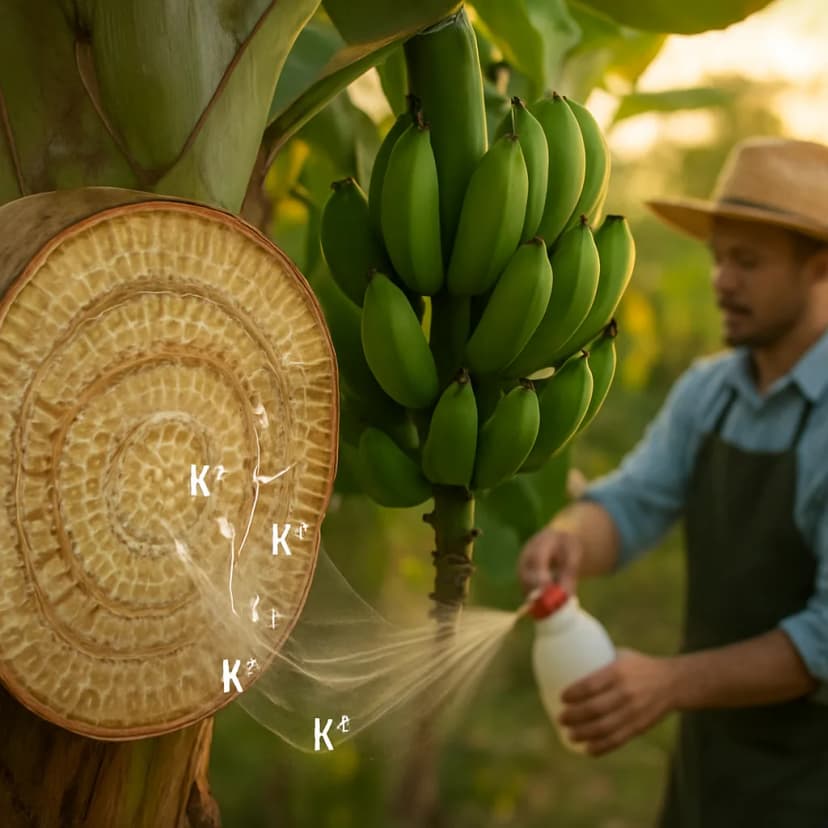
Root application through organic fertigation allows more controlled release and better distribution in the active root zone, which in banana is concentrated in the first 30-40 cm of depth and up to 1.5 m from the pseudostem. Organic agricultural biostimulants, especially those based on microalgae extracts and fulvic acids, improve foliar nutrient absorption and soil microbial activity, favouring the mineralisation of organic matter and the release of potassium. Foliar application of potassium, although it does not replace root fertilisation, can alleviate acute symptoms in phases of high demand, with doses of 2-4 kg of K2O per hectare in spraying, respecting phytotoxicity limits.
The role of microalgae and fulvic acid biostimulants
Microalgae biostimulants provide natural phytohormones, polysaccharides and amino acids that stimulate root growth, improve tolerance to water stress in crops and favour nutrient absorption. In banana, foliar applications of microalgae extracts at sprouting and flowering stages can increase stomatal conductance and photosynthetic efficiency, indirectly improving potassium absorption. Fulvic acids for organic farming, for their part, form complexes with cations such as potassium, increasing their mobility in the soil and their availability to the root, as well as stimulating soil microbiota and improving the structure of the clay-humic complex.
Ecoganic biostimulant technology integrates freshwater microalgae extracts, humic and fulvic acids and beneficial microorganisms in formulations designed to improve nutritional efficiency and crop resilience. In trials and field results, the combined application of certified organic fertilisers and biostimulants has shown increases in bunch weight and harvest uniformity in banana and other tropical crops, although results depend on soil, climate and management conditions.
Indicative correction plan for organic banana
| Phenological stage | Application route | Product and indicative dose | Objective |
|---|---|---|---|
| Pre-sprouting (start of cycle) | Root | Mature compost 5-10 t/ha + organic fertiliser rich in K (150-200 kg K2O/ha) | Replenish reserves and activate microbiota |
| Active sprouting | Foliar | Microalgae biostimulant 2-3 L/ha | Stimulate rooting and growth |
| Floral differentiation | Root + foliar | Organic K fertiliser (100-150 kg K2O/ha) + fulvic acids 3-5 L/ha | Improve availability and absorption |
| Flowering | Foliar | Biostimulant with K and microalgae 2-4 L/ha | Reduce stress and improve fruit set |
| Bunch filling | Root | Organic K fertiliser (150-200 kg K2O/ha) + liquid organic matter | Maximise fruit weight and quality |
It is important to adjust these doses according to soil and leaf analyses, plantation age, productive potential and climatic conditions. In certified organic systems, all inputs must be authorised in accordance with European organic production regulations (Regulation EC 2018/848) or equivalent local regulations in Latin America, and it is advisable to verify the Ecoganic organic certifications of each product before use.
Agronomic management to prevent potassium deficiency
Prevention is more cost-effective than correction. Agronomic management aimed at maintaining the integral fertility of the soil reduces the likelihood of potassium deficiency in organic banana and improves the sustainability of the system. The key lies in combining cultural practices, management of soil organic matter and continuous monitoring.
The regular supply of organic matter is the basis of any preventive strategy. Mature compost, green manures and correctly managed crop residues feed the soil microbiota and maintain a constant flow of potassium into the soil solution. It is recommended to maintain organic matter levels above 2 % in tropical soils, with C/N ratios between 10 and 15 to favour mineralisation without excessive immobilisation. The incorporation of legumes as cover between rows or in alleys provides nitrogen and improves structure, favouring root exploration.
Irrigation management is decisive: excess water leaches potassium, while a deficit reduces its uptake due to a lack of mass flow towards the root. In banana, localised irrigation programmed according to evapotranspiration and phenological stage allows moisture to be maintained at field capacity without saturation. Soil pH should be kept between 6.0 and 7.0 to optimise potassium availability and avoid antagonisms with calcium and magnesium. In acid soils, liming with materials permitted in organic farming must be accompanied by magnesium inputs so as not to induce imbalances.
Crop rotation and diversification, where the system allows, helps to break cycles of intensive extraction and to maintain the functional biodiversity of the soil. In banana plantations, association with cover crops or the management of controlled spontaneous vegetation favours the presence of beneficial fauna and beneficial microorganisms. Monitoring through annual foliar analysis and soil analysis every 2-3 years allows trends to be detected before they become visible deficiencies.
Good application practices and critical moments
Root applications should be directed to the zone of greatest root density, avoiding direct contact with the pseudostem to prevent damage. In fertigation, it is preferable to split the weekly or fortnightly doses to maintain stable concentrations in the soil solution and reduce losses through leaching. Foliar applications should be carried out during hours of lower temperature and higher relative humidity, preferably at dusk, to maximise foliar nutrient uptake and minimise evaporation. The addition of adjuvants permitted in organic farming improves coverage and cuticular penetration.
The critical moments for potassium in banana are floral differentiation and bunch filling. A deficit in these phases has a disproportionate impact on yield and quality. Therefore, the application calendar must anticipate these peaks, not react when symptoms are already visible. The integration of biostimulants that improve crop rooting and nutrient uptake reinforces the efficiency of the programme and contributes to a reduction in chemical fertiliser in conventional systems in transition to organic.
Success indicators and continuous adjustment
The success of the management is evaluated with objective indicators: foliar potassium concentration within the appropriate range, average bunch weight, number of fingers per hand, uniformity of ripening and post-harvest shelf life. Annual monitoring allows doses and application times to be adjusted. In organic systems, the improvement of organic matter and microbial activity is usually reflected in greater resilience to water and biotic stress, with benefits that go beyond potassium.
Related articles
Do you need professional help?
At Ecoganic in Spain, Europe, we offer Biostimulants and Organic Fertilizers. Call us: +34 623 753 719.
Request your free quote
Frequently asked questions about potassium deficiency in organic banana
How is potassium deficiency corrected in organic banana?
Correction combines root applications of organic fertilisers rich in potassium, mature compost and organic matter, together with foliar applications of microalgae biostimulants and fulvic acids. It is key to split the doses according to the phenological stage, prioritising floral differentiation and bunch filling, and to adjust according to foliar analysis. In soils with imbalances, the ratio with calcium and magnesium must also be corrected. Results are usually observed over one or two crop cycles.
What are the visual symptoms of potassium deficiency in banana?
The first symptoms appear on mature leaves in the lower third: yellowing of the margin that progresses towards the midrib, followed by marginal necrosis and loss of turgidity. The leaves become brittle and the pseudostem may decrease in diameter. In advanced stages, the bunches are smaller, with short fingers and irregular ripening. These symptoms must be confirmed with foliar analysis of leaf 3, as they can be confused with magnesium deficiencies or toxicities.
What dose of potassium does organic banana need?
Indicative maintenance doses are between 300 and 500 kg of K2O per hectare per year, split into 3-4 applications. When correcting confirmed deficiencies, they may be increased by up to 30-50 % during the first cycle. These figures must be adjusted according to soil and foliar analysis, productive potential, soil texture and climatic conditions. In organic farming, it is preferable to prioritise organic sources with gradual release and to complement with biostimulants to improve absorption efficiency.
Can foliar potassium be applied in organic banana?
Yes, foliar application of potassium is permitted in organic farming with authorised products and can alleviate acute symptoms during phases of high demand. Doses of 2-4 kg of K2O per hectare are recommended in spraying, during the cooler hours and with permitted adjuvants. However, it does not replace root fertilisation, which is the main route for replenishing soil reserves and sustaining production in the long term. Combining both routes improves the efficiency of the nutritional programme.
References