Introduction
Natural degreening in organic Canary Islands bananas is a key process for guaranteeing the commercial quality of the fruit without resorting to synthetic chemical products, in compliance with organic production regulations and the demands of an increasingly sustainability-oriented market. In the Canary Islands, the banana (Musa acuminata Colla, Cavendish subgroup) is one of the most emblematic crops and one of the greatest economic importance, with a dedicated area exceeding 9,000 hectares, mainly in Tenerife, La Palma, Gran Canaria and Lanzarote. The natural ripening of the banana involves the degradation of chlorophyll, which allows the fruit to acquire its characteristic yellow colour. However, under cultivation and post-harvest conditions, this process can be irregular or too slow, which is why exogenous ethylene or chemical treatments have traditionally been used to accelerate degreening. In organic farming, these practices are restricted, which drives the search for natural and sustainable alternatives.
Natural degreening not only affects the visual appearance of the fruit, but also influences its content of starches, sugars, phenolic compounds and vitamin C, as well as its texture and aroma. Mastering this technique is therefore essential for organic producers who wish to offer a differentiated product, with a longer shelf life and better acceptance in local and international markets. In this article, we will explore in depth what natural degreening is, why it is crucial in organic Canary Islands bananas, which techniques and products can be used, and how Ecoganic's biostimulants and organic fertilizers can help optimise this process, always from a technical and environmentally respectful approach.
What is natural degreening?
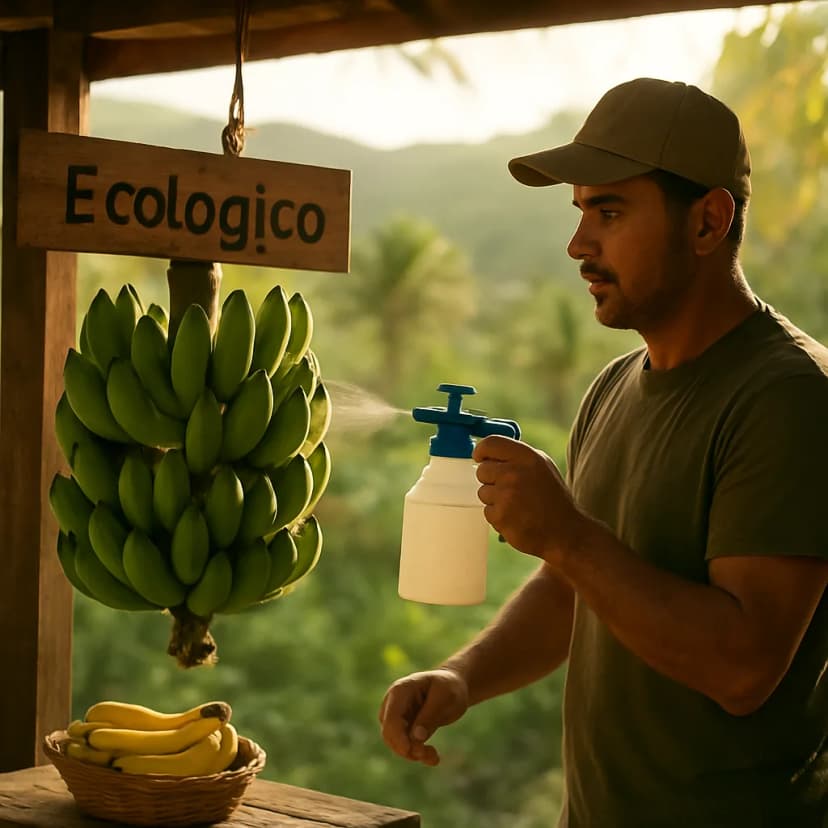
Natural degreening is the physiological process by which fruits, in this case the banana, lose their green colour due to the degradation of chlorophyll and the synthesis of pigments such as carotenoids, which give it its characteristic yellow tone. This process is part of ripening, which involves a series of complex biochemical changes: hydrolysis of starches into soluble sugars, a decrease in acidity, production of aromatic volatile compounds and softening of the pulp. Under natural conditions, the banana produces ethylene endogenously, a gaseous phytohormone that acts as a regulator of ripening. However, the speed and uniformity of this process depend on multiple factors, such as temperature, relative humidity, the concentration of oxygen and carbon dioxide, and the physiological maturity stage at the time of harvest.
In conventional agriculture, degreening is accelerated by applying exogenous ethylene in ripening chambers, or by using chemical products such as calcium carbide, which releases acetylene. However, in organic production, these practices are prohibited or severely limited by regulations such as Regulation (EU) 2018/848, which lays down the rules for organic production in the European Union. Natural degreening therefore becomes both a necessity and an opportunity to innovate with methods that respect the physiology of the fruit and the environment. Natural techniques include the management of temperature and humidity in ripening chambers, exposure to controlled atmospheres with a higher concentration of endogenous ethylene, and the use of biostimulants that favour ethylene production or the expression of genes related to ripening.
Importance in organic bananas
Organic Canary Island bananas are grown under strict standards that prohibit the use of pesticides and synthetic fertilizers, and that promote practices which maintain soil and ecosystem health. Natural degreening is essential for the final product to meet consumer expectations, as consumers associate bright yellow colour with freshness and ripeness. Poor degreening can result in fruit with green spots, uneven ripening, lower sugar content and a shorter shelf life, which reduces its commercial value and increases post-harvest losses. The magnitude of these losses depends on the temperature and humidity during ripening, on the physiological state of the fruit at the time of cutting and on cold chain management, so careful control of these conditions is decisive for the grower.
In addition, natural degreening contributes to the sustainability of the crop by reducing dependence on external inputs and lowering the carbon footprint associated with the production and application of chemicals. In a context of climate change and demand for healthier food, consumers increasingly value organic products and their environmental benefits. Organic Canary Island bananas, with their Protected Geographical Indication (PGI), already enjoy quality recognition, and natural degreening reinforces their positioning as a premium product that respects the environment. On the other hand, the use of biostimulants based on microalgae, fulvic acids and other natural compounds can favour ripening uniformity and the organoleptic quality of the fruit, although the result depends on crop conditions and agronomic management, which opens up new possibilities for organic farmers.
Natural degreening techniques
Temperature and humidity management
One of the most effective techniques for favouring natural degreening is the control of temperature and relative humidity in ripening chambers. The banana is a climacteric fruit, which means that its ripening continues after harvest. The optimum temperature for banana ripening is between 14 and 18 °C, with a relative humidity of 90-95%. At lower temperatures, the process slows down, while temperatures above 20 °C can accelerate ripening but also increase the risk of chilling injury or pathogen development. In practice, organic growers can use chambers with ventilation and misting systems to maintain these conditions, allowing endogenous ethylene to accumulate and act uniformly.
Controlled atmospheres and endogenous ethylene
Another technique consists of exposing the fruit to atmospheres with high ethylene concentrations, but without resorting to synthetic sources. This is achieved by recirculating the air in airtight chambers, where the ethylene produced by the bananas themselves accumulates. In addition, the application of biostimulants that induce ethylene production in the plant, such as certain seaweed extracts, can be a promising alternative. For example, the foliar application of extracts of Ascophyllum nodosum, rich in cytokinins and auxins, has shown positive effects in regulating the ripening of various fruits, including the banana.
Biostimulants and natural products
The use of biostimulants is one of the most innovative and sustainable strategies for natural degreening. Biostimulants are substances or microorganisms that, applied to plants or soil, stimulate the natural processes of nutrition, stress resistance and crop quality. In the case of the banana, biostimulants can act in several ways: favouring ethylene synthesis, improving the mobilisation of nutrients involved in ripening, or modulating the expression of genes related to chlorophyll degradation. For example, products based on freshwater unicellular algae, such as Chlorella vulgaris, are rich in amino acids, vitamins and phytohormones that can stimulate the metabolism of the fruit. Ecoganic offers a range of biostimulants that can be integrated into management programmes to improve natural degreening, always within the framework of organic farming.
Recommended products and biostimulants
At Ecoganic, we develop specific solutions for organic banana cultivation, based on science and field experience. Our biostimulants, such as those made from freshwater unicellular algae, contain a combination of bioactive compounds that promote uniform ripening and fruit quality. For example, the application of our product based on Chlorella vulgaris at a rate of 2-3 L/ha, via foliar application, during the bunch growth phase, can improve ethylene synthesis and accelerate degreening in post-harvest. In addition, our organic fertilizers, enriched with fulvic acids, improve the uptake of potassium and calcium, nutrients essential for fruit firmness and colour.
The combination of biostimulants and correct nutrition is key to obtaining bananas with optimal natural degreening. Our products are certified for organic farming under Regulation (EU) 2018/848 and other international standards, which guarantees their use in sustainable production. We also offer technical advice so that each grower can adjust the rates and timing of application to their specific conditions, whether in the Canary Islands or in other tropical regions. If you wish to improve the degreening of your organic bananas, we invite you to contact us and request your free quote.
Agronomic and environmental benefits
Natural degreening not only improves the appearance of the fruit, but also has a positive impact on nutritional quality and on the sustainability of the crop. Naturally ripened bananas have a higher content of antioxidants, such as phenolic compounds and vitamin C, compared with those subjected to chemical treatments. This is because natural ripening allows an adequate balance between the degradation of chlorophyll and the synthesis of other metabolites. In addition, by reducing the use of synthetic ethylene, workers' exposure to potentially hazardous substances is reduced and contamination of the environment with chemical residues is avoided.
From an agronomic point of view, natural degreening can increase the shelf life of the fruit, reducing post-harvest losses and improving the profitability of the crop. For example, proper temperature management and the use of biostimulants can extend the marketing window, allowing producers to access more distant markets without deterioration in quality. Likewise, the implementation of these techniques contributes to climate change mitigation, by reducing the carbon footprint associated with the production and transport of chemical inputs. In the context of the Sustainable Development Goals (SDGs), natural degreening is aligned with responsible production and consumption (SDG 12) and climate action (SDG 13).
Case studies in the Canary Islands
In the Canary Islands, several organic producers have implemented natural degreening techniques with promising results. For example, at the Cooperativa del Norte de Tenerife, an integrated management approach has been used that combines harvesting at the optimal point of physiological maturity, storage at 16 °C with high humidity and the application of a biostimulant based on microalgae at fruit set.
Another case is that of the experimental farm of the ICIA (Canary Islands Institute of Agricultural Research), where different natural degreening strategies have been evaluated, including the use of atmospheres enriched with endogenous ethylene and the application of algae extracts. The trials demonstrated that the combination of a temperature of 15 °C and an ethylene concentration of 50 ppm, generated by the respiration of the fruits themselves, achieved uniform degreening in 6 days, without negatively affecting firmness or taste. These results support the viability of these techniques under commercial conditions and their potential to be adopted by more producers.
Experience in the Canary Islands shows that natural degreening is a viable and profitable practice, provided that the technical knowledge and the right products are available. At Ecoganic, we are committed to developing solutions that help growers improve the quality of their products and become more sustainable.
Related articles
- Pulp firmness in banana for European export
- Post-harvest anthracnose in banana: integrated control 2026
- Post-harvest checklist for banana: ready to export?
Do you need professional help?
At Ecoganic in Spain, Europe, we offer biostimulants and organic fertilizers. Call us: +34 623 753 719.
Request your free quote
FAQ
What is natural degreening and why is it important?
Natural degreening is the process by which the banana loses its green colour and takes on yellow, due to the degradation of chlorophyll. It is important because it determines the visual and organoleptic quality of the fruit, and in organic farming, since chemicals cannot be used, it becomes a technical challenge. Good degreening improves market acceptance and reduces losses.
What natural techniques can be used to degreen bananas?
Natural techniques include the control of temperature and humidity in ripening chambers, the use of atmospheres with endogenous ethylene, and the application of biostimulants such as algae extracts. These techniques respect the physiology of the fruit and organic standards, and can be combined to obtain better results.
How do biostimulants help in degreening?
Biostimulants, such as those from Ecoganic, provide phytohormones and bioactive compounds that stimulate ethylene production and the expression of ripening genes. This accelerates degreening naturally, improves colour uniformity and increases the nutritional quality of the fruit, without chemical residues.
Which Ecoganic products are recommended for organic banana?
We recommend our microalgae-based biostimulants, such as the product with Chlorella vulgaris, and our fertilizers with fulvic acids. These products are certified for organic farming and have shown positive results in field trials. For a specific recommendation, we suggest you contact our technical team.
Is natural degreening profitable in organic banana?
Yes, although it requires investment in infrastructure (chambers) and products, the benefits in quality and reduction of losses compensate for it. In practical cases in the Canary Islands, it has been possible to reduce degreening time and increase shelf life, which improves the profitability and competitiveness of the organic product.