
Banana microbiota: activate the soil with agricultural biostimulants. Improve roots, nutrient uptake and yield. Request your free quote.
Introduction: banana depends on a living soil
Banana microbiota is the community of bacteria, fungi, actinomycetes and protozoa that live in the rhizosphere and the soil surrounding the roots. These microorganisms transform organic matter into assimilable nutrients, protect the roots against pathogens and improve soil structure. In plantain and banana plantations in Latin America, where soils are often acidic, low in organic matter and under high disease pressure, activating this microbiota has become a key strategy for sustaining yield.
Agricultural biostimulants, especially those formulated with microalgae, humic extracts and amino acids, act as catalysts for this microbial life. It is not just about fertilising: it is about creating the conditions for the soil itself to release nutrients and for the roots to absorb them more efficiently. This article explains, with a technical basis and field examples, how to activate banana microbiota through biostimulants and sustainable management practices.
What is banana microbiota and why is it key?
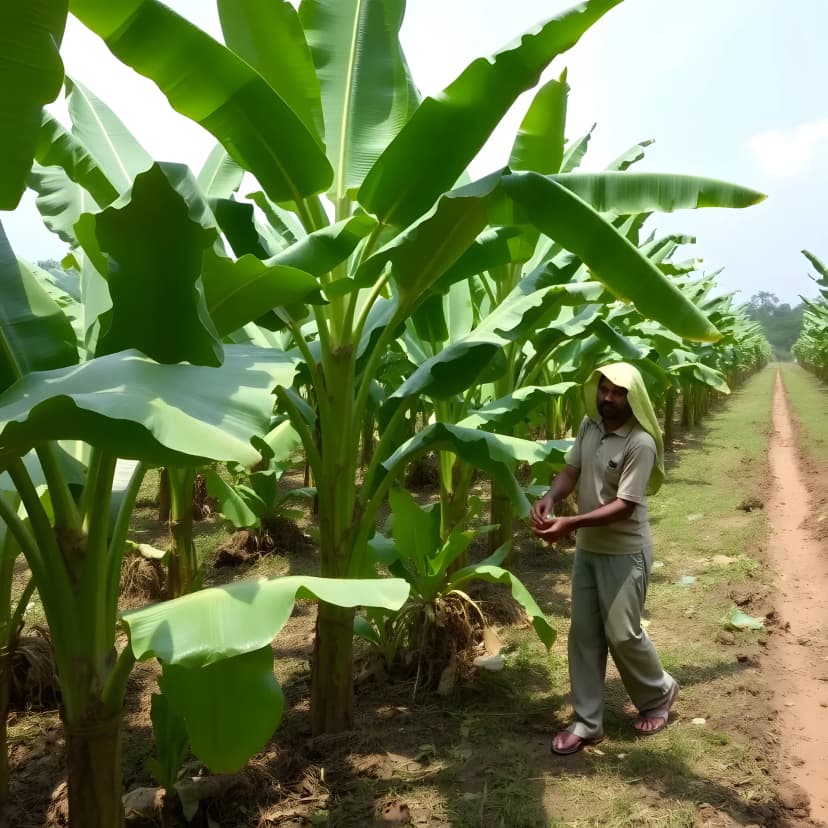
Banana microbiota includes populations of Bacillus, Pseudomonas, Trichoderma, arbuscular mycorrhizae and nitrogen-fixing bacteria. These communities live associated with the roots and the soil, and perform essential functions: they solubilise phosphorus, chelate micronutrients such as iron and zinc, break down crop residues and compete with pathogens such as Fusarium oxysporum f. sp. cubense, the cause of Panama disease.
In a soil with active microbiota, the banana plant expresses its genetic potential better. Roots explore a greater volume of soil, absorb water more efficiently and tolerate water stress better. Conversely, in soils degraded by monoculture, intensive tillage or excessive use of synthetic fertilisers, microbial diversity falls and problems of rooting, chlorosis and bunch drop appear.
A practical point: in plantations where organic matter and biostimulants are applied regularly, soil microbial activity can double in a single season, measured as basal respiration or microbial biomass. This translates into greater availability of nitrogen and phosphorus for the plant, and a potential reduction in chemical fertiliser of up to 30 % without loss of yield.
Microbiota also influences fruit set and bunch filling. A root well colonised by beneficial microorganisms sends hormonal signals that favour fruit retention and sugar accumulation. In banana, a long-cycle crop with high nutritional demand, this symbiosis makes the difference between a mediocre harvest and a commercially profitable one.
Agricultural biostimulants that activate the banana microbiota
Not all biostimulants act in the same way. To activate the banana microbiota it is advisable to combine three types of inputs: microalgae extracts, humic and fulvic acids, and beneficial microorganisms. Ecoganic's organic agricultural biostimulants are formulated to stimulate both the plant and the soil, in compliance with European Regulation EC 2019/1009 and Latin American organic certifications.
Microalgae extracts
Freshwater microalgae, such as Chlorella and Scenedesmus, provide free amino acids, polysaccharides, phytohormones (auxins, cytokinins, gibberellins) and chelated micronutrients. When applied to the soil or via foliar application, these compounds stimulate the proliferation of beneficial bacteria and improve foliar nutrient absorption. Ecoganic biostimulant technology uses freshwater microalgae extracts to boost rooting and microbial activity.
Humic and fulvic acids
Fulvic acids are low-molecular-weight molecules that penetrate the root quickly and act as nutrient carriers. Humic acids improve soil structure, increase cation exchange capacity and serve as a substrate for microorganisms. Applying fulvic acids for organic farming at the foot of the plant is one of the most effective ways to reactivate a tired soil.
Beneficial microorganisms
Inoculation with Bacillus subtilis, Trichoderma harzianum and arbuscular mycorrhizae accelerates colonisation of the rhizosphere. These microorganisms compete with pathogens, produce enzymes that break down organic matter and facilitate the absorption of phosphorus and zinc. In banana, application directed at the planting hole or at the corm improves plant establishment and reduces mortality in the first months.
Combining these three groups in an organic fertilisation programme makes it possible to move from management dependent on synthetic inputs towards a system based on soil biology. Certified organic fertilisers complement this strategy by supplying balanced nutrients without harming the microbiota.
Agronomic management to enhance the microbiota in banana plantations
Biostimulants work best when agronomic management supports them. The banana microbiota benefits from practices that reduce soil disturbance and increase organic matter. The most relevant for banana and plantain plantations in tropical areas are detailed below.
Organic matter and living covers
Incorporating compost, mature manure or chopped harvest residues provides an energy substrate for microorganisms. Maintaining living covers between rows, such as creeping legumes, fixes nitrogen and protects the soil from erosion. In areas with heavy rainfall, covers reduce nutrient leaching and maintain stable moisture, which benefits beneficial fungi and bacteria.
Irrigation and drainage
Banana is sensitive to waterlogging. A saturated soil loses oxygen and favours pathogens such as Fusarium. Designing ridges or drains that evacuate excess water is essential for aerobic microbiota to thrive. In the dry season, drip irrigation with short pulses keeps moisture in the optimal range without leaching salts.
Fertilisation management
The reduction of chemical fertiliser should be gradual. Replacing part of the synthetic nitrogen with organic sources and nitrogenous biostimulants, such as those based on ammoniacal nitrogen, makes it possible to maintain vigour without acidifying the soil. Freshwater microalgae for agriculture provide slow-release organic nitrogen that the microbiota transforms into assimilable forms.
A typical programme for organic banana includes: application of compost or vermicompost at the start of the season (2-4 kg per plant), microbial inoculation at transplanting or at planting of the sucker, foliar applications of microalgae every 21-30 days during vegetative growth, and root applications of fulvic acids at times of greatest demand (floral differentiation and bunch filling).
Expected results and practical field cases
On banana farms on the Ecuadorian coast and in the Colombian coffee-growing axis, the implementation of programmes with biostimulants has shown consistent improvements in the root system, foliage health and bunch weight. These are not miraculous results, but rather the physiological response to a more living soil and a better-nourished plant.
A case documented on a barraganete banana plantation in Ecuador: after two cycles of application of microalgae extracts and fulvic acids, the density of active roots increased visibly, the incidence of chlorosis decreased and the average bunch weight rose by around 12-15 % compared with conventional management. The producer reduced the urea dose by 25 % without any loss of vigour.
In another trial in the Urabá region of Colombia, inoculation with Trichoderma and Bacillus combined with organic matter reduced the mortality of young plants due to root rot. The key was to apply the microorganisms before the pathogen colonised the soil, that is, preventively.
These results match Ecoganic's field experience in tropical crops: when the microbiota is activated, the plant invests less energy in defending itself and more in producing. The Ecoganic trials and field results compiles verified data under different agroclimatic conditions.
Related articles
Do you need professional help?
At Ecoganic in Spain, Europe, we offer Biostimulants and Organic Fertilizers. Call us: +34 623 753 719.
Request your free quote
Frequently asked questions about banana microbiota and biostimulants
How often should biostimulants be applied to activate banana microbiota?
A root application is recommended at the start of each cycle (planting or regrowth) and foliar applications every 21-30 days during active growth. In periods of water or heat stress, it is advisable to reinforce with an additional microalgae application to maintain microbial activity and cell turgidity.
Can chemical fertiliser be reduced when using biostimulants?
Yes, gradually. A safe strategy is to replace between 20 % and 30 % of synthetic nitrogen with organic sources and biostimulants, monitoring leaf colour and growth. If the soil has good organic matter and active microbiota, the plant makes better use of residual fertiliser.
What is the difference between a biostimulant and a fertiliser?
A fertiliser supplies nutrients directly; a biostimulant stimulates the plant's physiological processes and the soil's microbial activity. Both are complementary: the biostimulant improves fertiliser efficiency, but does not replace it completely. The combination of both is the basis of balanced nutrition.
Do biostimulants work in acidic soils?
In acidic soils, fulvic and humic acids help to buffer pH and release blocked nutrients such as phosphorus and molybdenum. In addition, acid-tolerant beneficial microorganisms can colonise the rhizosphere and improve micronutrient uptake. It is advisable to adjust the pH with calcareous amendments if it is below 5.0.
Activating banana microbiota is not a fad: it is an investment in soil health and in the long-term profitability of the crop. Agricultural biostimulants, used well, are an effective tool for achieving this. Request your free quote and discover how to adapt a biostimulation programme to your plantation.
Integrated management of banana microbiota: application timings and synergies with agronomic practices
The effective activation of banana (Musa spp.) microbiota does not depend solely on the presence of beneficial microorganisms in the soil, but on creating the physicochemical and nutritional conditions that allow their establishment, multiplication and functionality. Biostimulants based on seaweed extracts (Ascophyllum nodosum, Ecklonia maxima), protein hydrolysates, humic and fulvic acids, and microbial consortia (plant growth-promoting bacteria and arbuscular mycorrhizae) can support this process, provided there is a base of organic matter for them to act on. Combining biostimulants with organic inputs can favour soil biological activity and the efficiency with which the plant uses nutrients, something especially relevant in the case of phosphorus and potassium, critical elements for bunch filling and fruit quality. The magnitude of the response, however, depends on the product, the soil and the management, so it is advisable to verify it on each farm.
The timing of application influences how well the microbial response is used. A particularly interesting period is from planting or transplanting to the first weeks of crop establishment, when the root system is expanding fully and offers more surface for colonisation. At this stage it makes sense to combine a biostimulant rich in humic acids with beneficial microorganisms via fertigation, at the dose and frequency indicated on each product's label. In mature plantations, periodic re-applications are considered, especially after water stress events, sucker removal work or applications of broad-spectrum agrochemicals, which can disturb soil microbial populations. The schedule should be set with the farm's technical adviser depending on the product and the state of the crop, and each application should be recorded so that its effect can be assessed afterwards.
The synergy between biostimulants and agronomic practices is fundamental. The use of living cover crops or organic mulching with legumes, such as Mucuna pruriens or Canavalia ensiformis, together with microbial biostimulants, provides organic matter to the soil and food for biological and enzymatic activity. Likewise, managing soil acidity is critical: beneficial microorganisms work best within a pH range suitable for the crop, and in very acidic soils mycorrhizal colonisation may be less efficient. It is therefore advisable to correct acidity, for example with limestone or dolomitic amendments, based on an analysis and the technical adviser's recommendation, before committing to biostimulants. Combining biostimulants with organic fertilisation (mature compost, vermicompost) may allow mineral fertilisation to be adjusted, but only after verifying on the farm itself that yield is maintained.
Finally, monitoring the microbial response allows the biostimulation programme to be adjusted. Microbiological soil analyses (CFU counts, basal respiration, microbial biomass carbon) are recommended at a frequency agreed with the laboratory, and should always be compared with a reference plot on the farm itself, because generic values vary with soil type. When indicators worsen, rather than automatically repeating the product, it is advisable first to review the causes (organic matter, compaction, pH, moisture, recent work) and, if appropriate, to reinforce inputs of organic matter or readily available carbon sources, using the products and doses indicated on the label. Integrating these strategies contributes to crop nutrition and can help reduce dependence on synthetic inputs, favouring the sustainability and profitability of the banana production system in the long term, provided it is evaluated with the farm's own data.