
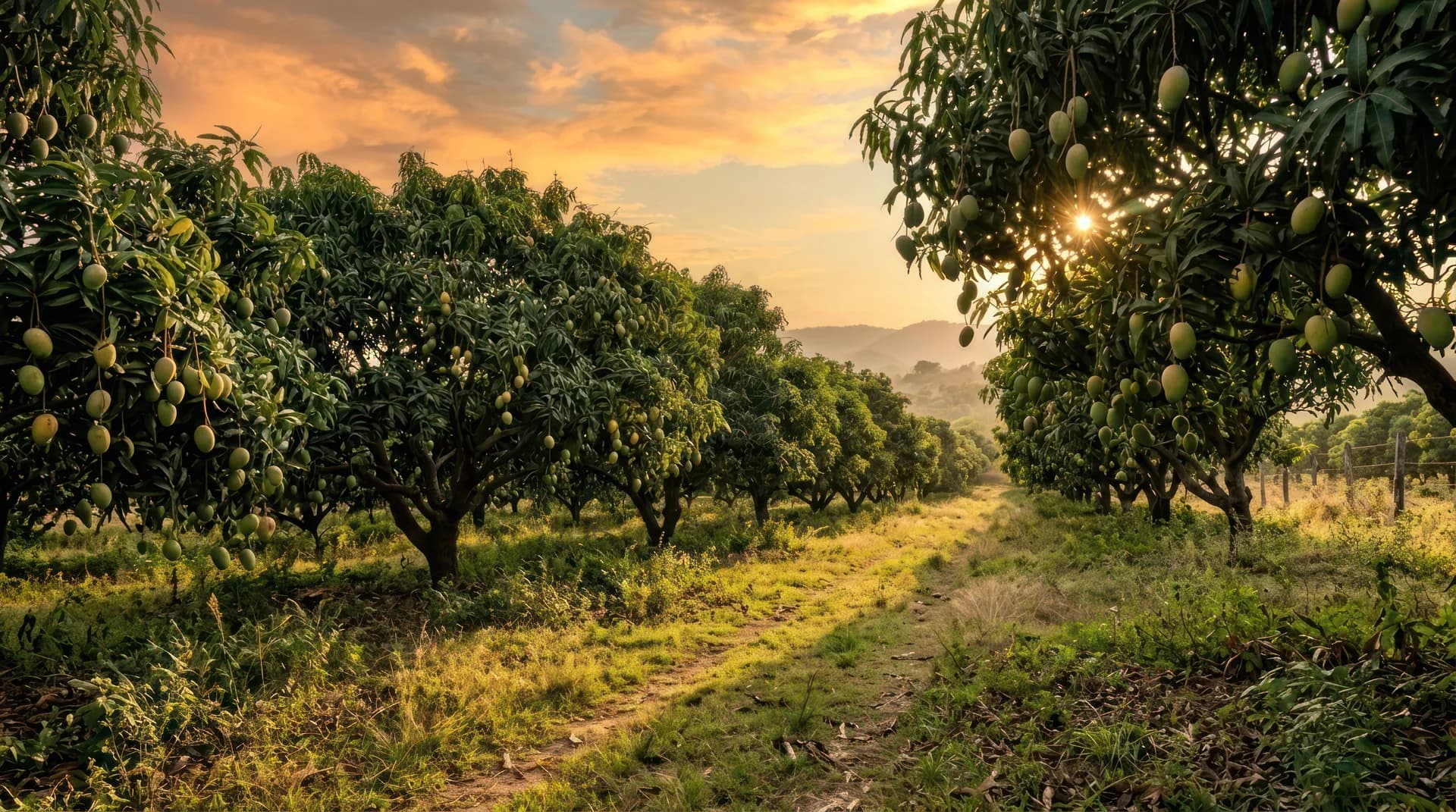
Biostimulants can contribute to the overall vigour of the mango, including the development of its root system, but they do not replace soil, irrigation or nutrition management, and they are not a plant protection treatment. The response depends on the product, the plantation and the timing of application, and the dose is the one stated on the label.
Introduction
The development of the root system determines much of what happens later in a mango: the uptake of water and nutrients, the vigour of the plant and the regularity of the crop. That is why, in young plantations, in poor soils or in areas where water is limited, rooting is one of the first questions the grower asks. Among the tools available are biostimulants, products that can contribute to the overall vigour of the crop when they are integrated into well-planned management.
This guide explains what biostimulants are, what can reasonably be expected of them in mango, which factors the response depends on, what should be checked before buying and applying a product, and how to assess afterwards whether it has made sense. It does not include field results or yield figures, because the response of a specific plantation depends on its soil, its irrigation, its variety and its climate, and can only be known by measuring it in that plantation.
What biostimulants can contribute to mango cultivation
In mango cultivation, biostimulants are used as a complement to standard management, never as a substitute for irrigation, fertilisation or cultivation practices. The benefits usually attributed to these products fall into three areas, which should be read with caution and always checked against the technical information for each product:
- Root development: some products may contribute to the vigour of the root system, especially in the early stages after planting.
- Behaviour under water stress: they may contribute to the general vigour of the plant during periods of limited irrigation, without replacing good water management.
- Fruit quality: a tree in good general condition usually shows more regular fruit set and fruit filling, although many factors besides the root are involved.
Root development
The root is the organ through which the plant takes up water and nutrients, and its development depends above all on conditions that no product replaces: soil texture and structure, drainage, aeration, available moisture and temperature. Compacted or waterlogged soil limits root growth regardless of what is applied. On that basis, some biostimulants declare that they contribute to the vigour of the root system, and their use makes more sense when the other conditions have already been addressed.
A well-established root system makes it easier for the plant to make use of the water and nutrients supplied to it, but it does not multiply them: if fertilisation or irrigation is insufficient or poorly distributed, a biostimulant does not compensate for it.
Water stress
In areas where water is a limited resource, the priority is irrigation management: a schedule adjusted to the needs of the crop, a suitable application system, ground cover that reduces evaporation and a soil structure that retains moisture. Biostimulants can form part of the overall approach, since some manufacturers declare that their products contribute to plant vigour during periods of water stress, but they do not replace any of those measures nor guarantee a particular behaviour in a specific drought.
If the main reason for interest is water stress, it is advisable to ask the supplier what that declaration is based on, which crops and conditions the product is intended for and what monitoring criterion they recommend.
Fruit quality
Mango quality, that is, its size, firmness, sugar content and post-harvest keeping quality, depends on the variety, the fruit load, balanced nutrition, irrigation, pruning, the time of harvest and post-harvest handling. A good general condition of the tree contributes to more regular fruit set and fruit filling, and in that context biostimulants can contribute to crop vigour. Attributing specific improvements in size, sugars or shelf life directly to them is not rigorous: those parameters can only be assessed by comparing, on the plantation itself, plots managed identically except for the product.
How biostimulants act: what you should know
The name biostimulants covers products of very different natures, and that is why there is no single explanation of how they act. More useful than looking for a specific mechanism is understanding which family the product belongs to and what its manufacturer declares. These are the three points of reference:
- Origin and composition of the product: the starting material and the manufacturing process determine what can be expected of it.
- Root environment: the soil, its organic matter and its moisture determine whether any product can be useful.
- Crop status: the situation is not the same in a young plant that is establishing itself, in a tree in production or in a crop subjected to adverse conditions.
Origin and composition of the product
Seaweed extracts, protein or amino acid hydrolysates, humic substances and preparations with microorganisms are some of the usual families. Each one has a different composition and purpose, and within each family there are differences between manufacturers. That is why it is not reasonable to extrapolate to one product what is said about another with a similar name. The label and the technical data sheet must state the composition, the method of use and the declared purpose.
Soil and root environment
Any product acts on a specific soil. Organic matter, pH, salinity, texture and moisture influence what happens around the root and, therefore, whether an application is useful or not. Before deciding on an application, it is advisable to review the soil analysis and, where appropriate, the irrigation water analysis. Organic amendments and good management of soil cover are usually the starting point.
Stress tolerance: what a product can declare
Some biostimulants are marketed with the purpose of contributing to the plant's behaviour under adverse conditions, such as lack of water, salinity or extreme temperatures. This is a purpose declared by the manufacturer, not a treatment: no biostimulant replaces authorised plant protection products or the recommendations of a technician when there is a problem of pests, fungi or diseases.
Regulation (EU) 2019/1009, applicable since July 2022, regulates plant biostimulants marketed as EU fertilising products and defines them by the purpose they declare. To find out under which framework a specific product is marketed, the simplest thing is to ask the supplier for the corresponding documentation.
What to check before applying a biostimulant in mango
Before incorporating a biostimulant into a mango plantation, it is advisable to carry out a brief diagnostic and product review exercise. This is what makes it possible to decide whether it makes sense to apply it and how to evaluate its effect afterwards.
Diagnosis of the plantation
The usual starting points are the age and condition of the plants, the variety and the rootstock, the type of soil and its drainage, the irrigation system and schedule, the current fertilisation programme and the problems observed, for example slow rooting after planting or leaves with symptoms of lack of water or nutrients. Several of these situations have causes that are corrected through management, by means of irrigation, drainage or fertilisation, and not with a biostimulant. A technician and a soil analysis help to distinguish them.
Information to request from the supplier
Before buying, it is worth requesting:
- The composition of the product and its technical data sheet.
- The declared purpose and the crops for which it is recommended.
- The method of application (foliar, with irrigation or to the soil) and compatibility with the rest of the programme.
- The regulatory framework under which it is marketed.
- If the holding is in organic production, information on its acceptance: this must be confirmed with the certification body before applying it.
An illustrative example of an approach
By way of an illustrative example, and without results: imagine a young mango plantation on a light soil, with drip irrigation, in which the plants take time to establish. The reasonable thing is to first review irrigation, drainage and fertilisation, and correct whatever is needed. If, after that review, it is decided to try a biostimulant, it can be applied to one part of the plantation and another part left untreated, with the same management, so that a comparison can be made on a sound basis. The example does not describe any result: it only shows the order in which decisions should be taken.
Recommendations for use
With the diagnosis made and the product chosen, these practices help you to use it judiciously:
- Timing of application: the one indicated by the manufacturer for each stage of the crop.
- Dosage according to the label: follow the instructions for each product, without extrapolating from others.
- Monitoring and record-keeping: record the applications and observe the development of the plants throughout the cycle.
Timing of application
The right timing depends on the product and on the stage of the crop. In young plantations, applications are usually planned for the early stages of growth, when the root system is becoming established; in producing trees, stages such as vegetative development, flowering or fruit set and fruit filling are taken into account. The manufacturer must indicate at which developmental stages the product is recommended and by which route (foliar, to the soil or with irrigation). It is advisable to avoid the hours of intense heat and waterlogged soil, and to coordinate applications with the irrigation and fertilisation schedule.
Dosage according to the label
The dosage, frequency and application conditions are those stated on the product label; they must not be taken from other products or from general recommendations. Applying more than indicated does not produce a greater effect and may alter the nutritional balance of the plant or represent an unnecessary expense. If in doubt, it is preferable to consult the technician or the supplier before modifying the regime.
Monitoring and record-keeping
Record each application (date, product, batch, route, plot, and weather and irrigation conditions) and observe the development of the plants throughout the cycle. An orderly record allows the programme to be adjusted and, above all, makes it possible to distinguish the effect of the product from that of other factors, such as rain, a change in irrigation or pruning. If symptoms of water stress or deficiencies appear, they must be addressed with management measures without waiting for a biostimulant to resolve them.
Related articles
Do you need professional help?
At Ecoganic in Spain, Europe, we offer biostimulants and organic fertilisers. Call us: +34 623 753 719.
Request your free quote
How to assess the response in your mango plantation
The most reliable way to know whether a biostimulant has made sense in a plantation is to compare it within the plantation itself. The simplest approach is to set aside an untreated control area, managed in the same way as the rest, and to observe both over the same period. Comparisons between different farms or between campaign years are of little value, because the soil, the climate and the management change.
The indicators usually recorded are vegetative growth, the general condition of the plants, the appearance of the root system in a soil pit or in a sample, fruit set and, in producing trees, the harvest and fruit quality. It is advisable to define in advance what is going to be measured, with which method and at how many points, so as not to interpret differences by eye. Small differences may be due to the natural variability of the plot, and the effect of a product, if there is one, may take time to become apparent and may vary from one campaign to another. For this reason, monitoring over more than one campaign provides more information than an isolated observation.
You may be interested in: Certified organic fertilisers.
In summary, biostimulants can be a complement within a well-planned mango management programme, and their usefulness in each plantation is decided with a prior diagnosis, with the product information and with orderly monitoring. If you want to assess whether they fit your case, Ecoganic works in the biostimulants and organic fertilisers sector and offers advice and quotations.
References
Frequently asked questions
What are biostimulants?
They are products that, while not nutrients in themselves, are applied to plants or to their root environment in order to contribute to the overall vigour of the crop. Their composition and stated purpose vary from product to product, so it is advisable to read the label and the technical data sheet.
Can biostimulants contribute to the root development of mango?
Some products state that they contribute to the vigour of the root system, especially in the early stages after planting. The response depends on the soil, irrigation, drainage and the product itself, and does not replace good crop management.
Do biostimulants help under water stress conditions?
They do not replace irrigation management nor do they guarantee a specific behaviour under drought. Some manufacturers state that their products contribute to plant vigour during periods of water stress; it is advisable to request the documentation supporting that claim.
What can be expected when using biostimulants on mango?
There is no single answer, because it depends on the variety, the soil, the climate and management. The reliable way to find out is to compare a treated area with an untreated one in the same plantation, under the same management, over more than one season.
What is the right time to apply biostimulants to mango?
It depends on the product and the stage of the crop. The manufacturer must state at which developmental stages and by which route it is applied, and the dose is the one shown on the label. If in doubt, consult a technician or the supplier.