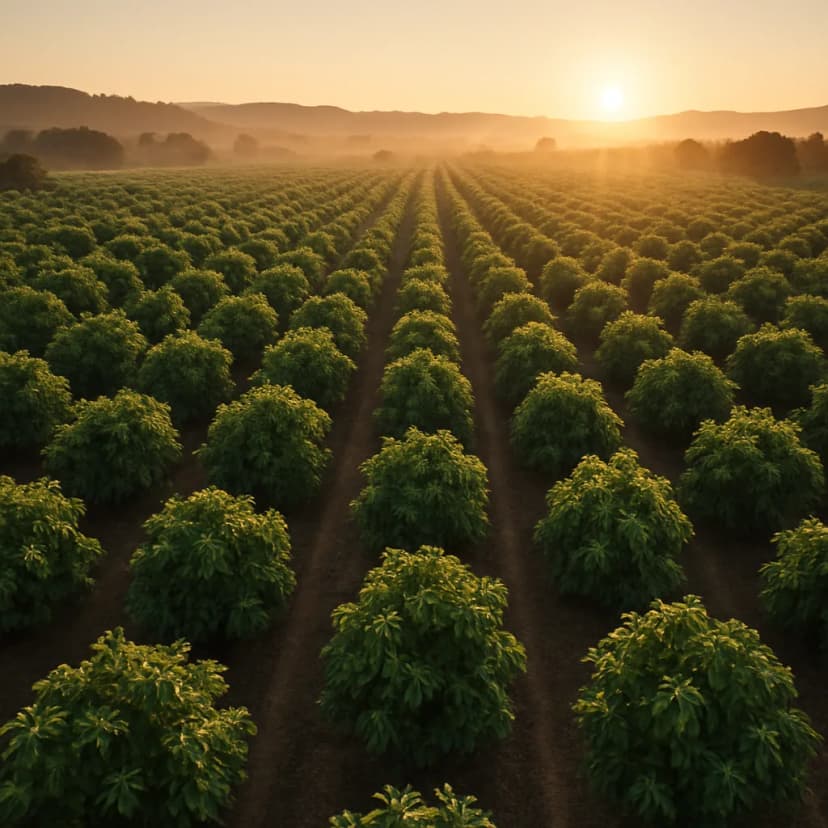

What small fruit drop in avocado is and why it occurs
Small fruit drop in avocado due to NPK imbalance is one of the physiological disorders that most affects crop profitability, especially in varieties such as Hass. It manifests as a progressive abortion of newly set fruits, generally during the first 8 to 12 weeks after flowering, when the tree decides to adjust its reproductive load to the available resources. Although the imbalance between nitrogen, phosphorus and potassium is a central factor, in the field it almost never acts alone: it interacts with water stress, excessive crop load, defoliation and a poor source-sink relationship.
Avocado is especially sensitive to this phenomenon because its root system is shallow, inefficient at nutrient uptake and highly dependent on soil organic matter and the soil microbiota. Added to this is the fact that the tree produces a massive flowering — thousands of flowers per tree — but retains only between 0.1% and 1% of those fruits through to harvest. Understanding that balance is key to avoid attributing all the drop to a single nutrient.
In agronomic terms, small fruit drop fulfils a self-regulation function: the tree aborts those fruits it cannot sustain in order to protect its survival and its vegetative growth. The problem arises when that drop is excessive, sustained or concentrated in fruits that had already reached commercial size. That is where nutritional management, and in particular the NPK balance, makes the difference.
How NPK imbalance influences fruit retention
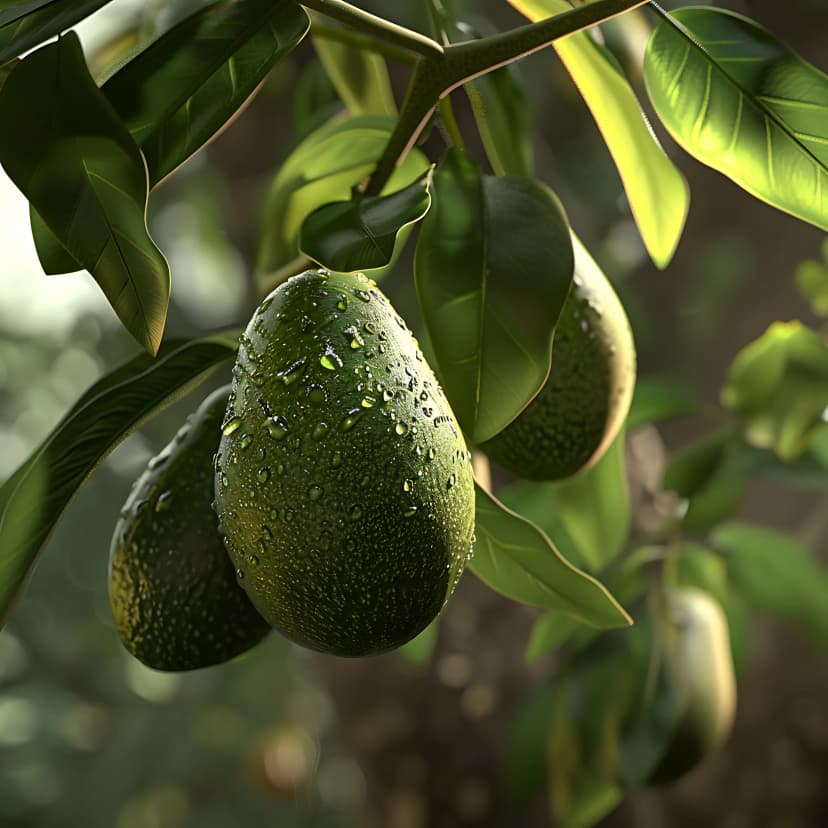
Nitrogen, phosphorus and potassium perform distinct but interconnected functions during fruit set and fruit filling. An excess of nitrogen favours vegetative vigour and the production of tender shoots, which compete with the small fruits for photoassimilates. That imbalance shifts the source-sink relationship towards the leaves and buds, and the tree responds by aborting flowers and newly set fruits. In the field it is seen as trees with lush foliage but very little fruit retained.
Phosphorus is decisive in flowering, cell division and early fruit development. When there is a deficiency, flowering is poor, fruits are smaller and retention falls. Potassium, for its part, regulates the transport of sugars to the fruit, fruit filling and final quality. A K deficiency is associated with small fruits, lower weight and greater premature drop, a physiological pattern consistent in fruit trees.
The role of nitrogen in flower and fruit abortion
Excess N, especially in nitrate form and in late applications, generates uncontrolled vegetative growth. The new shoots demand carbohydrates and nutrients that should be directed to the fruit. In addition, high N can reduce potassium and calcium uptake through ionic competition, weakening the cell wall of the small fruit and favouring its drop. The key is not to eliminate N, but to split it and adjust it to the phenology.
Phosphorus and potassium: fruit retention and filling
Phosphorus participates in root system formation, flowering and fruit set. Potassium is involved in osmoregulation, sugar transport and protein synthesis. An avocado with balanced P and K retains more fruits and reaches commercial calibres. When these nutrients are scarce, drop is accentuated and the fruits that remain on the tree usually fail to reach the calibre required by the market.
Field diagnosis: soil, foliar and source-sink balance
Before adjusting any dose, a diagnosis is necessary. Small fruit drop is rarely due to a single factor, so soil analysis and foliar analysis are complementary tools. Soil analysis indicates nutrient availability, pH, cation exchange capacity and organic matter level; foliar analysis shows what the tree actually absorbed and translocated to the tissue.
Foliar sampling should be done on mature leaves, without fruit, taken from shoots of the previous cycle, and at a representative time. Results are interpreted using sufficiency ranges for avocado, not generic values for other fruit trees. An NPK imbalance may appear as high N with low K, or as low P with normal N, and each combination requires a different correction.
Soil and foliar analysis: when and how to sample
Soil is sampled at a depth of 20-30 cm, in a zigzag pattern, avoiding edges and waterlogged areas. Foliar sampling is carried out before flowering or during fruit filling, depending on the objective. Combining both allows distinguishing between a true deficiency, an ionic antagonism or an absorption problem due to damaged roots.
Source-sink relationship and tree load
The source-sink relationship describes the capacity of the leaves (source) to supply carbohydrates to the fruits (sink). A tree with excessive load, defoliation or water stress reduces that capacity and aborts fruits. Manual or chemical thinning, where permitted, and irrigation management help to balance that relationship. Nutrition must accompany that adjustment, not replace it.
Nutritional correction strategy by phenological stage
Correction of the NPK imbalance must be planned by stages: pre-flowering, flowering-fruit set, fruit filling and post-harvest. At pre-flowering, the aim is a balance that favours floral differentiation without excessive vigour. At flowering-fruit set, priority is given to P, K and micronutrients such as boron and zinc, which participate in fertilisation and fruit set. During filling, K and calcium support sugar transport and fruit firmness.
Splitting nitrogen application is a recommended practice: apply moderate, frequent doses instead of a single high application. This reduces the risk of excess N at critical moments for retention. Fertigation allows concentrations to be adjusted according to crop demand and the electrical conductivity of the solution.
| Phenological stage | Nutritional priority | Objective |
|---|---|---|
| Pre-flowering | Moderate N, P, B, Zn | Floral differentiation and reserves |
| Flowering-fruit set | P, K, B, Ca | Retention of small fruits |
| Fruit filling | K, Ca, Mg | Size and quality |
| Post-harvest | N, organic matter, microbiota | Recovery and reserves |
The specific doses depend on soil and foliar analysis, expected yield and variety. As a general reference, K is usually applied in doses that cover crop extraction, split during filling, while P is concentrated before and during fruit set. Avoiding high N applications at flowering is a simple but effective measure to reduce fruit abortion.
Biostimulants and organic matter to reduce fruit drop
Agricultural biostimulants complement NPK correction by improving nutrient uptake, stress tolerance and soil microbial activity. Microalgae extracts, fulvic acids and beneficial microorganisms promote root development, foliar nutrient uptake and overall tree health. In avocado, a more active root system translates into better use of fertigation and lower fruit loss due to nutritional imbalance.
Organic matter and soil microbiota improve structure, water retention and nutrient availability. In tropical and subtropical soils, where avocado is frequently grown, mineralisation is rapid and organic matter is depleted if not replenished. Incorporating compost, humic and fulvic acids, and microalgae biostimulants helps maintain biological fertility.
Microalgae biostimulants and foliar uptake
Microalgae biostimulants provide bioactive compounds, amino acids and natural phytohormones that stimulate plant metabolism. Applied foliarly during periods of stress — high temperatures, water deficit or post-fruit set — they can improve foliar nutrient uptake and fruit retention. The key is to apply them preventively and in combination with a balanced nutritional plan.
Fulvic acids and soil microbiota
Fulvic acids improve nutrient availability, chelate micronutrients and stimulate microbial activity. In avocado, where the root system is shallow and sensitive to compaction, their root application promotes rooting and soil exploration. Combining fulvic acids with microalgae biostimulants is a coherent strategy to reduce fruit drop associated with nutritional imbalances.
A practical field example: in a Hass plantation in a subtropical climate, with foliar analysis showing high N and low K, the N dose at flowering was reduced, fractionated K was increased during fruit filling and a microalgae biostimulant was applied foliarly after fruit set. Small fruit drop was visibly reduced in the following season, and commercial calibre improved. It was not a single product, but the integral adjustment of the plan.
Common mistakes and good management practices
One of the most common mistakes is to increase nitrogen when fruit drop is observed, thinking that the tree "needs strength". This usually aggravates the problem, because it stimulates vegetative vigour and competition for photoassimilates. Another mistake is to correct only with soil analysis, without foliar analysis, or to apply generic doses without considering the phenological stage.
Neglecting irrigation is also common: water stress, both from deficit and excess, accentuates fruit drop. Avocado is sensitive to root asphyxia and salinity, so water management and soil electrical conductivity are part of the diagnosis. Plant health also counts: diseases such as anthracnose can cause fruit drop and be confused with a purely nutritional problem.
- Avoid high N applications at flowering and fruit set.
- Fractionate K during fruit filling.
- Maintain organic matter and active microbiota in the soil.
- Monitor irrigation and electrical conductivity.
- Carry out soil and foliar analysis at least once a year.
- Integrate biostimulants during periods of stress.
Reducing chemical fertiliser does not mean eliminating nutrients, but improving their efficiency. A well-adjusted plan, with certified ecological sources and biostimulants, can maintain productivity and reduce losses from fruit drop. Ecological certification CE 2019/1009 is a useful framework for selecting inputs compatible with organic production, which is increasingly in demand in export markets.
Related articles
Do you need professional help?
At Ecoganic in Spain, Europe, we offer biostimulants and ecological fertilisers. Call us: +34 623 753 719.
Request your free quote
FAQ: frequently asked questions about fruit drop in avocado
Why do small avocado fruits drop?
Small fruit drop in avocado is due to a combination of factors: NPK imbalance, water stress, excessive crop load, defoliation and a poor source-sink relationship. The tree aborts fruits to adjust its demand to the available resources. When the drop is excessive and sustained, nutrition, irrigation and plant health should be reviewed comprehensively.
How can you tell whether it is due to NPK imbalance and not another cause?
Diagnosis is based on soil and leaf analysis. High N with low K, or low P at flowering, are typical signs of imbalance. If there is also water stress or disease, the problem is multifactorial. Interpretation by sufficiency ranges for avocado avoids erroneous conclusions based on generic values.
What doses of potassium and phosphorus are recommended in avocado?
Doses depend on soil and leaf analysis, expected yield and variety. As a guide, K is split during fruit filling and P is concentrated before and during fruit set. Avoiding excess N at flowering is as important as adjusting P and K. A well-calibrated fertigation plan improves efficiency.
Do biostimulants help reduce fruit drop?
Yes, agricultural biostimulants, especially those based on microalgae and fulvic acids, improve nutrient uptake, rooting and stress tolerance. They do not replace balanced nutrition, but they complement it. Applied preventively after fruit set and at times of stress, they help retain more fruits and improve calibre.
When is the critical moment to prevent fruit drop?
The critical period runs from flowering to the first 8-12 weeks after fruit set. In that window, NPK balance, irrigation and plant health determine how many fruits the tree retains. Adjusting nutrition before flowering and during fruit set is more effective than correcting after the drop has already occurred.
If you are looking for an avocado nutrition plan that combines organic fertilisation, microalgae biostimulants and integrated soil management, at Ecoganic we can help you. Request your free quote and design a strategy tailored to your plantation.
References