Early defoliation in organic olive groves: learn how to manage leaf drop and protect oil quality. Request your free quote.
What is early defoliation in organic olive groves?
Early defoliation in organic olive groves is the premature fall of leaves, outside the normal period of leaf renewal, which can affect the tree's photosynthetic capacity and, consequently, oil quality. In an organic olive grove, where synthetic fertilisers are not used, nutritional balance and soil health are decisive for maintaining a functional and productive canopy.
The olive tree is an evergreen species that renews its foliage gradually, with an average leaf lifespan that can extend over several years. When defoliation occurs early, the tree reduces its photosynthetic surface area and mobilises reserves to sustain vital processes. This can translate into lower oil accumulation in the fruit and changes in the profile of fatty acids and phenolic compounds. In the context of organic farming, prevention is particularly important because the tools available are fundamentally preventive and based on soil management, balanced nutrition and biostimulation.
Early defoliation is not always a pathological phenomenon; sometimes it is a physiological response to stress conditions. However, when it becomes widespread and occurs before fruit ripening, it can compromise the harvest and oil quality. Early diagnosis and an understanding of its causes are therefore essential for designing an appropriate management strategy.
Causes of early defoliation in organic olive groves
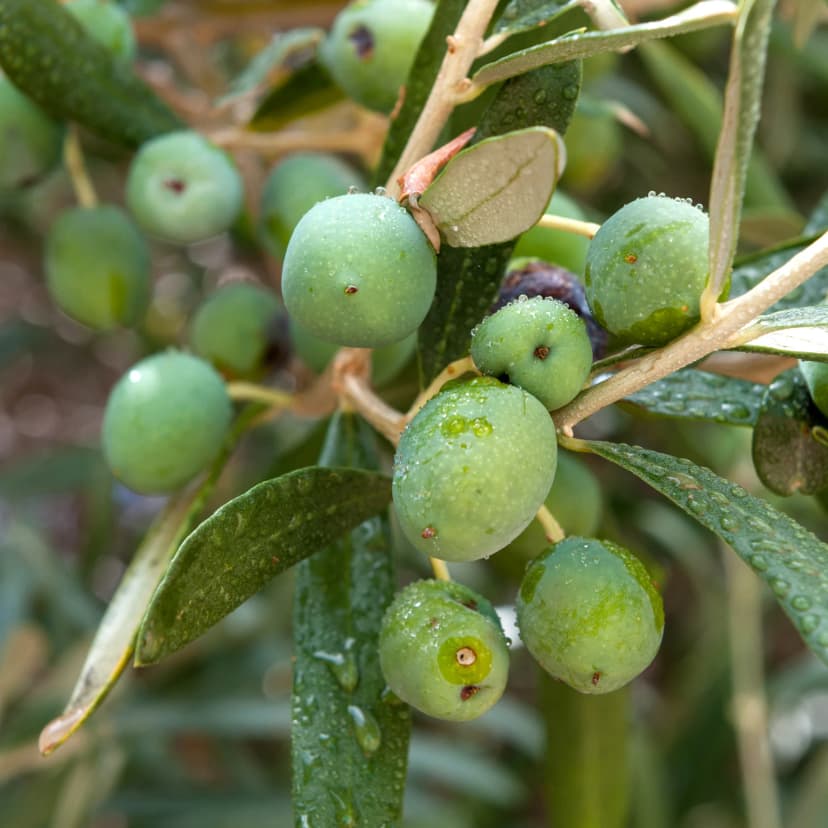
The causes of early defoliation are multiple and often interact with one another. In organic olive groves, the absence of synthetic fertilisers and the use of cover crops or tillage condition nutrient availability and soil health. The most relevant factors are described below.
Water stress and water deficit
The olive tree is drought-resistant, but a prolonged water deficit during the fruit growth phase can cause leaf abscission to reduce transpiration. In organic farming, water management through cover crops, mulching and improving soil organic matter is key to buffering stress. Early defoliation due to drought is usually accompanied by a smaller fruit size and lower oil accumulation.
Nutritional deficiencies
A lack of nutrients, especially nitrogen, potassium and magnesium, can induce leaf drop. In organic olive groves, the mineralisation of organic matter is slower and may not coincide with peak demand. Potassium deficiency, for example, affects osmotic regulation and can accelerate leaf senescence. Correction through organic fertilisers and biostimulants that improve nutrient uptake is essential.
Heat stress and radiation
Extreme temperatures, both high and low, can damage leaf tissues. Late frosts or heatwaves during the summer can cause defoliation. In growing areas with very hot summers, the combination of high temperatures and low relative humidity can trigger leaf drop. Acclimatisation of the tree and protection through covers or adequate irrigation help to mitigate this effect.
Diseases and pests
Various pathogens and pests can cause defoliation. In organic farming, management must be based on prevention and the use of bioprotectants. For example, olive leaf spot (Spilocaea oleagina) causes leaf spots and leaf drop; the olive mite (Aceria oleae) can deform and dislodge leaves. Monitoring and the application of authorised organic treatments are essential to prevent early defoliation.
Soil and root problems
Compaction, waterlogging or the presence of nematodes can affect water and nutrient uptake, inducing defoliation. In organic olive groves, fostering soil microbiota and the use of organic amendments improve structure and root health. Soil organic matter is a pillar of olive grove resilience.
Impact on olive oil quality
Early defoliation reduces the photosynthetic surface area and therefore the plant's capacity to synthesise and accumulate oil in the fruit. During lipogenesis, fatty acids are formed from photosynthates; a lower availability of these can reduce oil yield. In addition, the stress caused by defoliation can alter the fatty acid profile, increasing the proportion of saturated fatty acids and decreasing unsaturated ones, which affects the nutritional quality and oxidative stability of the oil.
Phenolic compounds, responsible for bitterness and pungency, can also be affected. Moderate stress can increase polyphenols, but severe and prolonged stress can reduce them. Early defoliation, by limiting photosynthesis, can decrease the synthesis of these compounds. Likewise, lower oil accumulation can concentrate other components and alter the sensory balance.
The quality of extra virgin olive oil depends on multiple factors, and early defoliation is one of them. Maintaining a healthy and functional leaf canopy until harvest is crucial to obtain a high-quality oil. In organic farming, where quick solutions cannot be applied, prevention through integrated management is the best strategy.
Agronomic and nutritional management to prevent defoliation
The management of organic olive groves must aim to maintain a balance between vegetative growth and production, ensuring adequate nutrition and healthy soil. The key practices are detailed below.
Balanced organic fertilisation
Fertilisation must be based on soil and foliar analysis to adjust the doses. In organic farming, certified organic fertilisers, such as compost, mature manure or algae-based fertilisers, release nutrients slowly. It is important to ensure adequate availability of nitrogen, phosphorus, potassium and micronutrients. Fulvic acids can improve nutrient uptake and soil structure.
Water and soil management
Irrigation must be efficient, avoiding both water stress and waterlogging. Living or inert cover crops help to conserve moisture and improve organic matter. Soil microbiota, stimulated by organic amendments, favours nutrient availability and root health. In rainfed systems, pruning and canopy management can reduce water demand.
Pest and disease control
Prevention is the basis of control in organic farming. Aeration pruning, the removal of infected debris and the use of bioprotectants based on microorganisms or plant extracts can reduce the incidence of pathogens. Functional biodiversity, through hedgerows and cover crops, favours natural enemies.
Biostimulation
Agricultural biostimulants, such as microalgae extracts, amino acids or humic and fulvic acids, can improve stress tolerance and nutritional efficiency. Foliar application of biostimulants at key moments (pre-flowering, fruit set, stone hardening) can help to maintain photosynthetic activity and reduce leaf abscission. Freshwater microalgae technology offers bioactive compounds that stimulate the plant's natural defences.
Biostimulants and ecological strategies to mitigate defoliation
Within the framework of organic farming, biostimulants are tools that, while not fertilisers, improve plant physiology. Algae extracts, rich in phytohormones, polysaccharides and trace elements, can increase tolerance to abiotic stress. Foliar application of microalgae biostimulants can improve foliar nutrient uptake and strengthen tissues.
Fulvic acids, for their part, improve soil structure and nutrient availability, favouring a deeper and more efficient root system. The combination of root and foliar biostimulants can synchronise nutritional demand with soil supply. It is important to choose products certified for use in organic farming, in accordance with Regulation (EC) 2019/1009.
The strategy must be comprehensive: improve the soil, ensure nutrition, protect the plant and stimulate its defences. Early defoliation is a symptom; addressing its underlying causes is the way to maintain oil quality. At Ecoganic, we work with organic biostimulants and fertilisers that help farmers maintain resilient and productive olive groves.
How to assess early defoliation in the field and its real effect on the oil
Before making any decision, it is worth distinguishing between a one-off loss of leaf and a pattern that repeats over time. The most frequent mistake is to react to the first visible leaf drop by applying products without having identified which part of the tree is losing leaf, in which orientation and at what point in the season it occurs. Observing the olive grove calmly, walking several rows and comparing vigorous trees with the most affected ones, provides far more information than any generic recipe. Ask yourself whether the defoliation affects shoots of the year, inner branches or the sun-exposed canopy, because each situation points towards different causes and different responses.
Oil quality does not depend only on the amount of leaf remaining on the tree, but on how the fruit reaches harvest. An overly thinned canopy can expose the fruit to more radiation and temperature, which accelerates its evolution and conditions the sensory profile and stability of the oil obtained. That is why, when assessing the state of the olive grove, it is worth paying attention to the balance between leaf and fruit, to the shade the canopy casts on itself and to the uniformity of ripening within the tree. If you detect more advanced fruits in the most open areas, it is a sign that the loss of leaf is having a physiological effect that merits monitoring.
In organic management, the practical decision involves checking the state of the soil and the root system before acting on the aerial part. A common mistake is to treat the canopy when the problem lies in water availability, in compaction or in an underlying nutritional imbalance. It is worth reviewing soil moisture at depth, the presence of active roots and the evolution of shoot vigour. It is also useful to ask whether the defoliation appeared after a specific event, such as a period of heat, an excess of water or severe pruning, because that sequence helps to interpret the phenomenon and to avoid responses that merely mask the symptom.
- Avoid applying biostimulants repeatedly without first having checked the state of the soil and the evolution of the canopy.
- Do not confuse the natural leaf drop at certain times of year with a problem that requires intervention.
- Check whether the defoliation is uniform or localised, because the response must match the real scale of the problem.
- Ask about the traceability of any organic input and verify that its use fits with the planned management programme.
- Avoid drastic pruning as an immediate reaction, as it can worsen the imbalance between leaf and fruit.
The decision to intervene or to wait should be based on repeated observation and agronomic judgement, not on urgency. Documenting the tree's evolution throughout the season with notes and photographs allows comparison and learning for the next one. If the defoliation stabilises and the fruit develops normally, it may be more prudent to support the process than to force responses. If, on the other hand, it progresses and compromises ripening, it is worth reviewing the whole management approach and prioritising the measures that restore balance to the system. In all cases, the sensible thing is to avoid promises about specific effects on the oil and to focus on maintaining a balanced olive grove, which is the basis of sustained quality.
Related articles
Do you need professional help?
At Ecoganic in Spain and Europe, we offer organic biostimulants and fertilisers. Call us: +34 623 753 719.
Request your free quote
Frequently asked questions
Does early defoliation always reduce oil quality?
Not necessarily. Light, early defoliation may have no significant impact if the tree retains sufficient leaf area. However, severe or widespread defoliation reduces photosynthesis and can lower oil yield and alter the fatty acid profile. Timing and intensity are key.
How can I prevent early defoliation in organic olive groves?
Prevention is based on integrated management: balanced organic fertilisation, efficient water management, pest and disease control with bioprotectants, and biostimulation with certified products. Leaf and soil analysis allow practices to be adjusted.
Which biostimulants are most effective against defoliation?
Biostimulants based on seaweed extracts, amino acids and fulvic acids have shown positive effects on stress tolerance. The choice depends on the specific causes and the phenological stage. It is advisable to seek advice from a technician.
Does early defoliation affect organic certification?
Organic certification focuses on management practices, not on symptoms. If defoliation is due to inadequate management, it could indicate a weakness in the system, but it does not directly affect certification. What matters is using authorised inputs and keeping records.
What role does soil microbiota play in defoliation?
A diverse and active microbiota improves nutrient availability and root health, which strengthens the plant and reduces susceptibility to stress. Practices such as adding compost and reducing tillage favour the microbiota.
References