Importance of calcium in avocado firmness
Calcium is an essential nutrient in avocado physiology, not only for its role in cell division and cell wall stability, but also for its direct influence on fruit firmness and post-harvest shelf life. In avocado production in Latin America, especially in countries such as Mexico, Peru, Chile and Colombia, firmness is one of the main quality criteria for export, as it determines tolerance to handling, transport and acceptance in international markets. However, calcium translocation within the tree is a complex and frequently limited process, which results in fruit with internal deficiencies that manifest as rots, premature softening and significant losses.
Calcium moves mainly through the xylem, driven by transpiration, and unlike other nutrients such as nitrogen or potassium, its mobility in the phloem is very limited. This means that mature leaves, which transpire actively, tend to accumulate calcium, while the fruit, which transpire less, receive insufficient amounts. This uneven distribution is especially critical during the stages of rapid fruit growth, when the demand for calcium is high but the transport capacity is limited. For this reason, understanding the mechanisms of translocation and applying strategies that favour it is key to achieving firm, high-quality fruit.
Factors limiting calcium translocation
Soil conditions and nutrient availability
Calcium availability in the soil does not always translate into adequate uptake. In acidic soils with a pH below 5.5, calcium may be present but not assimilable due to competition with other cations such as aluminium and manganese. On the other hand, in calcareous soils with a high pH, the formation of insoluble carbonates reduces calcium solubility. In addition, soil texture plays an important role: sandy soils have a low cation exchange capacity and retain little calcium, while clayey soils can fix it in unavailable forms. A soil and foliar analysis is essential to determine the appropriate dose and timing of application, avoiding both deficiencies and excesses that may interfere with the uptake of other nutrients.
The role of the xylem and transpiration
Calcium translocation depends to a large extent on transpiration, which is the engine that drives the flow of raw sap from the roots to the leaves. Fruits, having a waxy surface and reduced stomata, transpire much less than leaves, so they receive less calcium. This phenomenon is aggravated under conditions of high relative humidity, typical of tropical and subtropical areas, where transpiration is further reduced. In addition, fruit age has an influence: young fruits transpire more than mature ones, so early calcium accumulation is crucial. Practices such as irrigation management and pruning can influence the transpiration rate and, therefore, the distribution of calcium.
Competition with other nutrients
Calcium does not act in isolation; its uptake is affected by the presence of other cations. Potassium, magnesium and ammonium compete with calcium for exchange sites in the roots, so an excess of these nutrients can reduce calcium uptake. In practice, it is common to observe calcium deficiencies induced by high doses of potassium in poorly balanced fertilization programmes. Therefore, an integrated nutritional management that considers cationic ratios is essential to optimise calcium translocation. Sap and plant tissue analyses can help adjust the proportions and avoid antagonisms.
Root fertilization and soil application
The application of calcium to the soil, whether in the form of calcium sulphate (gypsum), calcium carbonate (agricultural lime) or calcium nitrate, is the basis for ensuring adequate availability. However, due to the low mobility of calcium in the soil, it is advisable to apply in bands or localised near the active root zone. Gypsum, due to its greater solubility, is preferable in soils with a neutral or alkaline pH, while agricultural lime is used to correct acidity. The dose should be based on the soil analysis, with typical values of 200 to 400 kg of CaO per hectare. In addition, the incorporation of organic matter improves calcium retention and availability by increasing the cation exchange capacity of the soil.
Foliar calcium applications
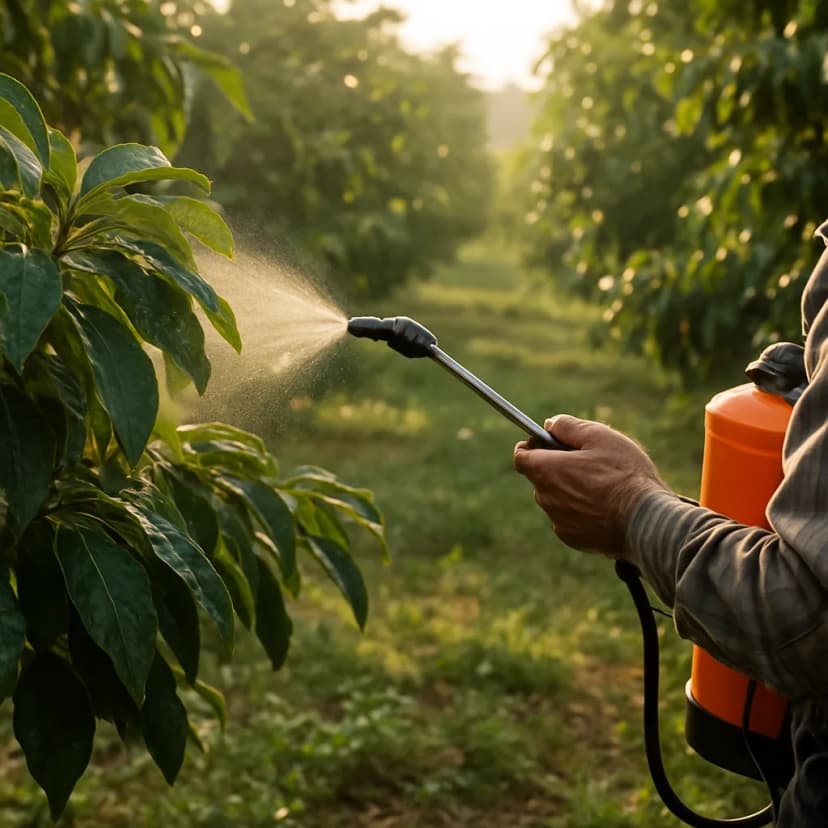
Since translocation via the xylem is limited, foliar calcium applications become a key tool to ensure that the fruit receives this nutrient directly. The most common products are calcium chloride, calcium nitrate and calcium chelates. Foliar uptake is rapid, but penetration is limited, so repeated applications are required during fruit development. The optimal timing is during the stages of active growth, from fruit set to seed hardening, making applications every 15-20 days. It is important to use adjuvants that improve penetration and to avoid applications during hours of high radiation to prevent phytotoxicity. The typical concentration is 0.5 to 1.5 kg of product per 100 litres of water.
Use of biostimulants to improve mobility
Biostimulants, such as seaweed extracts and fulvic acids, can improve calcium translocation by stimulating root development, increasing membrane permeability and favouring the formation of complexes that facilitate the movement of calcium. For example, fulvic acids can chelate calcium and keep it in solution, while microalgae extracts provide phytohormones that promote growth and improve water use efficiency. These products are a sustainable alternative to enhance calcium nutrition without increasing the chemical load, in line with the principles of organic farming.
Mechanisms of action of biostimulants
Biostimulants act through multiple mechanisms that favour nutrient uptake and mobilisation. On the one hand, they stimulate the growth of fine roots, increasing the absorption surface area. On the other, they improve the activity of proton pumps in cell membranes, which facilitates the entry of calcium ions. In addition, some biostimulants contain polysaccharides and amino acids that act as chelating agents, keeping calcium in soluble and transportable forms.
Practical recommendations for use
To obtain the best results, it is recommended to integrate biostimulants into a nutrition programme that includes both root and foliar applications. For example, at Ecoganic, we suggest applying a microalgae-based product together with irrigation at the flowering and fruit set stages, and complementing it with foliar calcium applications every 15 days. The typical biostimulant dose is 1-2 L/ha, and it is important to ensure good foliar coverage. It is essential to follow the manufacturer's recommendations and carry out trials on small areas before applying to the whole orchard, in order to adjust the doses to local conditions.
Balanced nutrition and monitoring
Fruit firmness does not depend on calcium alone, but on an adequate nutritional balance. Potassium, for example, is essential for osmotic regulation and fruit quality, but in excess it can antagonise calcium. It is therefore crucial to carry out periodic foliar analyses to adjust fertilizer doses. Optimal calcium levels in avocado leaves are between 1.0% and 2.5% of dry matter, and lower values indicate deficiency. Constant monitoring makes it possible to detect problems in time and correct the fertilization programme.
Irrigation and transpiration management
Irrigation has a direct influence on calcium translocation. Moderate water stress can reduce transpiration and, therefore, the flow of calcium to the fruits. On the other hand, excessive irrigation can dilute nutrients in the soil and favour leaching. The ideal strategy is to maintain constant soil moisture, avoiding sudden fluctuations. The use of drip irrigation with fertigation allows calcium to be applied efficiently in the root zone. In addition, the implementation of mulches can help maintain soil moisture and reduce evaporation, thus favouring more uniform transpiration.
Harvest and post-harvest management
Post-harvest firmness can be improved with proper management during harvest and storage. It is important to harvest at the optimum point of physiological maturity, avoiding overripe or immature fruits. Temperature management is crucial: a rapid reduction in temperature after harvest (pre-cooling) helps maintain firmness and reduce water loss. The application of post-harvest calcium, in the form of dipping or coating, has also been shown to be effective in prolonging shelf life. However, these measures do not replace adequate field nutrition, but complement it.
Related articles
- Pulp firmness in bananas for the European export market
- Water stress in avocado: physiological disorders and management
- Chlorella biostimulant for heat stress in grapevines
Do you need professional help?
At Ecoganic in Spain, Europe, we offer biostimulants and organic fertilizers. Call us: +34 623 753 719.
Request your free quote
How does calcium deficiency affect avocado firmness?
Calcium deficiency in avocado manifests as premature softening of the pulp, an increased incidence of rots and a reduction in post-harvest shelf life. At the cellular level, calcium is essential for the formation of pectates that maintain the cohesion of cell walls. Without sufficient calcium, cells break down more easily, which translates into a mealy or soft texture. In addition, calcium deficiency can increase susceptibility to diseases such as anthracnose.
What is the best time to apply calcium in avocado cultivation?
The best time to apply calcium is during the stages of active fruit growth, from fruit set to approximately two months before harvest. During this period, the demand for calcium is high and foliar applications can be more effective. Root applications of calcium, such as gypsum, can be made before flowering to ensure constant availability. It is important to split foliar applications into several doses (every 15-20 days) to maintain a continuous supply.
Can biostimulants replace calcium?
No, biostimulants do not replace calcium; rather, they improve its uptake and utilisation. They are complementary tools that enhance the efficiency of calcium fertilization. By improving root health and metabolic activity, biostimulants help the plant make better use of the available calcium, but they do not supply calcium themselves. Therefore, calcium must still be applied in adequate amounts, either to the soil or as a foliar application, and biostimulants should be used to maximise its effect.
Which type of calcium is most effective for foliar applications in avocado?
The calcium compounds most commonly used for foliar applications are calcium chloride, calcium nitrate and calcium chelates. Calcium chloride is highly soluble and economical, but it can cause phytotoxicity if used at high concentrations. Calcium nitrate supplies additional nitrogen, but it is less concentrated in calcium. Calcium chelates are more stable and have better penetration, but they are more expensive. The choice depends on cost, availability and the specific conditions. Carrying out compatibility tests and following the doses recommended by the manufacturer is advised.