
Importance of calcium in organic almond trees
Calcium is an essential nutrient for almond tree development, participating in cell wall stability, cell division and the regulation of physiological processes such as pollen germination and pollen tube growth. In the context of organic farming, where the use of synthetic fertilisers is restricted, calcium management requires an integrated approach combining soil amendments, fertigation and strategic foliar applications.
Unlike other nutrients such as nitrogen or potassium, calcium moves mainly by mass flow in the xylem, that is, with the transpiration stream. This means that its mobility within the plant is limited and that older leaves may accumulate calcium while young tissues, fruits and growing points may suffer local deficiencies, especially under conditions of high demand or water stress.
In organic almond trees, foliar calcium is used more as a corrective or preventive support than as the main source of calcium, because its foliar absorption is low. The technical literature consulted indicates that calcium is better corrected through the soil or fertigation when there is a real deficiency in the soil. However, foliar applications at critical moments such as flowering and fruit set can improve tissue firmness, pollen viability and fruit retention, which translates into an improvement in the final quality of the harvest.
The aim of a foliar calcium programme is not to drastically raise the calcium content in the leaf, but to ensure that growing tissues have this nutrient available when they need it most. Therefore, the most consistent recommendation is to split the applications and base them on annual leaf analyses and on the phenological stage of the crop, rather than following fixed calendars.
Foliar absorption of calcium: limitations and strategies

The cuticle of almond leaves is thick and waxy, which hinders the penetration of nutrients applied foliarly. This characteristic is especially relevant for calcium, a divalent cation that crosses the cuticle slowly. For this reason, foliar calcium formulations usually include adjuvants or chelating agents that improve penetration, but even so, absorption efficiency is limited compared with other nutrients such as boron or zinc.
To optimise foliar absorption of calcium in organic almond trees, application is recommended during hours of low solar radiation and high relative humidity, preferably at dawn or dusk. Conditions of high temperature and low humidity cause the droplet to dry quickly and reduce the time available for penetration. It is also important to avoid applications in strong wind, which can cause drift and uneven coverage of the foliage.
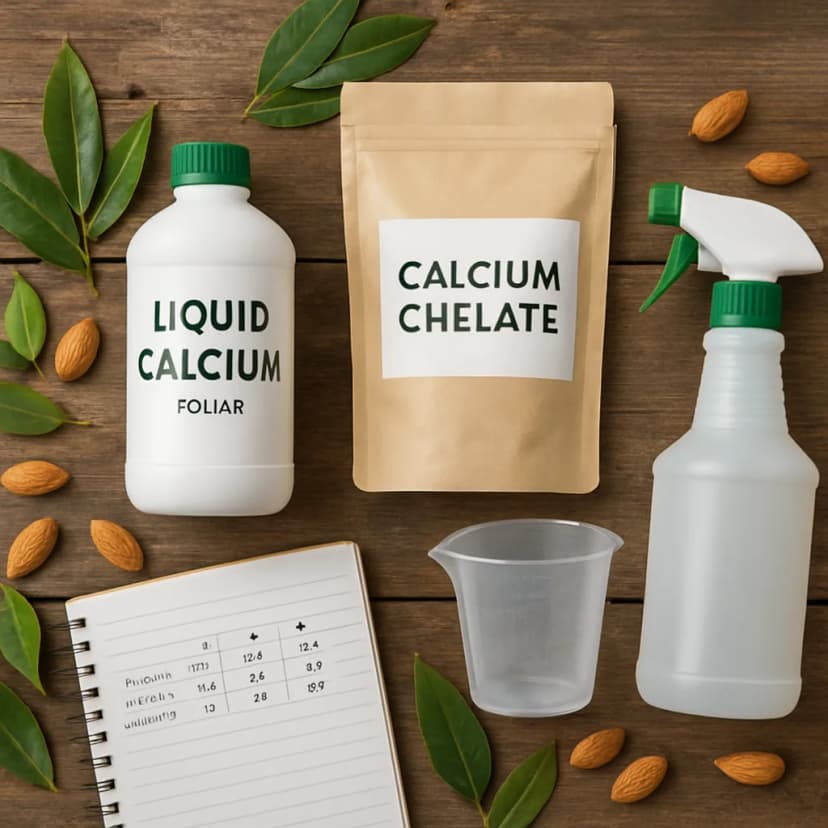
Liquid calcium formulations, such as calcium chelates or calcium complexes with lignosulfonates, usually have better absorption than inorganic salts such as calcium nitrate or calcium chloride. However, the choice of formulation must be based on compatibility with other products and on authorisation for use in organic farming. In recent commercial programmes for organic almond trees in Europe and Latin America, there is a trend towards using concentrated liquid products that allow low doses per hectare (2-3 L/ha) and greater ease of handling.
Another aspect to consider is the pH of the solution. Calcium is more soluble in slightly acidic solutions (pH 5.5-6.5), but when mixing it with other nutrients or plant protection products, compatibility must be verified to avoid precipitations that reduce efficacy. In practice, many organic farmers combine foliar calcium with biostimulants based on algae or fulvic acids, which can improve penetration and the physiological response of the plant.
Key phenological stages for foliar calcium application
Almond trees have several critical moments when calcium demand is high and when a foliar application can be most beneficial. These moments coincide with the flowering, fruit set and early fruit development phases, as well as with fruit fill and stone hardening.
Flowering and fruit set (BBCH 54-65)
During flowering, calcium plays a fundamental role in pollen viability and pollen tube growth, which directly influences fertilisation and fruit set. Foliar calcium applications at this stage can improve the firmness of floral tissues and reduce the abscission of flowers and young fruits. In several organic programmes, an application of 2 L/ha of foliar calcium at pink bud or full bloom is recommended, combined with other biostimulants or micronutrients such as boron.
Fruit development (BBCH 71-75)
After fruit set, the fruit enters a phase of rapid cell division and growth, during which calcium demand is high for cell wall formation. A foliar calcium application at this stage (fruit set and early fruit development) helps sustain fruit retention and prevent problems of black heart or fruit abortion, which may be associated with a local calcium deficiency. The typical dose at this phase is 3 L/ha, according to the programmes observed in 2024-2025.
Fruit fill and stone hardening
In the kernel fill and endocarp hardening phase, calcium contributes to stone consistency and the final quality of the fruit. Although foliar calcium uptake is limited, some guides place an application in this period to support fruit structure and resistance to splitting. In zero-residue programmes, doses of 300-500 cc/hl are used at open bloom and later stages.
It is important to note that applications should be split over the cycle, rather than concentrated in a single high dose. The frequency will depend on the results of foliar analysis and the climatic conditions of each season.
Recommended doses and formulations for foliar calcium in organic almond
Foliar calcium doses in organic almond vary according to the type of formulation (liquid or solid), the product concentration and the phenological stage. In recent commercial programmes, doses of 2 to 3 L/ha are observed for concentrated liquid formulations, applied at flowering and fruit set. Doses of 300 to 500 cc/hl are also reported in zero-residue programmes, especially at open bloom and later stages.
For solid formulations, such as calcium nitrate or calcium chloride, doses are usually expressed in kg/ha, and in some trials 2 to 3 kg/ha per application have been used. However, it is essential to follow the manufacturer's recommendations and to verify that the product is authorised for use in organic farming, complying with European regulations (Regulation EC 2018/848) or the local regulations of Latin American countries.
The following table summarises the indicative doses for different phenological stages, based on information from organic fertilisation programmes:
| Phenological stage | Indicative dose (liquid) | Indicative dose (solid) | Observations |
|---|---|---|---|
| Pink bud to full bloom | 2 L/ha | 2-3 kg/ha | Combine with boron if necessary |
| Fruit set and early fruit development | 3 L/ha | 2-3 kg/ha | Prioritise fruit retention |
| Fruit fill / stone hardening | 300-500 cc/hl | 2 kg/ha | Support endocarp quality |
It is important to remember that foliar calcium should not be the only source of calcium in the fertilisation programme. Correcting real calcium deficiencies in the soil requires the application of calcium amendments such as agricultural gypsum or calcium carbonate, which must be incorporated into the soil in advance. Foliar calcium acts as a complement at critical moments, not as a substitute for base fertilisation.
Diagnosis and monitoring: leaf analysis and sufficiency thresholds
To decide when and how to apply foliar calcium, it is essential to carry out an accurate diagnosis of the nutritional status of the almond tree. Leaf analysis is the most widely used tool for evaluating calcium levels in the plant. In almond cultivation, a value of around 2.2% calcium in the leaf is used as a foliar sufficiency reference, although the exact ranges may vary depending on the area and the laboratory.
Leaf samples should be taken from fully expanded leaves, generally from the middle part of the current year's shoots, and at a defined time (for example, between July and August in the northern hemisphere). It is important to avoid contamination of the samples with residues from foliar applications, so at least two weeks should be allowed after an application before taking the samples.
In addition to leaf analysis, it is advisable to carry out soil analyses to determine the assimilable calcium content and the pH. In acid soils, calcium availability may be low, whereas in calcareous soils calcium is usually present in abundance, but there may be uptake problems due to imbalances with other cations such as potassium or magnesium.
The interpretation of the results should be carried out by a specialised technician, taking into account the almond variety, climatic conditions and agronomic management. Depending on the results, the foliar calcium programme can be adjusted, increasing or decreasing the doses and the frequency of application.
Integration with organic fertilisation and the use of biostimulants
Within the framework of organic farming, foliar calcium management should be integrated with other fertilisation practices that promote soil health and nutrient availability. Soil organic matter plays a key role in calcium retention and in improving soil structure, favouring root uptake. The application of compost, manure or organic amendments rich in calcium, such as calcareous algae, can increase the assimilable calcium content in the soil in the medium term.
Biostimulants based on microalgae, fulvic acids or algae extracts can complement the action of foliar calcium, improving nutrient uptake and stress tolerance. For example, fulvic acids can chelate calcium and facilitate its penetration through the cuticle, while microalgae provide phytohormones that stimulate root growth and metabolic activity.
In organic fertilisation programmes for almond, it is common to combine foliar calcium with other nutrients such as boron, zinc or potassium, depending on leaf analyses. Boron is especially important during flowering, as it favours pollen germination and fruit set, and its interaction with calcium is synergistic. However, care must be taken with boron doses, as the margin between deficiency and toxicity is narrow.
The integration of these practices makes it possible to reduce dependence on chemical fertilisers and improve the sustainability of the crop. In this sense, Ecoganic's organic agricultural biostimulants offer a complementary solution to optimise the nutrition and resilience of the almond tree.
Related articles
- Foliar biostimulation in avocado under high radiation
- Photosynthesis and pulp quality in organic avocado
- Calcium translocation in avocado for fruit firmness
Do you need professional help?
At Ecoganic in Spain, Europe, we offer organic biostimulants and fertilisers. Call us: +34 623 753 719.
Request your free quote
Frequently asked questions (FAQ)
What is the best time to apply foliar calcium in organic almond orchards?
The best time is during flowering and fruit set (BBCH 54-75), when calcium demand is high for floral viability and fruit retention. It can also be useful during fruit filling to improve endocarp quality. It is recommended to split applications and base them on the phenological stage and leaf analysis.
What dose of foliar calcium is recommended for organic almond orchards?
Typical doses for liquid formulations are 2 to 3 L/ha per application, while for solid formulations they may be 2 to 3 kg/ha. In zero-residue programmes, doses of 300 to 500 cc/hl are used. The manufacturer's recommendation should always be followed and authorisation for organic use verified.
Can foliar calcium correct a calcium deficiency in the soil?
No, foliar calcium is not effective for correcting severe calcium deficiencies in the soil, since its absorption is limited and only reaches the treated tissues. To correct the problem at its root, it is necessary to apply calcium amendments to the soil, such as agricultural gypsum or calcium carbonate, and to improve calcium availability in the substrate.
How do I know if my almond tree needs foliar calcium?
The best way is to carry out an annual leaf analysis to determine calcium levels in the leaf. If the values are below the sufficiency threshold (around 2.2% Ca), or if the crop shows deficiency symptoms such as necrosis on the edges of young leaves or fruit with quality problems, it may be necessary to apply foliar calcium at the critical moments.
Conclusion
The management of foliar calcium in organic almond orchards is a valuable tool for improving fruit quality and crop resilience, but it must be part of an integrated strategy that includes soil fertilisation and the use of biostimulants. The key lies in applying at the right phenological moments, with adjusted doses based on an accurate diagnosis through leaf analysis.
To obtain the best results, it is advisable to seek advice from specialised technicians and to use products authorised for organic farming. At Ecoganic, we offer nutrition and biostimulation solutions adapted to the needs of organic almond orchards, contributing to more sustainable and profitable agriculture.
If you wish to implement a foliar calcium programme in your organic almond crop, we invite you to request your free quote and to discover how our products can help you.
References