Chloride mitigation in organic vineyards: diagnosis, amendments, biostimulants and irrigation to restore yield and quality. Request your quote.
How chlorides affect organic vines
Chloride mitigation in organic vineyards has become a technical priority for wine grape growers in areas with low-quality irrigation water, saline soils or the influence of coastal aquifers. Unlike other crops, the vine is moderately sensitive to chloride (Cl⁻), and its accumulation in leaves and must can alter photosynthesis, reduce fruit set and compromise oenological quality. In organic farming, where aggressive chemical correctors are not available, management must be based on improving soil structure, organic matter and biostimulation.
Chloride is a mobile anion that enters the plant via mass flow and accumulates in transpiring tissues. In vines, leaf concentrations above 0.5-1.0 % Cl⁻ in dry matter (depending on rootstock and variety) can cause marginal scorch, chlorosis and premature leaf drop. The problem is not only total salt, but the Cl⁻/NO₃⁻ ratio and the soil's capacity to leach salts. In this article we review a comprehensive approach, with field data and practices compatible with organic certification.
Diagnosis: symptoms and analysis to detect excess chloride
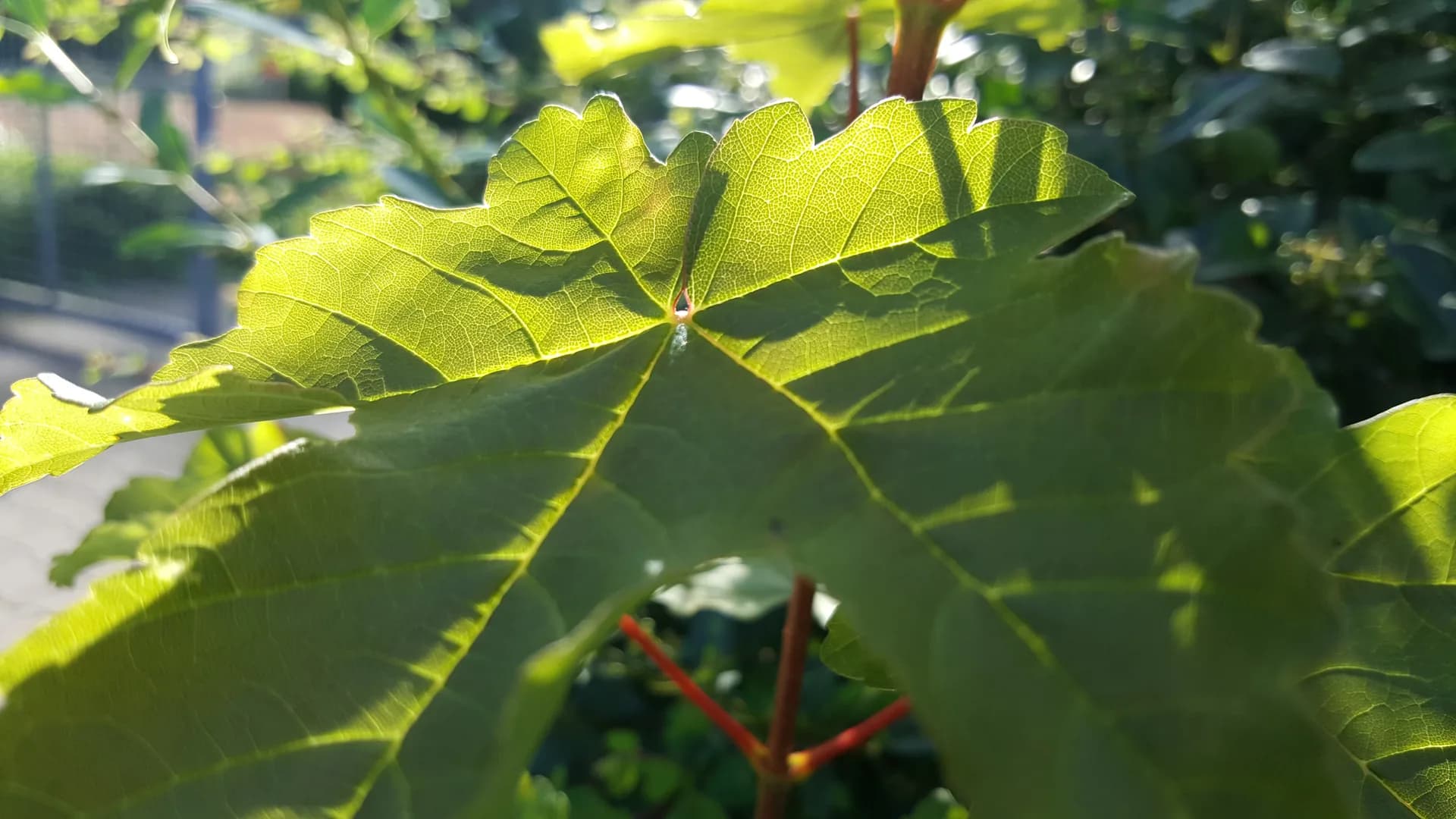
The first step in mitigation is to confirm that the problem is chloride and not sodium, boron or another ion. The visual symptoms of chloride damage in vines appear first on basal and middle leaves: light brown marginal or interveinal necrosis, with a chlorotic halo, progressing towards the centre of the blade. In red varieties such as Tempranillo or Cabernet Sauvignon, the symptom can be confused with magnesium deficiency or boron toxicity. Visual diagnosis must therefore be complemented with leaf and soil analysis.
Leaf and soil analysis
Leaf analysis should be carried out on whole leaves (petiole + blade) at flowering or veraison, taking samples of leaves opposite the first cluster. Indicative Cl⁻ values in dry matter: <0.3 % normal; 0.3-0.5 % moderate risk; >0.5 % high risk. In soil, an electrical conductivity of the saturated extract (ECe) above 2 dS/m can already limit growth, although the vine tolerates salinity better than crops such as avocado or citrus. It is essential to measure the sodium adsorption ratio (SAR) and the exchangeable sodium percentage (ESP) to rule out sodicity.
Strategic sampling in the vineyard
In an organic vineyard, sampling must be targeted: divide the plot into homogeneous zones according to texture, slope and proximity to the irrigation point. In a real case in the Valle de Guadalupe (Mexico), the lower zone of a 4 ha plot had an ECe of 3.8 dS/m and leaf Cl⁻ of 0.72 %, while the upper zone did not exceed 0.25 %. Correction focused on the affected zones, optimising resources. A common mistake is to sample only the area with symptoms, without characterising the rest of the vineyard.
Mitigation strategies in soil and irrigation
Chloride mitigation in organic vineyards rests on three pillars: controlled leaching, improvement of soil structure and the use of organic amendments that complex or partially block the chloride ion. Leaching requires good-quality water and well-drained soil; in organic farming, infiltration can be improved with fulvic acids and stabilised organic matter. The application of agricultural gypsum (calcium sulphate) is not permitted under all organic regulations, so organic sources of calcium and organic matter are prioritised.
Irrigation management and salt leaching
Irrigation should be split into several applications to maintain moisture without saturating the soil, favouring the leaching of chlorides towards deeper horizons. In drip irrigation, apply volumes that generate slight leaching (10-20 % leaching fraction) when the ECe exceeds 2.5 dS/m. It is important to avoid irrigation with water of EC >1.5 dS/m in sensitive varieties. In the rainy season, take advantage of rainwater for leaching, provided drainage is adequate. A vineyard with a cover crop can improve infiltration but competes for water; in saline areas, management of the cover in alternate alleys is recommended.
Organic amendments and chloride complexation
Soil organic matter (SOM) acts as a buffer: it improves structure, increases cation exchange capacity (CEC) and favours salt leaching. Applications of mature compost (10-20 t/ha) or vermicompost (5-8 t/ha) increase aggregation and microbial activity. Humic and fulvic acids can form complexes with cations, but their direct effect on chloride is indirect: they improve water dynamics and reduce osmotic stress. In field trials, the application of seaweed extracts (Ascophyllum nodosum) at 0.3-0.5 % foliar has shown a reduction in leaf Cl⁻ of around 15-25 % in grapevine, probably due to improved water balance and lower transpiration.
Biostimulants and organic amendments for salt stress
Agricultural biostimulants are key tools in chloride mitigation in organic vineyards. They do not replace leaching or soil improvement, but they modulate the physiological response: they increase the synthesis of osmolytes (proline, glycine betaine), improve antioxidant activity and favour the uptake of antagonistic nutrients such as nitrate. The application of organic agricultural biostimulants based on microalgae and seaweed extracts has been shown in the field to improve tolerance to osmotic stress in grapevine.
Microalgae and seaweed extracts
Freshwater microalgae (Chlorella, Scenedesmus) provide phytohormones, amino acids and polysaccharides that stimulate the root and microbial activity. In root applications, doses of 2-4 L/ha of liquid extract at 20 % solids, applied at budburst and post-fruit set, improve root development in saline soils. Ascophyllum nodosum extracts, rich in mannitol and betaines, applied foliarly at 1.5-2.5 L/ha at pre-flowering and veraison, reduce Cl⁻ accumulation and improve fruit set. It is important to apply during hours of lower evapotranspiration and with high relative humidity.
Mycorrhizae and soil microbiota
Inoculation with arbuscular mycorrhizal fungi (AMF) improves water and nutrient uptake and can reduce chloride entry by competing for transport sites. In grapevine, symbiosis with AMF increases tolerance to salinity. Applications of 10-20 kg/ha of mycorrhizal inoculum at planting or at the start of the cycle, combined with organic matter, have shown increases in root biomass of 20-30 % in soils with an ECe of 3 dS/m. In addition, diversified soil microbiota competes with pathogens and improves aggregation.
Agronomic management of wine grapes under chloride salinity
Agronomic management must be adapted to the variety, rootstock and oenological objective. Rootstocks such as 1103 Paulsen, 110 Richter or 140 Ruggeri have a greater capacity for chloride exclusion than 41B or SO4. In organic farming, the choice of rootstock is a long-term decision that conditions mitigation. Pruning and canopy management also have an influence: an excessive leaf area increases transpiration and the accumulation of Cl⁻ in the leaf; moderate leaf removal in the bunch zone can reduce the ionic load in the must.
Balanced fertilisation and ionic antagonism
Chloride competes with nitrate (NO₃⁻) and sulphate (SO₄²⁻) for uptake. Therefore, maintaining adequate levels of nitric nitrogen and sulphur can reduce the entry of Cl⁻. In organic farming, sources such as guano, blood meal or seaweed extracts provide organic nitrogen that mineralises to nitrate. Applications of calcium nitrate are not permitted in organic farming, but calcium from organic sources (seaweed, micronised eggshell) helps to maintain membrane integrity. A balanced fertilisation plan, with prior analyses, prevents imbalances that aggravate salinity.
Canopy management and harvest
In plots with high chloride levels, it is recommended to harvest slightly before over-ripening to avoid accumulation of Cl⁻ in the must. Strategic leaf removal on the east side improves aeration and reduces humidity, but it must not be excessive. Selective harvesting by zones makes it possible to separate grapes with a higher Cl⁻ content and direct them to lower-quality wines or to a blending base. In a case in Chile, separating the lower zone of the plot (Cl⁻ in must > 500 mg/L) made it possible to maintain the quality of the base wine.
Related articles
Do you need professional help?
At Ecoganic in Spain, Europe, we offer organic biostimulants and fertilisers. Call us: +34 623 753 719.
Request your free quote
Frequently asked questions
How do chlorides affect the yield and quality of organic grapes?
Excess chlorides reduce photosynthesis, cause leaf necrosis and decrease fruit set, which translates into lower yield and must with a higher Cl⁻ content. In wines, concentrations above 500 mg/L of Cl⁻ can affect fermentation and the sensory profile, contributing unwanted saline notes.
Which practices help to mitigate chloride salinity in the vineyard?
Key practices include controlled leaching with good-quality irrigation, improving soil structure with organic matter, using biostimulants that improve the water balance and choosing excluding rootstocks. The combination of these measures is more effective than a single application.
What are the visible symptoms of chloride damage in grapevines?
Typical symptoms are marginal or interveinal necrosis on basal leaves, with associated chlorosis, which progresses towards the centre of the leaf blade. In severe cases, premature defoliation and reduced shoot growth are observed. These symptoms must be confirmed with leaf analysis.
Which biostimulants improve tolerance to osmotic and saline stress in grapevines?
Extracts of Ascophyllum nodosum, freshwater microalgae and osmoprotective amino acids have shown improvements in tolerance. Applied foliarly at pre-flowering and veraison, they reduce chloride accumulation and improve fruit set and grape quality.
Conclusion and final recommendations
Mitigating chlorides in organic vineyards requires an integrated approach: precise diagnosis, irrigation management for leaching, organic amendments that improve structure and biostimulants that modulate the physiological response. There are no miracle solutions, but the combination of these practices makes it possible to maintain productivity and quality in areas with chloride salinity. It is essential to monitor with leaf and soil analyses, and to adjust doses according to how conditions evolve. At Ecoganic we offer certified organic fertilisers and microalgae biostimulants adapted to vineyards, with specific programmes for grapevine cultivation with biostimulants. Request your free quote and we will help you design a tailored strategy.
Mitigation of chlorides in organic vineyards: technical strategies and management criteria
The accumulation of chlorides (Cl⁻) in the soil of organic vineyards can pose a threat to the sustainability of the crop, especially in coastal areas, irrigated land using poor-quality water or saline soils. Grapevines show a sensitivity to chlorides that varies with the rootstock, the variety and the soil and irrigation water conditions, so there is no single threshold valid for all plots. When the chloride concentration continues to rise, reductions in yield and changes in must quality may appear, so it is advisable to monitor the problem before it becomes apparent at harvest. In organic farming, where the range of permitted amendments and corrective products is limited, mitigation must be based on integrated strategies of soil management, rootstock selection and, as a complement, biostimulants that can contribute to vine vigour. Before applying any amendment or product, it is advisable to confirm with the certification body that it is permitted.
The first pillar of mitigation is the choice of rootstock. Rootstocks show notable differences in their capacity to exclude chlorides. Rootstocks such as 1103 Paulsen, 140 Ruggeri or 110 Richter are usually cited among those with the best performance, while others, such as SO4 or 420A, are considered more sensitive. This information should be checked with the nursery and with the local agronomist, because actual performance depends on the soil and water of each holding. For organic vineyards in risk areas, priority should be given to rootstocks with good exclusion capacity and, in the case of replanting, a chloride analysis of the soil profile should be carried out before selecting the plant material. Prior diagnosis avoids a costly mistake: planting on an unsuitable rootstock and discovering the problem years later, when it no longer allows a simple correction.
Soil and water management constitutes the second axis of mitigation. The leaching of chlorides by drip irrigation with low-salinity water and controlled leaching fractions can reduce the concentration in the root zone, provided that drainage is sufficient to evacuate the salts. However, in organic farming, excess water that causes nutrient leaching and loss of organic matter must be avoided, so the leaching programme must be adjusted with conductivity measurements in the soil and in the water. The incorporation of mature compost, in the amount indicated by the analysis and the agronomist, improves soil structure and can favour the leaching of chlorides without degrading the profile. Likewise, the use of cover crops with species that tolerate the salinity of the plot can reduce direct evaporation from the soil and limit the surface accumulation of salts compared with bare, cultivated soil; this should be verified with analyses specific to the plot and care should be taken that the cover does not compete with the vine for water in summer.
The application of biostimulants can be a complementary tool, never a substitute for soil and water management. Seaweed extracts (Ascophyllum nodosum), which usually contain betaines and polysaccharides, are applied to the soil or by foliar application according to the product label and can contribute to the general vigour of the vine under stress conditions. Free amino acids, including proline and glycine betaine, can be used at times of salt stress with the same aim, and humic and fulvic acids, derived from leonardite or compost, can be used to support soil structure and nutrient availability. None of these products removes chlorides from the soil, and their effectiveness depends on the product, the timing and the conditions of the plot. It is therefore advisable to leave an untreated area of the holding as a control and to compare over several seasons the evolution of leaf chloride levels and yield. It is also advisable to request the technical data sheet and composition from the supplier, and to verify with the certification body that each product is permitted in organic production.
Fertilisation management must be adjusted to avoid imbalances that aggravate chloride toxicity. The chloride content of the fertilisers and amendments applied should be reviewed, and, whenever the certification body permits it, sources that do not supply chlorides should be preferred. An excess of potassium can interfere with the uptake of other nutrients and create new imbalances, so doses must be decided on the basis of soil and leaf analyses and with the advice of an agronomist, and reviewed each season in the light of the evolution of chlorides in the soil and in the leaf.