General guide to ammoniacal nitrogen in organic maize in rotation: organic sources, management factors and what to check before fertilising the field.
Introduction
Ammoniacal nitrogen for organic maize in rotation is a central point when planning fertilisation without synthetic products. Ammonium is one of the mineral forms of nitrogen that maize can take up through the root and, in organic production, it reaches the soil through organic matter, rotation residues and permitted organic fertilisers. How much nitrogen is actually within the crop's reach, and when, cannot be deduced from a table: it depends on the soil, the season's climate, the preceding crop and how the inputs are managed.
This general guide explains where ammonium can come from, which factors drive its availability, how the management of a maize crop that forms part of a rotation is usually planned and what is worth checking and asking for before buying or applying a fertiliser. It is a guide to criteria, not a dosing programme: the specific amounts depend on each field and are defined with analyses and a technical adviser.
European organic production is governed by Regulation (EU) 2018/848 and its implementing rules, which limit the permitted inputs and promote nutrient recycling and crop diversity. Within that framework, rotation is more than a formal requirement: it spreads nutrient demand across different crops, supplies nitrogen when it includes legumes and helps maintain a soil with good structure. Before using any input, it is advisable to confirm with the certification body that it is admissible on the holding.
What is ammoniacal nitrogen and why is it key in organic maize?
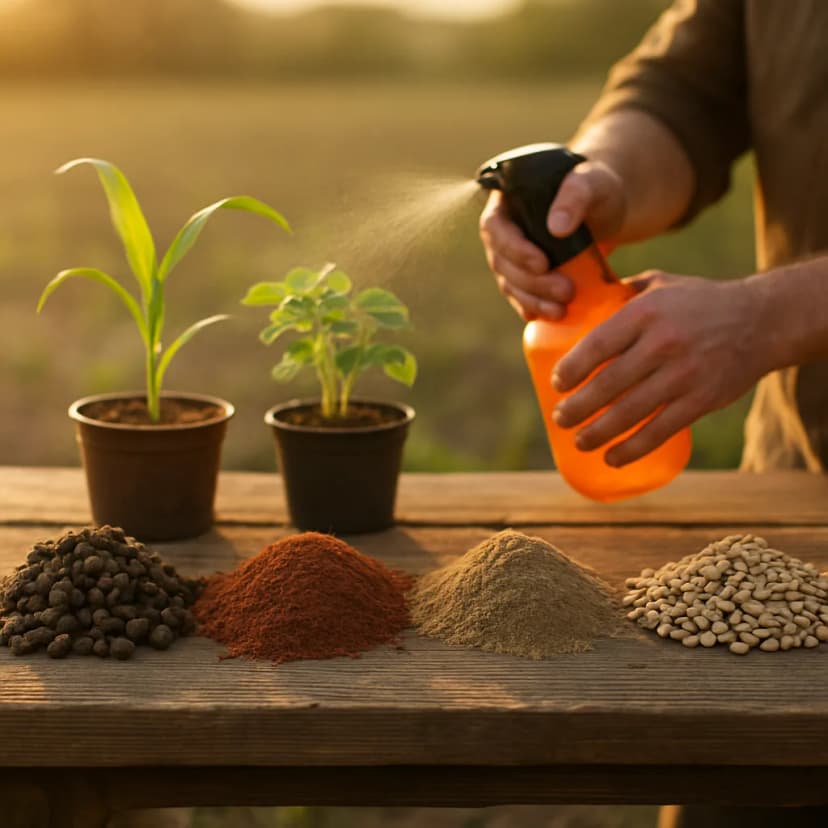
Ammoniacal nitrogen is the nitrogen present in the form of ammonium, one of the two mineral forms, together with nitrate, that maize can take up from the soil. In the soil both forms coexist and are transformed into one another depending on temperature, moisture, aeration and biological activity. Generally speaking, ammonium tends to be retained more in soil particles than nitrate, which moves with water more easily. That is why texture, organic matter content and the rainfall or irrigation regime influence how much nitrogen remains near the roots and how much is lost.
In organic farming, nitrogen does not arrive in a single form or at a single moment. It comes from the decomposition of the soil's own organic matter, from the residues of the previous crop, from green manures and legumes in the rotation, and from any organic fertilisers applied. The practical difficulty is making that release coincide with maize demand: the crop needs available nitrogen throughout vegetative growth, with demand intensifying before flowering and continuing during grain filling.
Management seeks to avoid two opposite situations. On the one hand, a nitrogen deficit in the phases when the crop needs it most, which can translate into poor growth and a pale green leaf colour. On the other, an excess or a poorly synchronised application, which can be lost through leaching with water or escape into the atmosphere as ammonia when the material is left on the surface with heat, wind or dry soil. Both situations are better resolved with planning and crop observation than with large, one-off applications.
The result also depends on the rotation. A well-developed legume before the maize can leave nitrogen in its residues, which becomes available as they decompose; the rate depends on the type of residue, temperature and moisture. That contribution cannot be taken for granted: it is advisable to assess it plot by plot and to take it into account when deciding how much additional nitrogen to apply. A rotation with species of different root systems and cycles also favours soil structure, and a well-structured soil makes it easier for water and air to circulate and for organic matter to decompose more evenly.
Sources of ammoniacal nitrogen for organic maize in rotation
There are several organically sourced materials that supply ammonium or nitrogen that ends up being converted into ammonium in the soil. They differ in their richness, in their speed of release and in their effect on soil structure, and the choice depends on the type of soil, the rotation and what is available locally. In organic production, both the material and its origin must be admissible, so confirmation with the certification body comes before purchase.
Manures and compost
Composted manure is one of the traditional sources of nitrogen in organic farming. Its composition varies greatly depending on the animal, the bedding, the maturation time and the composting process, so the average values in tables are of limited use as a guide. A mature, stabilised compost releases nitrogen gradually and supplies organic matter; a fresh or insufficiently mature material can easily lose ammonium and cause problems with crop emergence. It is advisable to request the analysis of the specific batch to be applied and to check its maturity.
The origin of the manure also matters: in organic production there may be conditions on the type of livestock of origin and on the treatment of the material, and it is the certification body that must verify them.
Feather, blood and bone meals
These are by-products of animal origin with a high nitrogen content compared with that of composts. Their speed of release varies: in general, blood meal acts sooner, while feather or bone meals act more slowly, depending on the treatment they have received and the soil temperature. They are usually lightly incorporated to limit losses through volatilisation. Their use in organic farming is subject to production regulations, so the technical data sheet and the admissibility of the specific product are reviewed before application.
Oilseed cakes
Sunflower, soya or other oilseed cakes are by-products of oil extraction rich in organic nitrogen. Their decomposition in the soil is usually relatively rapid, which makes them useful in applications before sowing or as a top dressing. As they are materials of agro-industrial origin, their provenance and treatment must be checked: in organic production, materials obtained from genetically modified organisms are not permitted, so the provenance of each batch is checked.
Microbial biofertilisers
These are products containing microorganisms and are presented as a complement to fertilisation. Their result depends on the strain, the soil, the application conditions and the quality of the product, and they do not replace a fertilisation plan based on analysis. When choosing one, it is advisable to request the technical data sheet, the declared composition and the manufacturer's instructions for use, and to verify that its labelling complies with the regulations; when it is marketed as an EU fertilising product, it must bear the CE marking. In rotations with legumes there are specific inoculants for each species, and the supplier can indicate which one corresponds to the crop preceding the maize.
Indicative summary of the sources
The following table sets out, in an indicative way and without figures, the general features of each source and what should be checked before using it.
| Source | General feature | What to check |
|---|---|---|
| Manure compost | Gradual release and supply of organic matter | Maturity, batch analysis and origin of the material |
| Blood, feather or bone meals | Speed of release varies according to the material | Admission in organic farming, product data sheet and treatment received |
| Oilseed cakes | Relatively rapid decomposition | Provenance, absence of materials of transgenic origin and admission |
| Microbial biofertilisers | A complement, not a substitute for a fertilisation plan | Declared composition, labelling and manufacturer's instructions |
| Legume residues and green manures | Supply nitrogen to the system as they decompose | Species, condition of the residue and timing of incorporation |
Agronomic management: rates, timings and application methods
The aim of management is to synchronise nitrogen supply with maize demand. Since the crop needs available nitrogen from vegetative growth through to grain filling, planning is done by crop stage — before sowing, rapid growth, flowering and filling — and not by fixed dates, which depend on the area and the season.
Rates and quantities
There is no single nitrogen rate that is valid for all plots. To estimate it, a simple balance is used as a starting point: what the crop needs for the plot's production target, minus what the soil and the rotation already supply. The factors that shift this balance are as follows:
- The production target and the destination of the grain.
- The organic matter content and texture of the soil, which determine how much nitrogen it releases on its own and how much it retains.
- The previous crop and its residues, especially if it was a legume or a green manure.
- The actual nutrient content of the organic material applied, which is known from its analysis or from the manufacturer's declaration.
- Water availability, in rainfed or irrigated conditions, which influences nitrogen release and losses.
- The applicable regulations: in areas declared vulnerable to nitrate pollution, action programmes apply that may limit the quantities and application dates, and the agricultural authority of the autonomous community provides information on what applies to each plot.
For commercial products, the rate is the one stated on the product label: it is not advisable to increase it on one's own initiative or to mix products without checking their compatibility. A technical adviser can translate the balance into a plan for each plot and adjust it during the season according to how the crop develops.
Application timings
Splitting applications is usually more prudent than applying everything at once. A common approach consists of a base application before sowing, incorporated into the soil, and a later top-dressing application during vegetative growth, with a faster-release material, so that nitrogen is available before the crop enters its period of highest demand. After a well-developed legume, the decomposition of its residues can cover part of the early stages, which allows the external application to be adjusted or delayed.
Application should be avoided on waterlogged soil or just before heavy rain, and also in strong heat and wind when the material remains on the surface. The specific dates depend on the area and the season, so it is preferable to be guided by the crop stage and the weather forecast. Some advisers use a soil nitrate analysis before top-dressing to decide whether the second application is necessary and how large it should be.
Application methods and losses
The main method is application to the soil. Shallow incorporation shortly after application and placing the fertiliser in a band with suitable machinery help to limit ammonia losses; by contrast, leaving the material on the surface at high temperatures or with dry soil encourages losses. If it is placed near the sowing line, direct contact with the seed must be avoided, especially with concentrated materials. In irrigated systems, fertigation with compost extracts or diluted slurry may be considered, a practice with its own requirements for filtration, material quality and organic eligibility that must be reviewed before starting.
Foliar applications of amino acids or seaweed extracts can complement nutrition in specific stress situations, but they do not replace base or top-dressing fertilisation. They are not a plant protection treatment.
Monitoring during the season
The fertilisation plan does not end with the application. Observing the colour and vigour of the crop at different points in the plot, comparing areas with different soils and recording what happened makes it possible to correct course within the same season and to improve planning for the next one. A farm record book with the materials applied, the dates, the crop stage and the day's conditions is also a useful tool when dealing with the certification body.
Interaction with soil microbiota and biostimulants
Soil is a living system: much of the transformation of organic nitrogen into forms that the plant can absorb is carried out by microorganisms, and their activity depends on temperature, moisture, aeration, pH and organic matter content. A soil with good structure, with regular inputs of organic matter and with a diverse rotation that includes legumes and green manures usually offers a more gradual and predictable release of nitrogen than a compacted soil, poor in organic matter or with frequent waterlogging.
Biostimulants are products distinct from fertilisers: they do not supply the nitrogen the crop needs and they are not a plant protection treatment. Regulation (EU) 2019/1009 regulates plant biostimulants and has applied since July 2022, with requirements on composition, labelling and conformity. Products based on seaweed or microalgae extracts can contribute to the general vigour of the crop, and their effect depends on the product, the timing of use, the crop and the conditions of the season. For more information on this type of product, you can consult the page on organic agricultural biostimulants.
Before incorporating a biostimulant into an organic maize plan, these are the reasonable checks:
- The technical data sheet and the declared composition of the product.
- The crops and growth stages for which it is indicated, and the application instructions according to the product label.
- Conformity with Regulation (EU) 2019/1009 and CE marking, where applicable.
- Confirmation from the certification body that the product is admissible on the holding.
- Compatibility with the other products in the plan, which the manufacturer must state.
It is wise to be wary of promises of guaranteed efficacy: no biostimulant replaces soil analysis or a well-constructed fertilisation plan.
Illustrative examples of an approach in the rotation
The following two examples are hypothetical situations, set out only to show how the decisions are chained together. They are illustrative examples and do not include figures: they do not describe any specific holding.
First illustrative example: legume before maize in rainfed conditions
Let us imagine a rainfed plot in which a legume is grown as a green manure that is incorporated before maize sowing. The first step is to review the state of that residue and the soil moisture to assess how much nitrogen can be expected from its decomposition. With the soil analysis in hand, a decision is made whether a moderate basal input of mature compost is sufficient or whether it is advisable to reserve part of it for top dressing.
During the crop, the colour and vigour of the plants are observed and rainfall is taken into account: in a dry season the release of nitrogen is slower and a top-dressing input meets with less response; in a rainy season the risk of losses must be monitored. Only with that information is the second input decided.
Second illustrative example: grain legume before maize under irrigation
Let us now suppose an irrigated plot in which maize follows a grain legume whose residues have remained on the surface. Here the plan can combine a basal input with stabilised organic material, incorporated before sowing, and a top-dressing input with a faster-release material, applied during vegetative growth and coordinated with irrigation.
Under irrigation, irrigation becomes part of the fertilisation: excessive irrigation can leach nitrogen beyond the reach of the roots, and an uneven distribution of water means the crop receives nitrogen unevenly. Reviewing irrigation uniformity and recording each input in the farm register makes it easier to adjust the plan in the following season.
In both examples what is repeated is the method: start from an analysis, count what the rotation contributes, split the inputs, observe the crop and record what is done. For more details on nutrition programmes adapted to maize, you can consult the maize crop with organic nutrition.
What to check and what to request before fertilising
These checks help turn this general guide into a plan for a specific plot:
- A recent soil analysis of the plot (organic matter, texture, pH and nutrients) and, where possible, the analysis of the specific organic material to be applied.
- The crop and crop residue history of the rotation, paying attention to previous legumes and green manures.
- The eligibility of each input in organic production, confirmed with the certification body before purchase.
- The technical data sheet, labelling and declared composition of each product, and the application instructions according to the product label.
- Local regulations: nitrate-vulnerable zones, distances to watercourses and wells, and the conditions for storing and applying manure.
- A record of each application in the holding register: material, date, crop stage and the day's conditions.
With this data, a technical adviser can help adjust the plan during the season and decide when an additional input is necessary and when it is not.
Related articles
Do you need professional help?
At Ecoganic in Spain, Europe, we offer organic biostimulants and fertilisers. Call us: +34 623 753 719.
Request your free quote
Frequently asked questions
Which source of ammoniacal nitrogen is best for organic maize?
There is no single best source for every case: it depends on the soil, the rotation, what is available locally and what the certification body allows. Mature compost usually serves as a gradual-release base input, and animal-derived meals or oilseed cakes can complement it when a faster-release nitrogen is needed. Microbial biofertilisers are a supplement, not a substitute for the fertilisation plan.
How much ammoniacal nitrogen does organic maize need?
There is no amount that is valid for every field. It depends on the production target, the nitrogen supplied by the soil and the rotation, the richness of the material applied and the water available. It is estimated with a balance based on soil and organic material analysis, with the help of a technical adviser, and in compliance with the nitrate regulations applicable to the area.
How can ammonia losses through volatilisation be limited?
Incorporating the material into the soil shortly after application helps, as does avoiding application in heat, wind or very dry soil, not applying to waterlogged soil or before heavy rain, and choosing stabilised, mature materials. Placing the fertiliser in a band rather than leaving it on the surface also helps to limit losses.
Can I use biostimulants together with ammoniacal fertilisers?
It depends on the product: the manufacturer must state its compatibility and the application instructions according to the product label. A biostimulant can contribute to the general vigour of the crop, but it does not supply the nitrogen maize needs, nor is it a plant protection treatment. In organic production, the certification body must confirm that the product is admissible.
What role does crop rotation play in ammonium availability?
A well-developed legume before maize can leave nitrogen in its residues, which becomes available as they decompose; the amount and rate depend on the species, the crop's development, temperature and moisture. Rotation also favours soil structure and biological activity, but it does not remove the need for a fertilisation plan based on analysis.
What should I check before buying an organic fertiliser for organic maize?
It is advisable to confirm with the certification body that the product and its origin are admissible, to request the technical data sheet and the declared composition, to review the labelling and, if possible, to have the analysis of the specific batch. The dose is applied according to the product label, and each application is recorded in the farm register.
Is it advisable to apply all the nitrogen before sowing?
As a rule, splitting applications is more prudent: a base input before sowing and another as a top dressing during vegetative growth, with a faster-release material. This way the nitrogen is available when the crop enters its period of highest demand and the risk of losses is limited. The specific split depends on the area, the season and the state of the crop.