
Introduction: salinity in vineyards, a growing challenge
Salinity in vineyards has become one of the main limiting factors for viticulture in arid and semi-arid regions of Latin America and southern Europe. In recent years, the combination of prolonged droughts, declining rainfall and overexploitation of aquifers has increased the concentration of salts in soils and irrigation water. This phenomenon not only affects the growth and productivity of the vine, but also has an impact on the organoleptic quality of the wine, generating significant economic losses for producers.
This year, the situation has worsened in various wine-growing areas, especially in Chile and Argentina, where recent studies have shown an increase in the electrical conductivity of irrigation water and a higher incidence of saline soils. Climate change, with increasingly frequent drought episodes, is intensifying salt stress in vineyards, forcing winegrowers to adopt new management and monitoring strategies to protect their crops.
What has changed this year in vineyard salinity?
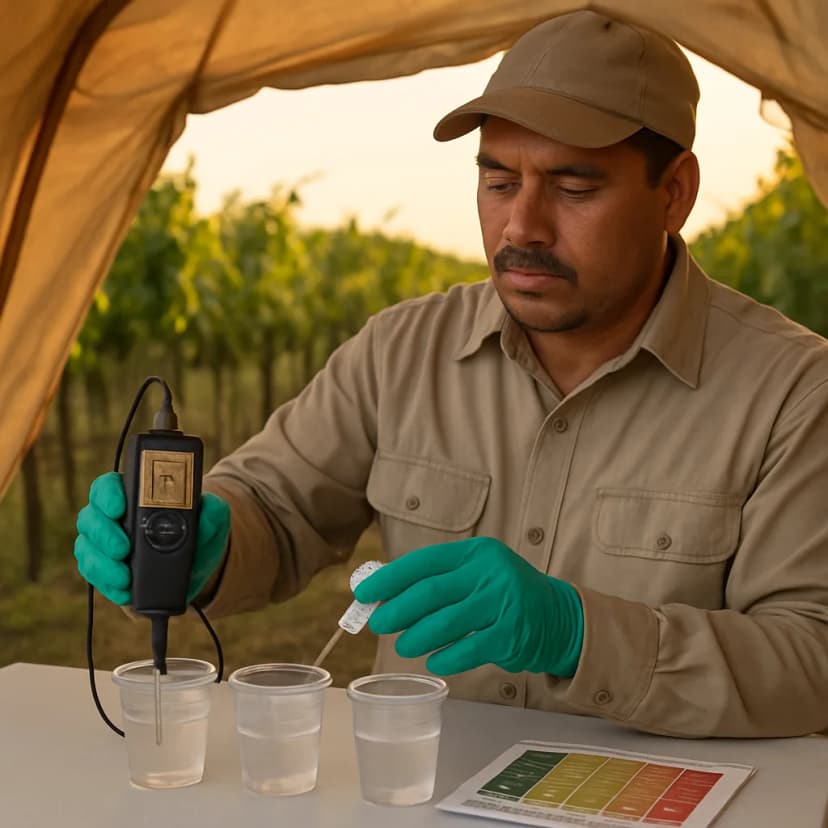
The most visible factor in 2026 is not a single regulatory change, but the intensification of water stress and the resulting higher concentration of salts in rivers, wells and irrigation water. In Chile, research carried out by the University of California, Davis and published on its website indicates that, in 18 vineyards sampled, 17% of the samples fell into the medium risk category and 10% into the high salinity risk category. In addition, in the Maipo basin, 14 of 16 vineyards had electrical conductivity above 0.8 mS/cm, and 7 exceeded 1.7 mS/cm. These data reveal an alarming trend that affects the sustainability of viticulture in the region.
In Argentina, research by INTA and UNCuyo has shown that soil salinity directly influences the sensory perception of wines, increasing salty and bitter notes. This finding has commercial implications, since international markets, including the European one, are increasingly demanding regarding the quality and typicity of wines. Producers must therefore pay particular attention to salinity management in order to maintain competitiveness.
Monitoring and risk thresholds
Annual monitoring of soil and irrigation water salinity has become essential. According to the UC Davis study, the risk thresholds have been established as follows: electrical conductivity (EC) below 0.8 mS/cm indicates low risk; between 0.8 and 1.6 mS/cm, medium risk; and above 1.6 mS/cm, high risk. These criteria are being used to decide irrigation management and mitigation strategies in Chilean vineyards.
The adoption of these thresholds allows winegrowers to identify salinity problems early and take corrective measures before they significantly affect production. In addition, it is recommended to analyse not only electrical conductivity, but also the concentration of specific ions such as sodium, chlorides, calcium, magnesium, sulphates and bicarbonates, in order to obtain a complete diagnosis of water quality.
Salinity risk thresholds in vineyards
Establishing clear thresholds is essential for efficient salinity management. In the Latin American context, and taking the UC Davis study as a reference, the following ranges of electrical conductivity (EC) in irrigation water have been defined:
| Risk level | EC (mS/cm) | Recommendations |
|---|---|---|
| Low | < 0.8 | Periodic monitoring, standard management |
| Medium | 0.8 – 1.6 | Implement leaching strategies and selection of tolerant rootstocks |
| High | > 1.6 | Intensive measures: drip irrigation, salt washing, use of biostimulants |
These thresholds are a practical guide for growers to assess the salinity risk in their vineyards. However, it is important to consider that vine sensitivity varies according to the rootstock, the climate and agronomic management. For this reason, it is recommended to complement these values with soil analyses and field observations.
In Argentina, the wine sector has also established chloride limits for wine certification. A technical source indicates that the limit is 0.80 g/L of sodium chloride for the analysis certificate for free circulation and export, and 1 g/L without that certificate. This aspect is relevant for growers seeking to export to demanding markets, since salinity can affect compliance with these requirements.
Impact of salinity on the vine and wine quality
Salinity affects the vine in two main ways: through osmotic stress and through ionic toxicity. Osmotic stress occurs when the high concentration of salts in the soil solution reduces the availability of water for the plant, causing a water deficit similar to that of drought. This translates into reduced growth, lower leaf area and decreased photosynthesis, which directly affects the production of sugars and phenolic compounds in the grape.
Ionic toxicity, for its part, is caused by the accumulation of specific ions such as sodium and chloride in plant tissues. These ions can interfere with metabolic processes, damage cell membranes and reduce bud viability. In the long term, salinity can cause the death of the plant, especially if appropriate management measures are not implemented.
In terms of wine quality, studies have shown that soil salinity can alter the sensory profile, increasing the perception of salty and bitter flavours. A study by INTA and UNCuyo, published in ENOLIFE, found that vines grown in saline soils produce wines with a higher concentration of chlorides, which correlates with a greater perception of salinity in the mouth. In addition, salinity can affect the acidity, colour and stability of the wine, which compromises its quality and market acceptance.
Specific effects on grape varieties
Not all grape varieties respond in the same way to salinity. For example, the Chardonnay and Shiraz varieties have been studied in trials with saline irrigation, with differences observed in salt accumulation and in the perception of salty taste. These studies, cited by the Federación Española de Enología, indicate that some varieties are more tolerant than others, which opens the door to the selection of more resistant varieties or rootstocks.
In regions such as Chile and Argentina, where viticulture is a key economic activity, the choice of plant material becomes crucial. Salinity-tolerant rootstocks, such as those of the 1103 Paulsen or 140 Ruggeri series, can offer a significant advantage in soils with salt problems. However, each particular case must be evaluated, considering the specific conditions of the vineyard.
Management strategies to mitigate salinity in vineyards
To tackle salinity in vineyards, growers are implementing various strategies that combine agronomic practices, irrigation management and the use of biotechnological inputs. One of the most effective measures is salt leaching, which consists of applying an excess of irrigation water to wash the salts below the root zone. This practice must be carried out carefully to avoid waterlogging and nutrient loss.
Drip irrigation is another widely used technique, as it allows precise control of the amount of water applied and reduces the accumulation of salts on the soil surface. In addition, the use of salt-tolerant rootstocks is essential in soils with chronic problems. Recent research has shown that certain rootstocks can effectively exclude sodium and chloride, protecting the plant from toxic effects.
Balanced nutrition also plays a crucial role. An adequate supply of calcium and potassium can counteract the effects of sodium, improving cell membrane stability. In this context, organic fertilisers rich in calcium and potassium can be important allies in maintaining an ionic balance in the plant.
Use of amendments and organic matter
The application of fulvic acids and other organic amendments improves soil structure, increases its cation exchange capacity and favours salt leaching. Organic matter also stimulates microbial activity, which contributes to the overall health of the soil and to nutrient availability.
In soils with high salinity, it is recommended to incorporate agricultural gypsum (calcium sulphate) to displace sodium from exchange sites and improve soil permeability. This practice must be complemented with good drainage to remove the leached salts.
The role of biostimulants in salinity tolerance
Agricultural biostimulants have positioned themselves as an effective tool for mitigating the effects of salt stress on crops. These products, which may contain seaweed extracts, amino acids, beneficial microorganisms and other bioactive compounds, act at a physiological level by improving the plant's tolerance to stress.
In the case of grapevines, biostimulants can induce the synthesis of osmoprotectants, such as proline and glycine betaine, which help maintain cellular water balance under osmotic stress conditions. In addition, some biostimulants promote antioxidant activity, reducing the oxidative damage caused by ionic toxicity.
Ecoganic, a specialist in the development of biostimulants based on freshwater microalgae, offers solutions that have been shown to improve the salinity tolerance of grapevines in field trials. The application of these products, both foliar and via the roots, can complement conventional management strategies, helping to maintain productivity and grape quality under adverse conditions.
Practical application in vineyards
To obtain the best results, it is recommended to apply biostimulants at key moments in the vegetative cycle, such as budbreak, flowering and veraison. The dose and frequency of application will depend on the level of salt stress and the specific conditions of the vineyard. It is important to follow the manufacturer's recommendations and carry out constant monitoring to adjust the application programme.
In vineyards with severe salinity problems, combining biostimulants with proper irrigation and nutrition management can make the difference between an acceptable harvest and a total loss. For this reason, technical advisers are increasingly integrating these products into their recommendations.
Related articles
- Sodium chloride in citrus: improvement with algae
- Foliar calcium in organic almond orchards: technical guide
- Microalgae against salt stress in lemon trees: 2026 guide
Do you need professional help?
At Ecoganic in Spain, Europe, we offer Biostimulants and Organic Fertilisers. Call us: +34 623 753 719.
Request your free quote
FAQ on salinity in vineyards
What is salinity in vineyards and how is it measured?
Salinity in vineyards refers to the excessive accumulation of soluble salts in the soil or in the irrigation water, which can affect vine growth. It is commonly measured through the electrical conductivity (EC) of the saturated soil extract or of the water, expressed in mS/cm. Values above 0.8 mS/cm can already be considered a medium risk for the vine.
How does salinity affect wine quality?
Salinity can alter the composition of the grape and therefore the quality of the wine. Studies have shown that an excess of salts in the soil can increase the concentration of chlorides in the must, which translates into wines with a greater perception of salty and bitter flavours. In addition, it can reduce acidity and affect colour and aroma.
Which rootstocks are most tolerant to salinity?
There are rootstocks that have shown greater tolerance to salinity, such as those of the 1103 Paulsen, 140 Ruggeri and 110 Richter series. These rootstocks have the ability to exclude sodium and chloride, preventing them from accumulating in the leaves and affecting photosynthesis. The choice of rootstock should be based on an analysis of the soil and irrigation water.
Can biostimulants help mitigate salinity?
Yes, biostimulants can be a complementary tool to mitigate the effects of salinity. They act by improving tolerance to osmotic stress, stimulating the antioxidant system and favouring nutrient uptake. At Ecoganic, our microalgae-based biostimulants have shown positive results in field trials with vines under salt stress.
What is the most critical timing for the application of biostimulants?
The most critical timing is during periods of greatest stress, such as flowering and veraison, when the plant is most susceptible to salinity. Applying biostimulants at these times can help the plant cope with stress and maintain good development. However, preventive applications from budbreak are advisable.
If you would like more information on how to manage salinity in your vineyard, we invite you to visit our page on grapevine cultivation with biostimulants or contact our technical team.
References