Introduction: potassium and the salinity challenge in vineyards
Potassium in vineyards is an essential macronutrient for water balance, grape ripening and must quality. However, in winegrowing regions with saline soils or poor-quality irrigation water, potassium uptake is compromised by ionic competition from sodium (Na⁺) and chloride (Cl⁻). This technical article addresses integrated salt management and the optimisation of potassium nutrition in grapevine, with a practical focus for professional growers in Latin America.
Grapevine (Vitis vinifera) is moderately sensitive to salinity, and its response depends on the rootstock, soil texture and water quality. In arid and semi-arid areas, such as northern Chile, Mendoza (Argentina) or north-eastern Brazil, salt accumulation in the rhizosphere is a recurring problem that limits yield and quality. Understanding potassium dynamics in these contexts makes it possible to design more efficient and sustainable fertilization programmes, avoiding economic losses and soil degradation.
Physiology of potassium uptake in grapevine
Potassium (K⁺) is taken up by grapevine roots through specific high- and low-affinity transporters, such as potassium channels and K⁺/H⁺ cotransporters. Once inside the plant, K⁺ is distributed through the xylem and participates in key processes: osmotic regulation, enzyme activation, protein synthesis and transport of photoassimilates. In the grape, potassium directly influences must pH, total acidity and sugar concentration.
K⁺ uptake is an active process that consumes energy (ATP) and depends on the electrochemical gradient generated by the plasma membrane H⁺-ATPase. Under saline conditions, the high Na⁺ concentration in the soil solution can block the binding sites of K⁺ transporters, reducing its entry. In addition, Cl⁻ can accumulate in tissues and cause toxicity, affecting photosynthesis and root growth.
Effect of salts (Na⁺ and Cl⁻) on potassium nutrition
Salinity affects potassium nutrition in grapevine in two ways: direct competition for uptake sites and indirect effects on soil structure and water availability. Na⁺ competes with K⁺ for membrane transporters, while Cl⁻ can cause ionic imbalances and foliar toxicity. In sodic soils, moreover, structural degradation reduces aeration and root penetration, limiting soil exploration.
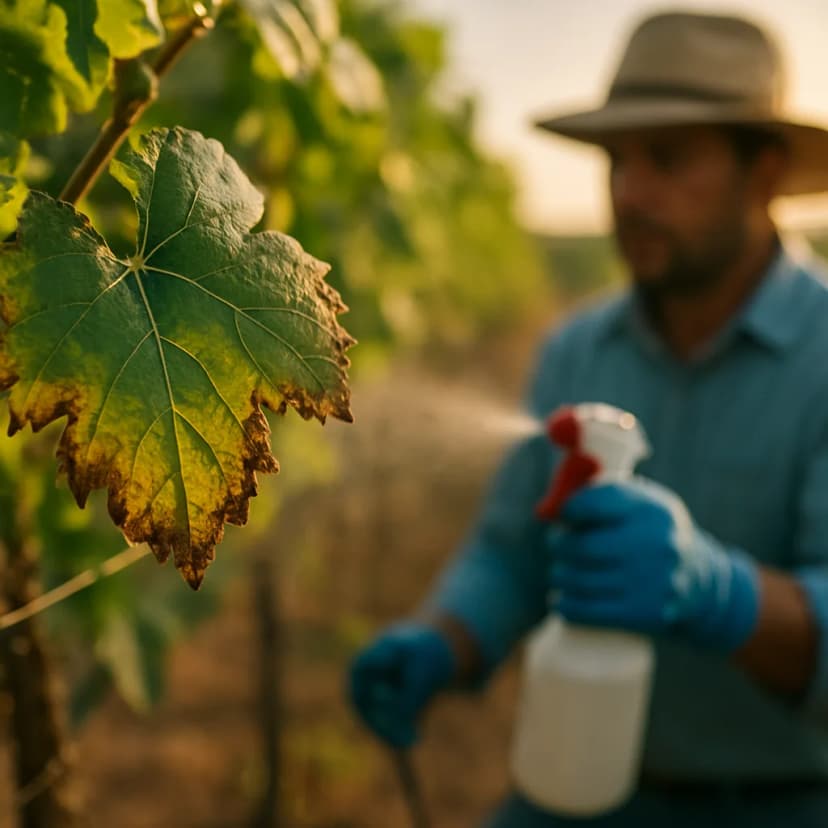
However, these mechanisms carry an energy cost that can reduce growth and production. In sensitive varieties, such as Thompson Seedless, chloride damage manifests as marginal necrosis on mature leaves.
Salt management must consider not only potassium but also the balance with calcium (Ca²⁺) and magnesium (Mg²⁺). An excess of Na⁺ in the cation exchange complex displaces Ca²⁺ and Mg²⁺, worsening compaction and reducing infiltration. In this context, amendments with gypsum (calcium sulphate) followed by leaching are a widespread practice for reclaiming sodic soils, as described in technical guides from ATTRA and Agrocabildo.
Salinity diagnosis: soil, water and plant analysis
Accurate diagnosis is the basis for any management strategy. Soil analysis (saturated extract, EC, pH, exchangeable cations), irrigation water analysis (EC, sodium adsorption ratio - SAR, chlorides, boron) and leaf or petiole analysis to assess the nutritional status of the vine are recommended. Combining these data makes it possible to determine whether the problem is salinity, sodicity or both.
Tolerance thresholds vary according to rootstock and variety. In general, the vine is considered moderately tolerant to salinity: above a certain EC value of the saturated extract, yield suffers, and the magnitude of that loss depends on the rootstock, the soil type and irrigation management. For irrigation water, it is suggested to keep EC below 1.5 dS/m to avoid excessive accumulation in the wetting bulb. As for chlorides, the limit of 0.6 g/L in wine (mentioned in Argentine regulations) is a reference point for avoiding organoleptic defects.
It is crucial to monitor soil EC throughout the cycle, especially after each irrigation or rainfall event. Moisture and salinity sensors allow the frequency and volume of leaching to be adjusted. In vineyards with drip irrigation, salt accumulation occurs at the periphery of the bulb, so sampling must be carried out in the active root zone.
Salt management strategies and improved potassium uptake
Integrated salt and potassium management in the vineyard combines cultural practices, amendments and adjustments to fertigation. The most effective strategies are detailed below:
- Salt leaching: apply extra water volumes to displace salts out of the root zone. It requires efficient drainage to prevent capillary rise. Leaching is recommended in winter or during periods of low evaporative demand.
- Calcium amendments: in sodic soils, the application of agricultural gypsum (2-5 t/ha) followed by leaching improves structure and facilitates sodium leaching. Calcium displaces Na⁺ from the exchange complex.
- Choice of tolerant rootstocks: rootstocks such as 1103 Paulsen, 140 Ruggeri or Ramsey show greater exclusion of Na⁺ and Cl⁻, maintaining K⁺ uptake better under saline conditions.
- Split fertigation: apply potassium in small, frequent doses, adjusted according to analysis. Avoid fertilizers with a high salinity index (such as KCl) and prefer K sources with low saline impact (potassium sulphate, potassium nitrate).
- Use of biostimulants: seaweed and microalgae extracts can improve tolerance to salt stress and favour nutrient uptake. Organic agricultural biostimulants help to maintain ionic balance and root activity.
- Irrigation management: use high-frequency drip irrigation to maintain constant moisture and prevent salt concentration. Scheduling must be based on crop evapotranspiration.
Managing potassium at critical phenological stages
Potassium demand in grapevines varies throughout the cycle. The critical stages are: budburst, flowering-fruit set, veraison and ripening. During flowering and fruit set, K⁺ is essential for cell division and the development of reproductive organs. At veraison, potassium promotes sugar accumulation and anthocyanin synthesis. During ripening, it contributes to osmotic regulation and must quality.
In saline soils, K⁺ uptake may be limited precisely at these stages, so it is recommended to adjust the doses and split the applications. For example, at flowering a low K dose (20-30 kg K₂O/ha) can be applied together with biostimulants that improve stress tolerance. At veraison, increase to 40-50 kg K₂O/ha, always monitoring soil EC to avoid unwanted increases.
It is important to avoid excessive potassium applications, as they can induce magnesium and calcium deficiencies through antagonism, as well as increase soil salinity. Nutritional balance is key. Fulvic acids for organic farming can improve the availability of K⁺ and other cations, forming complexes that facilitate their uptake.
For more detailed management, you can consult Ecoganic's fertilization programme for grapevines, which includes recommendations by phenological stage and adaptations for salinity conditions.
Related articles
- Foliar uptake in almond trees: 2026 changes
- Mycorrhizae in organic citrus: benefits and management
- Microalgae against salts in citrus: harvest data
Do you need professional help?
At Ecoganic in Spain, Europe, we offer biostimulants and organic fertilizers. Call us: +34 623 753 719.
Request your free quote
How does salinity affect potassium uptake in grapevines?
Salinity affects potassium uptake because sodium (Na⁺) competes with K⁺ for membrane transporters in the roots. In addition, chloride (Cl⁻) can cause toxicity and damage the root system. As a result, the plant takes up less potassium, which translates into nutritional imbalances, lower grape quality and reduced yield. Proper irrigation management and amendments can mitigate this effect.
What levels of electrical conductivity (EC) are tolerable in the soil for vineyards?
Grapevines are moderately tolerant to salinity. Above a threshold EC of the saturated extract, yield may suffer, and the magnitude of that loss depends on the rootstock, the variety, the soil texture and irrigation management. It is essential to monitor EC regularly and adjust irrigation management to keep it at optimal levels.
How can potassium uptake be improved in saline soils?
To improve potassium uptake in saline soils, it is recommended to: 1) carry out salt leaching with good-quality water and adequate drainage; 2) apply calcium amendments such as gypsum to displace sodium; 3) choose salinity-tolerant rootstocks; 4) split potassium fertilization and use sources with a low salt index; 5) incorporate biostimulants that relieve stress and favour root activity. These combined practices help maintain balanced nutrition.
Which rootstocks are most recommended for vineyards with salinity problems?
The rootstocks with greater salinity tolerance include 1103 Paulsen, 140 Ruggeri, Ramsey and 1613 C. These have the ability to partially exclude Na⁺ and Cl⁻, maintaining better uptake of potassium and other nutrients. The final choice depends on the soil type, the grafted variety and the climatic conditions. It is recommended to consult a technical adviser to select the most suitable rootstock.
In summary, salt management in vineyards and the optimisation of potassium uptake require an integrated approach that combines diagnosis, cultural practices and balanced nutrition. To receive personalised advice, Ecoganic field trials and results and the Ecoganic distributor network are at your disposal. Request your free quote and improve the sustainability and profitability of your vineyard.
Managing salts in vineyards: potassium uptake
Potassium (K) is one of the most abundant cations in the grape and plays critical roles in sugar synthesis, osmotic regulation and must quality. However, in soils with high electrical conductivity (EC), K uptake by the vine may be reduced due to ionic competition with sodium (Na⁺), calcium (Ca²⁺) and magnesium (Mg²⁺). This interference occurs because Na⁺ can compete with K⁺ in the root transport systems: when Na⁺ dominates over K⁺ in the soil solution, it can partially slow its entry into the root. In vineyards with moderate salinity, this may be reflected in lower K concentrations in petioles at flowering, which in turn may affect must pH and acidity and increase the risk of acid imbalances.
Early diagnosis is key. Foliar analysis at veraison (sampling of petioles opposite the first cluster) must be interpreted using the laboratory's reference ranges, taking into account the salinity of the plot, so it is advisable to ask the laboratory for the interpretation table applicable to the variety and the area. In parallel, the K/Na ratio in the leaf should be monitored closely: the lower its values, the greater the potential risk of yield losses. As for the soil, the sodium adsorption ratio (SAR) and the EC of the saturated extract help to anticipate K availability: with high SAR and EC, part of the potassium applied as fertilizer may not be taken up by the root.
Management strategies should combine amendments, split fertilization and controlled leaching practices. The application of agricultural gypsum (calcium sulphate) in autumn, at the rate determined by the agronomist based on soil analysis, reduces exchangeable Na⁺ in sodic soils and can thus improve the conditions for K uptake at the following budbreak; in organic production, it is advisable to confirm with the certification body which origin of gypsum is permitted. In fertigation, it is recommended to split K into several applications from fruit set to veraison, using low-salinity-index sources such as potassium sulphate (K₂SO₄) instead of potassium chloride (KCl), which has a higher salinity index and supplies chlorides. Rates should be guided by petiole and soil analysis and adjusted each season. Leaching of salts through leaching irrigations, with a leaching fraction calculated by the agronomist, should preferably be carried out in winter or after harvest, avoiding the washing of K into deeper layers.
Organic matter and biostimulants can help to coexist with salt stress. The incorporation of mature compost, at the frequency and rate recommended by the agronomist, improves soil structure and increases cation exchange capacity (CEC), which can reduce ionic competition and facilitate K uptake. Seaweed extracts (Ascophyllum nodosum) applied by foliar application before veraison, according to the product label, are proposed as support for the general vigour of the vine under high EC conditions, although their effect depends on the product, the variety and the plot and must be verified with untreated control plots. These practices should be combined with water management adjusted to the crop stage and water quality; regulated deficit irrigation, for example, requires close monitoring of salt accumulation in the root zone. In summary, salt management in vineyards does not consist of eliminating Na⁺, but of managing the Na/K ratio so that the vine maintains sufficient potassium uptake for oenological quality.