Introduction: phosphorus and the avocado root
Phosphorus deficiency in avocado is one of the nutritional limitations that can most affect root development and crop growth. Phosphorus is an essential macronutrient involved in energy transfer within the plant, in the formation of nucleic acids and membranes, and in cell division and elongation. When this element is scarce, the plant prioritises its survival and reduces the emission of new roots, which can trigger a vicious circle: fewer roots, less soil exploration and, therefore, less capacity to absorb water and other nutrients.
Avocado (Persea americana) generally develops best in well-aerated soils with good organic matter. In highly weathered soils with a very acid reaction, phosphorus can be retained along with iron and aluminium; in calcareous soils it can precipitate as calcium phosphate. In both cases phosphorus is present in the soil, but not in a form available to the root. The result can be a tree with weak roots, short shoots, small leaves and production that suffers in the medium term. Addressing phosphorus deficiency in avocado requires an integrated approach: correct diagnosis, improvement of soil fertility and biostimulation of the root.
This article reviews the symptoms, causes, diagnosis and management criteria, with particular attention to the use of biostimulants and organic fertilisers to contribute to phosphorus uptake efficiency and a vigorous root system. It is a general guide, without figures or specific cases: doses and application timings are always those of each product's technical data sheet and those recommended by the technician, and results depend on the crop, the soil, the water and the management.
Why the root is at the centre of the problem
Avocado has a relatively shallow and delicate root system, highly dependent on soil oxygen. Any factor that limits the emission of new roots, whether lack of phosphorus, compaction or waterlogging, immediately translates into less soil exploration and a tree that grows less. That is why, with a poorly growing avocado, the useful question is not only what it lacks, but why the root is not working as it should.
Visual symptoms of phosphorus deficiency in avocado
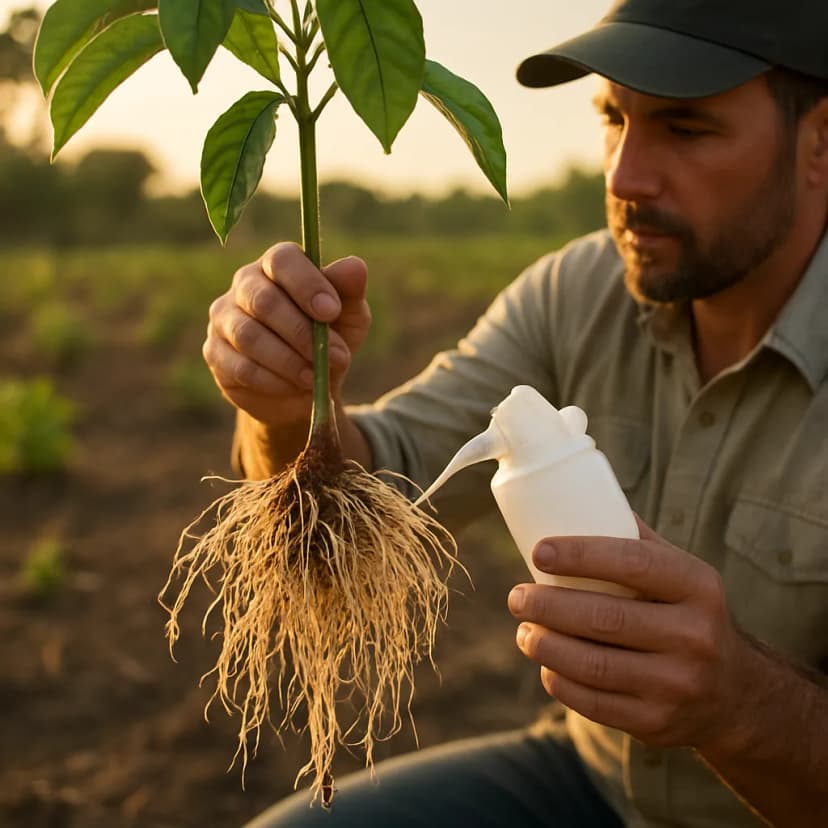
Phosphorus is a mobile nutrient within the plant. When there is a deficiency, the plant tends to redistribute it from mature leaves to young growing tissues. This is why the first symptoms usually appear on the oldest leaves, although in avocado the symptomatology can be subtle and confused with other deficiencies or with root problems. Visual observation guides, but it should never be the sole basis for a decision.
Leaves and shoots
Affected leaves are usually described as a dull dark green, sometimes with bronzed or purplish tones on the underside and on the veins. In severe cases they may become small and narrow and fall prematurely. New shoots are short and the tree canopy loses density. Reddish or purple colourations may be observed on the petioles and veins, although this symptom does not always appear and may depend on the variety and on temperature conditions.
Root system
The most decisive symptom is usually the weak root: the tree emits few new roots, the absorbing roots are scarce and the root system becomes shallow. This limits soil exploration and reduces the absorption of water and nutrients, which in turn accentuates water stress. In the field, slow growth is observed, with trees that do not finish establishing after transplanting and that show lower tolerance to drought.
Growth and production
Vegetative growth is notably reduced: young trees take longer to come into production and mature trees show poorer sprouting. Flowering may be abundant but with low fruit set, and the fruits may be of smaller calibre. In short, phosphorus deficiency in avocado compromises the productivity and longevity of the plantation.
Symptoms that are confused with other problems
Small leaves, slow growth and dull colouration may also be due to compaction, waterlogging, salinity, other deficiencies or root health problems. It is therefore prudent to always combine three sources of information: what is seen in the canopy, what is seen in the root and what soil and leaf analyses say. If all three point in the same direction, the diagnosis is far more reliable than if only leaf colour is considered.
Causes of phosphorus deficiency in avocado
Phosphorus deficiency is rarely due to a total absence of the element in the soil, but rather to its low availability. Phosphorus is a poorly mobile nutrient and tends to remain in forms that the plant cannot use. The most common causes are the following.
Inadequate soil pH
In very acidic soils, phosphorus may be retained together with iron and aluminium, forming poorly soluble compounds. In very calcareous soils, it may precipitate as calcium phosphate. Avocado usually develops better in soils with a slightly acidic reaction, where phosphorus availability is greater, although the suitable range for each plantation must be set with the analysis and with the technician. This is why a pH far from the appropriate level is a frequent cause of phosphorus deficiency in avocado.
Low organic matter and low soil biological activity
Soil organic matter is an important source of organic phosphorus and favours the microbial activity that releases it in usable forms. Degraded soils, with little organic matter and impoverished microbial life, have a lower capacity to recycle phosphorus. Soil bacteria and fungi capable of solubilising phosphates are key pieces for transforming poorly available forms into others that the root can indeed absorb.
Fixation and losses
In sandy soils, phosphorus may be lost with drainage water, although it is less mobile than nitrogen. In clay soils with a high retention capacity, phosphorus applied as fertiliser may become fixed and not reach the root. In addition, intensive tillage and the lack of vegetation cover contribute to the loss of organic matter and to the degradation of soil structure, which aggravates the problem.
Competition between nutrients
An excess of some elements, such as zinc, iron or calcium, can interfere with phosphorus absorption. Likewise, a root system damaged by waterlogging, compaction, soil pests or health problems reduces absorption capacity and can simulate a phosphorus deficiency. It is therefore advisable to rule out these causes before increasing fertiliser inputs.
Diagnosis: soil and leaf analysis
The diagnosis of phosphorus deficiency in avocado should combine the observation of symptoms in the field with laboratory analyses. Soil analyses allow the availability of phosphorus to be estimated using extraction methods that must be chosen according to the type of soil, for example depending on whether it is acidic or calcareous; the laboratory will be able to indicate which one is appropriate. It is important to interpret the results according to the type of soil and the method used, since reference values vary from one method to another and are not interchangeable.
Leaf analysis
Leaf analysis is a complementary tool that reflects the real nutritional status of the tree. Sampling mature leaves of uniform age is recommended, at a similar position in the canopy and always at the same point in the cycle, following the laboratory's instructions. The results should be compared with the reference ranges for avocado provided by the laboratory or the agronomist. A level below the reference range suggests a deficiency and justifies investigating the cause, but the result from a single year or a single sample should be interpreted with caution.
Observation of roots and soil
The careful excavation of a small inspection pit in the drip zone allows the presence of absorbing roots to be assessed and compaction, waterlogging or root damage to be detected. A compacted soil or one with poor drainage limits root development and aggravates phosphorus deficiency. It is worth paying attention to the colour and smell of the soil, the structure, the depth reached by the roots and whether these are white and firm or darkened and soft.
How to organise the diagnosis
A simple sequence helps to avoid skipping steps and to avoid deciding on impression:
- Record the symptoms observed, with photographs and the date, and locate on the plan which trees or areas are affected.
- Dig and check the real state of the root and of the drainage in those trees and in others that look healthy, in order to compare.
- Take soil and leaf samples, both from the affected area and from a reference area without symptoms.
- Review the fertilisation, amendment and irrigation history of the plot before interpreting the analyses.
- Ask the agronomist to integrate all the data before deciding what to correct and in what order.
Correction strategies with biostimulants and organic fertilisation
The management of phosphorus deficiency in avocado must be approached from a comprehensive perspective: improving phosphorus availability in the soil, favouring root development and optimising uptake. Biostimulants and organic fertilisers can form part of this approach, always within a plan based on diagnosis and without expecting a single product to solve everything.
Organic phosphorus inputs and amendments
Organic fertilisers rich in phosphorus, such as those made from guano, bone meal or natural phosphates, provide slow-release phosphorus. Before using them, it is advisable to check that they are permitted in the holding's production system and to consult their technical data sheet. It is recommended to apply them in the drip zone, lightly incorporated or by fertigation where the product allows it, so that the phosphorus is close to the active roots. Combining them with composted organic matter improves soil structure and favours microbial activity.
Microalgae and fulvic acid biostimulants
Biostimulants made from microalgae extracts and fulvic acids can contribute to nutrient uptake and root development. Fulvic acids can form complexes with metal ions and help make phosphorus more available in the root zone. Microalgae provide bioactive compounds, such as polysaccharides and amino acids, which can contribute to the emission of lateral roots and absorbent hairs. The timing and dose of application are those given in the product's technical data sheet and those recommended by the technician, and the results depend on the soil, the water and the management.
Soil microorganisms that favour phosphorus
Inoculation with bacteria and fungi capable of solubilising phosphates, as well as with mycorrhizae, is a strategy that can help make the phosphorus retained in the soil more available. These organisms can release organic acids that modify the root environment, and mycorrhizae extend the reach of the root and facilitate uptake in soils with low availability. Their establishment depends on the soil offering favourable conditions, that is, organic matter, stable moisture and good aeration, so they do not work the same way on all plots.
pH management and liming
If the soil is excessively acidic, it can be corrected with calcareous amendments, such as agricultural lime or dolomite, to bring the pH closer to the suitable range. In calcareous soils, localised acidification using elemental sulphur or organic acids can improve phosphorus availability. However, these practices must be based on a soil analysis, applied with caution and follow the technician's guidance so as not to unbalance other nutrients.
Irrigation and soil management
Maintaining adequate moisture without waterlogging is essential for root development. Localised drip irrigation allows fertilisers and biostimulants to be applied efficiently. Vegetative cover or organic mulching helps to conserve moisture, regulate soil temperature and favour biological activity. None of these practices replaces diagnosis, but all of them help the root to work in better conditions.
Comparison with conventional chemical fertilisers
Conventional chemical fertilisers, such as superphosphates, supply phosphorus in soluble forms that can be absorbed quickly by the plant. Their advantage is immediate availability and the predictability of the composition. Their limitation is that, in soils with an unsuitable pH, a significant part of the applied phosphorus can become fixed and out of reach of the root, which reduces use efficiency. In addition, the continued use of synthetic fertilisers, without inputs of organic matter, can contribute to a gradual loss of biological activity and structure in the soil.
In contrast, the approach with biostimulants and organic fertilisers seeks to improve phosphorus availability through biological activity and soil structure. Fulvic acids and phosphate-solubilising microorganisms can contribute to the absorption efficiency of the applied phosphorus, whether of organic or mineral origin. Their disadvantage is that release is slower and less predictable, and that their result depends to a greater extent on soil conditions, moisture and temperature, so it requires more monitoring and patience.
In organic production, synthetic fertilisers are not permitted, so the comparison is theoretical and the approach must be based on permitted inputs. On a conventional holding, it is not a question of completely replacing conventional fertilisers, but of assessing whether integrating biological tools allows inputs to be adjusted better and nutritional efficiency to be improved. For a high-value crop such as avocado, combining balanced fertilisation with good root biostimulation may be an option worth evaluating on the holding itself, with a control that allows comparison.
How to decide between alternatives
- If the analysis shows a pH far from the desirable range, start by correcting it before increasing the phosphorus supplied.
- If the soil has little organic matter, prioritise organic inputs and mulching before new products.
- If the root is damaged by water or by health problems, resolve that cause first and consult the technician.
- If you want to evaluate a biostimulant, leave control trees under the same management so that you can compare.
- If there are doubts about which inputs are permitted, ask the certification body before buying.
Prevention and agronomic management
Avoiding phosphorus deficiency in avocado involves maintaining healthy soil and a vigorous root system. Some recommended practices are:
- Carry out soil and foliar analyses periodically to adjust fertilisation.
- Keep soil pH within the desirable range, applying amendments when the analysis indicates it.
- Supply organic matter regularly, such as compost, mature manure or mulches, to improve structure and microbial activity.
- Avoid excessive tillage and soil compaction.
- Use root biostimulants at key times, such as transplanting or the start of bud break, following the product's technical data sheet.
- Manage irrigation efficiently, avoiding waterlogging and prolonged droughts.
- Monitor the health status of the root and consult the technician at any suspicion.
Implementing an organic fertilisation programme, adapted to local conditions and to the crop's phenology, allows problems to be anticipated and the tree to be kept in a balanced nutritional state. An orderly record of analyses, inputs, amendments and observations of root and canopy is the best tool for adjusting the programme from one year to the next.
Related articles
Do you need professional help?
At Ecoganic we offer biostimulants and organic fertilisers. Contact our technical team to assess your case.
Request your free quote
Frequently asked questions
How does phosphorus deficiency manifest in avocado?
Phosphorus deficiency in avocado is usually associated with dull dark green leaves, short shoots, small leaves and a sparse canopy. The most decisive symptom is usually in the root, with poor emission of feeder roots, which limits growth and the uptake of water and nutrients. As the symptoms are non-specific and are confused with other problems, it is advisable to confirm them with analyses before acting.
What is the best time to apply root biostimulants in avocado?
It depends on the product, the climate and the condition of the tree, so it is advisable to follow the technical data sheet and the technician's judgement. Many programmes are planned around transplanting and the start of budbreak periods, when the plant needs to emit new roots. In areas with a defined rainy season, it is usually more convenient to apply to the soil at that time, always without waterlogging.
What phosphorus dose is recommended to correct the deficiency in avocado?
The phosphorus dose must be based on soil and leaf analysis and on the age of the tree, not on a general figure. In young trees, moderate amounts of an approved phosphate fertiliser are usually applied, while in mature trees it is adjusted according to what the crop extracts. It is important to split the application and always consult a technical adviser to adapt it to each case.
How does soil pH interact with phosphorus availability?
Soil pH directly affects phosphorus availability. In very acidic soils phosphorus tends to be retained together with iron and aluminium, and in very calcareous soils it tends to precipitate as calcium phosphate. Correcting the pH with suitable amendments and following the analysis can improve the efficiency of phosphate fertilisation.
Can I combine synthetic fertilisers with biostimulants to manage phosphorus deficiency?
In conventional holdings the combination is a common practice, whereas in organic production synthetic fertilisers are not approved and permitted inputs must be adhered to. Biostimulants can contribute to nutritional efficiency and root development, but their results depend on the soil, the water and the management. In any case, doses should be adjusted with the technician and excesses that cause imbalances with other nutrients should be avoided.
How can a phosphorus deficiency be distinguished from a root problem?
Both situations can produce similar symptoms in the canopy, such as slow growth and small leaves. The difference is clarified by carefully digging in the drip zone to observe the state of the roots and combining that observation with soil and leaf analyses. If the root is damaged by waterlogging or by health problems, correcting only the fertilisation will not resolve the origin and the technician should be consulted.