Learn how to protect flower set in mango under high temperatures with biostimulation strategies and agronomic management. Optimise your production.
Introduction
Flower set in mango is one of the most sensitive processes of the production cycle, especially when temperatures exceed critical thresholds during flowering. In tropical and subtropical regions of Latin America, where mango is a crop of great economic importance, increasingly frequent heatwaves are causing significant losses in fruit set. This technical article, prepared by Ecoganic, explains the physiological mechanisms of heat stress and offers practical strategies based on biostimulation and agronomic management to protect fruit set.
The problem is not a minor one: when nights exceed 20 °C and days reach or exceed 30–35 °C, pollen viability decreases, stigma receptivity is reduced and the abortion of flowers and newly set fruit increases. These conditions, increasingly common in mango-producing areas of Peru, Mexico, Colombia and Brazil, require the grower to adopt preventive and corrective measures. Throughout this article, we will present technical data, management recommendations and the role of biostimulants as key tools for maintaining productivity.
The impact of heat stress on mango flowering
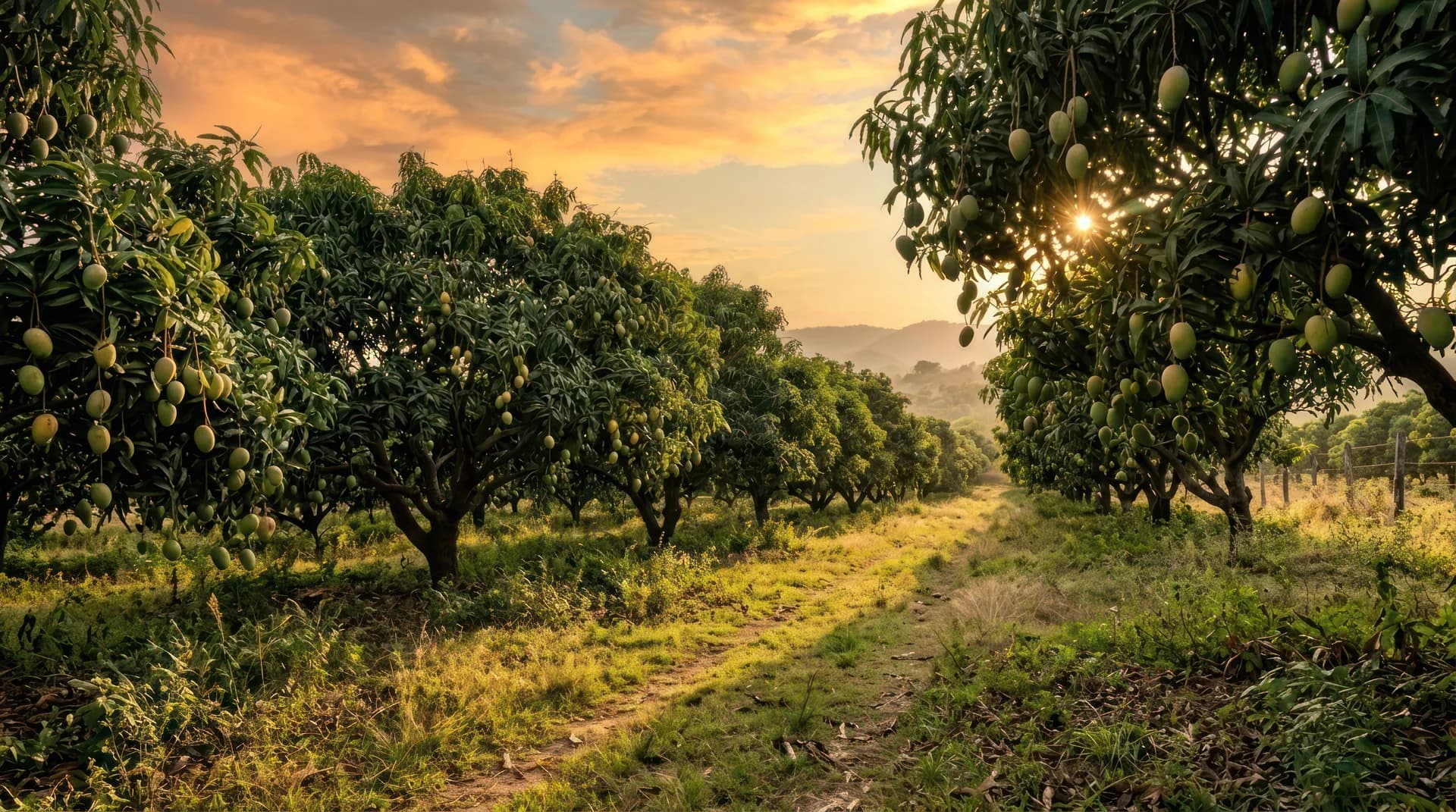
Mango (Mangifera indica L.) is a species adapted to warm climates, but its reproduction is extremely sensitive to extreme temperatures. Under these conditions, lower pollen germination, slower pollen tube growth and a higher probability of abortion of the fertilised ovule are observed.
In the Canary Islands, for example, it has been documented that temperatures below 15.6 °C during full bloom also cause embryo abortion and the typical drop of newly set fruit. This shows that mango requires an optimal temperature range, and that both cold and extreme heat are detrimental. In Latin America, heatwaves are increasingly intense and prolonged, often coinciding with mango flowering, which generates losses that can exceed 50% in critical years.
Critical temperature thresholds
Agronomic studies agree that the optimal range for mango flowering and fruit set is between 15 °C and 30 °C, with cool nights (below 20 °C) favouring pollen viability. When daytime temperatures exceed 35 °C, dehydration of the stigma and enzymatic inactivation drastically reduce fertilisation. In addition, heat accelerates flower senescence, shortening the window of opportunity for pollination.
It is important that the grower monitors temperatures during flowering and is prepared to apply mitigation measures when heatwaves are forecast. The installation of local weather stations and the use of early warnings are increasingly accessible and recommended tools.
Physiological mechanisms of floral abortion and fruit drop
Heat stress affects multiple physiological processes in the mango plant. First, it reduces pollen viability: high temperatures damage the proteins and enzymes required for germination, resulting in a lower number of viable pollen grains. Second, heat affects stigma receptivity, which becomes less sticky and less able to retain pollen. In addition, pollen tube growth along the style slows down, and in many cases it fails to reach the ovule before the ovule degrades.
Another key mechanism is the increase in respiration and transpiration, which causes a hormonal imbalance. It has been observed that heat stress increases the synthesis of ethylene and abscisic acid (ABA), while decreasing the levels of auxins and gibberellins, hormones essential for fruit set and early fruit development. This hormonal imbalance leads to flower abortion and to the drop of fruits less than 2 cm in diameter.
The role of photoassimilates
During fruit set, mango depends on the carbohydrate reserves accumulated in leaves and branches. High temperatures increase respiration, consuming more carbohydrates and reducing availability for fruit development. In addition, heat-induced water stress reduces photosynthesis, limiting the production of new photoassimilates. This competition for resources between vegetative and reproductive growth aggravates fruit drop.
Foliar application of biostimulants containing amino acids, fulvic acids and micronutrients such as calcium and boron can help maintain hormonal balance and improve the partitioning of assimilates towards developing fruits. These products act as metabolic regulators, favouring protein synthesis and the enzymatic activity required for fruit set.
Agronomic strategies to mitigate heat stress
Faced with the threat of extreme heat, the mango grower can adopt several agronomic strategies. One of the most effective is irrigation management: maintaining adequate soil moisture during flowering and fruit set is essential to reduce water stress. However, it is important to avoid excess water, which can favour root diseases. Drip irrigation with short frequencies and volumes adjusted to evapotranspiration demand is recommended by specialists.
Another strategy is the application of physical protectors such as kaolin, which is sprayed onto the tree canopy and forms a reflective barrier that reduces leaf and fruit temperature by 3–5 °C. Although it is not specific to mango, this technique has shown positive results in other fruit trees and can be a complementary tool in areas of very high radiation.
Pruning and planting density management
Proper pruning can improve ventilation and reduce the temperature inside the canopy, creating a microclimate more favourable for flowering. Removing internal branches and opening up the centre of the tree allows light to penetrate better and air to circulate, reducing humidity and accumulated heat. In very dense plantations, thinning is recommended to avoid competition for water and nutrients.
The selection of heat-tolerant varieties is another preventive measure. Although most commercial varieties are sensitive, some such as 'Kent' and 'Tommy Atkins' have shown some relative tolerance. The use of rootstocks adapted to warm conditions can also make a difference.
Biostimulants and key nutrition for fruit set
The application of biostimulants is one of the most promising tools for improving mango fruit set under heat stress. These products, which include seaweed extracts, amino acids, humic and fulvic acids, and micronutrients, act on the plant's physiological processes, increasing its stress tolerance and favouring reproductive development.
These products contain natural phytohormones such as cytokinins and auxins, which counteract the negative effects of heat stress.
Essential nutrients: calcium, boron and phosphorus
Calcium is a key nutrient in fruit set, as it participates in cell wall formation and in the stability of young tissues. Foliar application of calcium at doses of 150–250 g/hl during flowering can reduce physiological fruit drop. Boron, for its part, is essential for pollen germination and pollen tube growth; its deficiency is common in tropical soils and can be corrected with foliar boron applications at doses of 100–200 g/hl.
Phosphorus also plays an important role in the transition to fruit set, as it participates in energy metabolism and in nucleic acid synthesis. The application of fast-release phosphorus fertilizers, such as monopotassium phosphate, at doses of 2–3 kg/ha, can support early fruit development.
Managing irrigation and nutrition under heat conditions
Integrated irrigation and nutrition management is crucial to minimise the impact of heat stress on fruit set. During flowering, it is recommended to maintain soil moisture close to 80% of field capacity, avoiding both deficit and excess. Moderate water stress can induce flowering, but severe stress during fruit set causes fruit drop.
As for nutrition, it is important to ensure a balanced supply of potassium, which regulates the opening and closing of stomata and improves tolerance to water stress. Potassium is also involved in the transport of sugars to the fruits, improving their quality. Applying potassium at rates of 200–300 kg/ha, split during flowering and fruit set, is a recommended practice.
Fulvic acids, such as those present in FULVEX 50S from Ecoganic, improve the availability of nutrients in the soil and their uptake by the plant, especially under stress conditions. Their root application at rates of 1.5–2.5 kg/ha can increase the efficiency of the fertilization programme.
Related articles
- Till-up: biostimulant for fruit set and fruit filling
- Floral biostimulation in avocado with microalgae
- Managing heavy rainfall with microalgae in organic banana
Do you need professional help?
At Ecoganic in Spain, Europe, we offer certified organic biostimulants and fertilizers. Call us: +34 623 753 719.
Request your free quote
Frequently asked questions about fruit set in mango
When is fruit set most critical in mango? The most sensitive window runs from pre-flowering (panicles of 5–10 cm) to initial fruit set (fruits of 1–2 cm). During this period, any heat or water stress can cause significant losses.
At what temperature do problems start? Night temperatures above 20 °C and daytime temperatures above 30–35 °C during flowering are critical. In the Canary Islands, embryo abortion has been observed at temperatures below 15.6 °C, which indicates that the optimum range is narrow.
Is it worth applying amino acids when it is already hot? Yes, amino acids help the plant cope with stress, but they do not on their own correct heat damage if flowering is already compromised. It is better to apply them preventively before the heatwave.
Is it advisable to irrigate more to ensure fruit set? Not necessarily. Mango requires moderate water stress to induce flowering, but excess or deficit during fruit set can worsen fruit drop. Irrigation must be regulated according to climatic demand.
Conclusions and final recommendations
Flower fruit set in mango under high temperatures is a growing challenge for Latin American growers. However, the combination of appropriate agronomic management, the use of biostimulants and balanced nutrition can significantly reduce losses. It is essential to monitor temperatures, adjust irrigation and apply products that favour reproductive physiology.
Fruit set in mango under heat stress: physiological strategies and agronomic management
Fruit set in mango (Mangifera indica L.) is one of the phenological processes most sensitive to temperature variations. When daytime temperatures are very high during flowering, pollen viability can be markedly reduced and germination can decline. In addition, excessive heat can also hinder fertilization, which can translate into lower fruit formation. Under field conditions, the greater the excess heat during anthesis, the greater the loss of fruit set tends to be, with important differences depending on the variety and the tree's prior water status. It is therefore advisable to know the thermal behaviour of each farm at flowering time before deciding which measures to take.
Among the physiological explanations put forward for this loss of productivity are a possible alteration in polyamine synthesis and the accumulation of reactive oxygen species (ROS) in floral tissues. On farms in the dry tropics, the use of amino acid-based biostimulants, such as proline and glycine betaine, applied by foliar application at pre-anthesis and full bloom, is proposed, with the aim of supporting flower retention and final fruit set. These compounds are described as osmoprotectants: they could help stabilise cell membranes and maintain the turgor of floral tissue when the air reaches temperature peaks for several hours in a row. This is, in any case, a possible support, and the dose and frequency must always be adjusted to what the product label states. In organic production, it is advisable to confirm beforehand with the certification body that the product is approved. The sensible approach is to check the effect on the farm itself, comparing with untreated control trees.
Another critical factor is the management of irrigation and environmental humidity. Under heat stress, mango transpiration increases, but root uptake may be limited by the high evaporative demand. Intermittent micro-sprinkling during the hottest hours of the day can help temper the microclimate around the flowering, provided it is managed sensibly so as not to waterlog the soil or wet the flowers excessively. This practice should be combined with balanced nutrition: an excess of nitrogen favours vegetative growth to the detriment of fruit set, while an adequate supply of potassium and calcium through fertigation during flowering can contribute to a better condition of the floral tissues. The specific amounts depend on soil and leaf analysis, and it is not advisable to set them from memory or copy them from another farm.
From a practical perspective, it is recommended to implement a thermal monitoring protocol with local weather stations and to adjust, with the management tools authorised in each area, the timing of floral induction so that flowering coincides with periods of milder temperatures. In regions where extreme heat is inevitable, some programmes combine biostimulants with silicon and with other support compounds against abiotic stress; their usefulness varies from farm to farm and must be validated in a trial plot before extending them; in organic production, it is also advisable to confirm that they are approved. Finally, severe pruning during flowering should be avoided, since the emission of vegetative shoots can compete with the flowers for carbohydrates and water. Light thinning pruning, which removes unproductive branches, can improve aeration and light penetration and contribute to a more stable microclimate for fruit set.
Related articles
- Organic agricultural biostimulants
- Certified organic fertilizers