1. Introduction
The post-harvest checklist for bananas is an essential tool for producers seeking to export successfully. This process encompasses everything from harvesting to delivery to the buyer, and each step must meet strict standards of quality and safety. In Latin America, bananas are one of the main export products, and their post-harvest management determines acceptance in international markets such as Europe and North America. The value of the global banana trade has experienced sustained growth over the last decade, driven by consumer demand for nutritious and versatile products. This growth has raised quality standards, transforming post-harvest into a key competitive differentiator for producers wishing to position themselves in premium markets. For more information visit Ecoganic.
A well-executed post-harvest checklist for bananas reduces losses, improves profitability, and strengthens the producer's reputation. However, many farmers are unaware of the specific requirements of international buyers, leading to rejections and returns. In this article, we present a practical guide, based on technical standards and field experience, to help you verify if your bananas are ready for export. Rigorously adhering to this checklist not only minimises the risks of rejection but also optimises the operational efficiency of the farm by standardising processes and reducing variability in the quality of the final product.
2. Physical quality and field selection
The physical quality of the banana is the first filter in the post-harvest checklist for bananas. International buyers demand fruit with specific characteristics in size, shape, and appearance. Mechanical damage and healed insect scars must not exceed 5% of the surface area. Additionally, the fruit must be free from bruises, cracks, latex stains, and pests. The initial visual assessment in the field is a process that requires trained personnel who can quickly identify fruit that does not meet the standards, thus preventing it from entering the processing chain and affecting the overall efficiency of the system.
Calibre and length
Calibre and length are critical parameters that determine the commercial classification of the fruit. Generally, a minimum length of 25 to 28 cm and a calibre of 38 to 40 mm are recommended. These values may vary depending on the market and the buyer, so it is essential to know the client's specifications. For example, in Europe, larger calibre bananas are preferred, while smaller calibres are accepted in other markets. The calibre is measured with a specific caliper placed at the central part of the finger, and it is important that workers are trained to perform these measurements consistently. The uniformity of calibre within the same bunch is also a factor that buyers evaluate, as high variability complicates uniform packing and may lead to partial rejections of the lot.
Degree of ripeness
The fruit should be harvested at the commercial ripeness stage, that is, physiologically ripe but firm. If harvested too green, it will not ripen properly; if harvested overripe, it will be damaged during transport. Ripeness is assessed by the colour of the peel and the starch content, among other indicators. The finger filling index, determined by the roundness of the edges, is a practical field indicator: fingers with angular edges are immature, while rounded fingers indicate a higher degree of filling. For export, it is recommended to harvest when the fingers show a filling of 75% to 80%, which corresponds to a physiological ripeness state that allows for uniform ripening during transport and marketing. Measuring starch content in the laboratory can complement the visual assessment, but in the field, the experience of the harvester remains the most determining factor.
Defects and damage
Fingers with mechanical damage, scars, insects, stains, or deformities must be rejected. Additionally, the crown must be cut cleanly, without remnants of damaged tissue. Field handling must be careful to avoid bruises and scratches, using appropriate tools and cushioned containers. Workers should wear cotton gloves when handling the fruit to avoid transferring oils and dirt that may cause stains. Wounds on the peel, even microscopic ones, are entry points for pathogens such as Colletotrichum musae, the causal agent of anthracnose, which can manifest during transport and cause significant losses. Furthermore, scars from rubbing against leaves or stems must be carefully evaluated, as while they may be cosmetically acceptable in some markets, in others they may lead to rejection.
3. Immediate handling and washing/disinfection
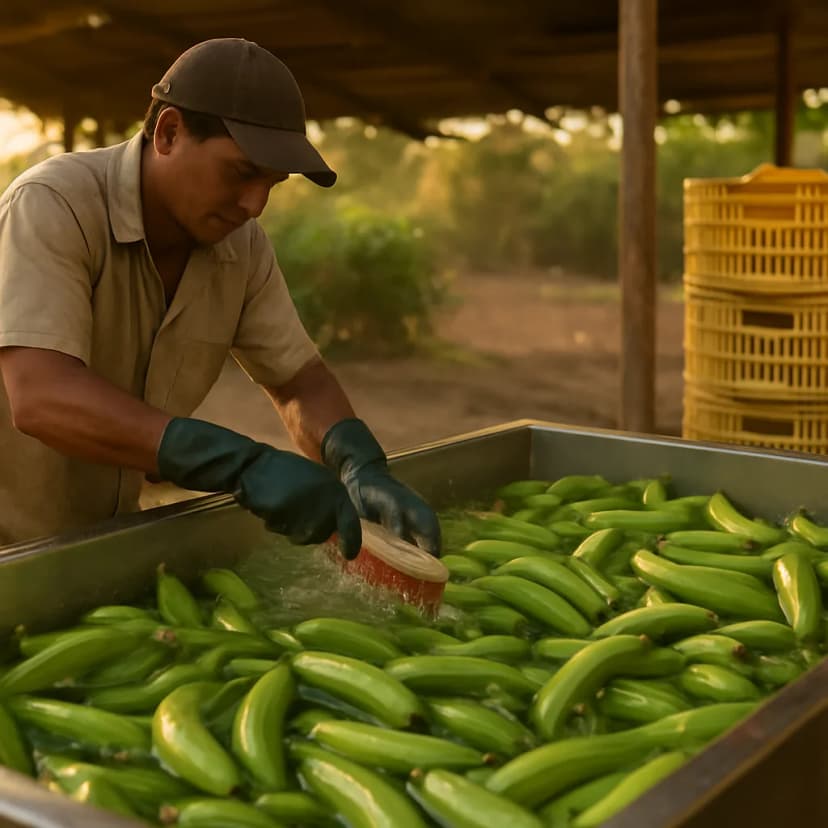
After harvest, the banana must be taken to the shade immediately to reduce dehydration and thermal shock. The time between harvest and packing is critical: the shorter, the better. At the collection centre, a pre-wash with clean water is carried out to remove dirt and residues. Exposure to direct sunlight for more than 30 minutes can raise the internal temperature of the fruit by several degrees, accelerating respiration and ethylene production, leading to uneven ripening and a reduction in shelf life. The use of mobile shade or harvesting in the morning hours are practices that minimise this risk.
Washing and disinfection are key steps in the post-harvest checklist for bananas. Chlorinated water at appropriate concentrations is used to reduce the microbial load. The recommended concentration of free chlorine in the washing water is 50 to 100 ppm, with a pH adjusted between 6.5 and 7.5 to maximise chlorine efficacy. It is essential to continuously monitor the chlorine concentration, as organic matter from the fruit can quickly neutralise it, reducing its disinfectant effect.
It is important to document each step of the process, including the products used and exposure times. This not only ensures safety but also facilitates traceability and compliance with international regulations. Records should include the date, time, batch of processed fruit, measured chlorine concentration, water pH, and immersion time. This documentation is essential for responding to third-party audits and for quickly identifying the root cause in case a quality issue is detected at destination. Furthermore, implementing a quality management system based on the principles of Hazard Analysis and Critical Control Points (HACCP) allows for the identification of critical points in the washing and disinfection process where risks can be controlled preventively.
4. Sorting and packing
Sorting involves grouping the fruit by variety, size, colour, and ripeness. Only homogeneous fruit is packed to ensure a uniform presentation. For export, rigid, ventilated cardboard boxes are used, with internal protection to prevent rubbing and compression. The packaging must be sturdy and allow for air circulation to maintain quality. Double-walled corrugated cardboard boxes are the industry standard for export, as they provide the necessary strength to withstand stacking during transport without deforming. The most common dimensions are 60 cm long, 40 cm wide, and 30 cm high, with a net weight of 18 to 22 kg per box, although these specifications may vary according to the buyer.
Selection of packaging materials
Packaging materials must be new, clean, and free from contaminants. Perforated polyethylene bags are used as internal liners to create a modified atmosphere that reduces water loss and respiration rate. Kraft paper or polyethylene foam sheets are placed at the bottom and sides of the box to provide additional cushioning. The corners of the box are the most vulnerable points to compression damage, so reinforcement with additional cardboard or plastic corner protectors may be necessary for long-distance destinations. The choice of material should also consider sustainability, as more and more European buyers demand packaging that is environmentally friendly.
Related articles
- Algal biostimulants for fruit set in hedgerow olive
- Organic amendments for water retention in palm
- Organic Matter for Clay Soil: Improves Aeration
Need professional help?
At Ecoganic in Spain, Europe, we offer certified organic Biostimulants and Fertilizers. Call us: +34 623 753 719.
Request your free quote
Post-Harvest Checklist for Bananas: Ready for Export?
The export of fresh bananas (Musa paradisiaca) requires rigorous control at every post-harvest stage, from cutting to the refrigerated container. For an exporter looking to comply with regulations such as GlobalG.A.P. or USDA Organic, the checklist must include quantifiable parameters: maturity index (scale of 1 to 7), firmness (measured with a penetrometer, 12-18 N), and starch content (≥70% in green state).
The first block of the checklist focuses on the selection and grading of the bunch. It is recommended to harvest when the central finger of the bunch reaches a diameter of 34-38 mm and a light green skin colour (scale 1-2). Subsequently, the handling must be done within a maximum of 24 hours after cutting, avoiding impacts that cause dark spots. Grading by weight (minimum 150 g per finger) and length (≥18 cm) is critical, as European standards reject batches with more than 3% of fruits out of specification.
Temperature management is the cornerstone of the post-harvest checklist. Bananas are highly sensitive to ethylene and thermal changes; therefore, pre-cooling must begin within 6 hours after cutting, reducing the temperature at the centre of the fruit from 28°C to 13-14°C within a maximum of 12 hours. During cold storage, relative humidity must be maintained between 85-90% to avoid dehydration (weight loss >5% invalidates export). For sea shipments, a temperature of 13°C ± 0.5°C and ventilation of 15-20 m³/h per pallet is recommended, which keeps CO₂ levels below 5% and prevents premature yellowing.
Packing and traceability constitute the final critical link. Corrugated cardboard boxes of 18-20 kg must have at least 5 lateral vents of 2 cm in diameter to ensure the circulation of cold air. Additionally, each box must be labelled with a QR code that includes field data, harvest date, batch, and internal temperature recorded with data loggers. The phytosanitary standard NIMF-15 requires that 100% of the wood is heat-treated; if using plastics, they must be 100% recyclable and free of BPA. Finally, the maturity test in the laboratory (starch measurement with iodine) must show an index of 3-4 on the maturity scale, and firmness must be ≥12 N.
Related Articles
What is the ideal temperature for transporting bananas?
The ideal temperature for transporting bananas is 12 to 16 °C, with a relative humidity of 90 to 95%. In the initial conservation stage, a temperature of 13 to 14 °C is recommended. Maintaining these conditions is crucial to delay ripening and prevent cold damage. It is important to verify that the refrigerated container is functioning correctly and that temperatures are recorded throughout the journey.
What is the minimum size required for exporting bananas?
The minimum size for exporting bananas is usually 38 to 40 mm, although it may vary depending on the market and the buyer. Some European markets prefer larger sizes, while others accept smaller sizes. It is essential to know the customer's specifications and grade the fruit according to those parameters. The minimum length is also a factor, generally from 25 to 28 cm.
How is the washing and disinfection of bananas carried out?
The washing of bananas is done with clean water and chlorine at appropriate concentrations to reduce the microbial load on the surface. It is important to document the products used and the exposure times to ensure safety and traceability.
What defects should be rejected during selection?
Fingers with mechanical damage, scars, insects, stains, or deformities should be rejected. Mechanical damage and scars healed by insects should not exceed 5% of the surface area. Additionally, the crown must be cut cleanly, without remnants of damaged tissue. Fruit with excessive latex should also be avoided, as it can stain the skin and affect appearance.
What documents are needed to export bananas?
To export bananas, phytosanitary documents, quality certificates, and in some cases, pesticide residue analysis results are required. In the European Union, compliance with maximum residue limits (MRL) is mandatory. Additionally, a commercial invoice, certificate of origin, and bill of lading must be provided. Traceability is key, so detailed records of each batch must be maintained.