

«`html
Modern agriculture faces the challenge of increasing productivity without compromising the environment. In this context, biological, organic, and ecological fertilizers have become pillars of sustainable fertilization, especially in Europe and Latin America. These natural origin nutrient amendments not only improve soil health but also reduce dependence on chemical inputs. Currently, more than 18.5 million hectares in Europe and 9.5 million in Latin America are cultivated under ecological practices, which evidences the growing adoption of these green alternatives on both continents.
What are they and how do they differ?
Organic fertilizers and ecological fertilizers are often used synonymously to refer to fertilizers derived from natural matter (plant residues, animal manures, compost, etc.) that are used according to organic farming standards. In Europe, it is common to speak of ecological agriculture for what is referred to as organic agriculture in Latin America; in both cases, it implies the absence of synthetic chemicals. These fertilizers provide essential nutrients gradually and improve soil structure without polluting the environment. In fact, a well-managed organic fertilizer “does not pollute soil, water, or air, is low cost, and can increase crop production by up to 30% without chemical fertilizers” This means that using organic fertilizers contributes to both environmental sustainability and agricultural profitability.
On the other hand, the term biological fertilizers usually refers to biofertilizers based on beneficial microorganisms. These products contain bacteria or fungi that improve nutrient availability for plants. For example, certain biofertilizers include phosphorus-solubilizing bacteria or nitrogen-fixing bacteria that are applied to the seed or soil to stimulate root growth. In other words, biological fertilizers “are products derived from microorganisms… that are sprayed during planting” to enrich the plant’s environment. This bio approach goes beyond providing nutrients: it creates a symbiosis between microbes and crops, naturally increasing soil fertility.
In practice, organic, ecological, and biological typically refer to the same general concept of natural and sustainable fertilizer, but with nuances: “organic/ecological” emphasizes the natural origin and certification for organic farming, while “biological” may highlight the involvement of living organisms in its formulation. All share the goal of responsibly nourishing crops in harmony with the environment.
Types of available natural fertilizers
There are various categories of organic/biological fertilizers, each with particular characteristics:
- Manures and guanos: Animal residues (cattle manure, poultry litter, seabird guano) rich in nitrogen and other nutrients. They must be composted or matured before application. They significantly improve the organic matter content of the soil.
- Compost and worm humus: Resulting from the controlled decomposition of organic domestic, agricultural, or pruning waste. They are balanced amendments that provide nutrients and improve soil structure. Vermicompost or worm humus is especially valuable for its richness in beneficial microorganisms.
- Green manures: Crops (such as legumes, mustard, rye) that are sown and then incorporated into the soil before they fruit. They provide fresh organic matter and nitrogen (in the case of legumes that fix atmospheric nitrogen) and help protect the soil from erosion.
- Meals and organic amendments: By-products such as bone meal (rich in phosphorus and calcium), blood meal, neem cake, fish meal, among others, that provide specific nutrients. For example, bone meal releases phosphorus slowly, and neem cake, in addition to providing nutrients, can act as a pest repellent.
- Microbial biofertilizers: Commercial preparations that contain strains of beneficial microorganisms. Some examples are Rhizobium inoculants (bacteria that form nodules on legume roots to fix nitrogen), Azospirillum (root growth-promoting bacteria), mycorrhizae (fungi that increase phosphorus and water absorption), and Trichoderma (fungus that decomposes organic matter and can suppress soil pathogens). These biological inputs enhance the natural processes of the soil and the rhizosphere.
- Natural mineral amendments: Although the term “organic” usually excludes mineral inputs, some natural minerals are allowed in ecological agriculture to correct deficiencies. For example, phosphate rock (a source of phosphorus), agricultural lime (to provide calcium and correct pH), or potassium sulfate of mineral origin. They are not organic fertilizers in the strict sense (they do not come from living beings), but they complement these by supplying elements that may be lacking in pure organic fertilizers.
Each type of ecological fertilizer has its function. Often, several are combined: for example, a farmer may apply compost as a base and complement it with a specific microbial biofertilizer to maximize results. This synergy replicates what happens in naturally fertile soils, where organic matter, minerals, and microbial life act together.
Benefits of organic/ecological fertilization
The use of organic and biological fertilizers brings numerous agronomic and environmental advantages:
- Improvement of soil health: By providing organic matter, these fertilizers increase the activity of beneficial microorganisms and biodiversity in the soil. Over time, fluffier soils are formed, with better structure and water retention capacity. A soil rich in humus suffers less erosion and retains nutrients that would otherwise be lost through leaching.
- Balanced nutrition and gradual release: Unlike chemical fertilizers that release nutrients quickly, organic fertilizers release nutrients gradually as they decompose. This provides more stable nutrition throughout the crop cycle and avoids salinity spikes or root burns. For example, the nitrogen from composted manure is mineralized slowly, better synchronizing with the plant’s needs.
- Greater moisture retention: Organic matter acts like a sponge in the soil. A soil amended with compost can retain more rainwater or irrigation, which is very valuable in dry climates. This improves crop resilience against short droughts.
- Reduction of pollution and positive environmental effect: Ecological fertilizers prevent the contamination of groundwater and rivers with nitrates or other leached chemicals, a common problem when synthetic fertilizers are overused. By coming from recycled waste, they also reduce waste accumulation (for example, reusing manure from intensive farms prevents it from becoming a contaminating waste). Thus, they contribute to the circular economy, repurposing organic by-products that would otherwise be waste. Argentina, for example, sees enormous potential in transforming the millions of tons of manure from its livestock production into biologically based fertilizers, reducing environmental impact and closing nutrient cycles.
- Food security and certifications: Crops fertilized organically often more easily meet the standards of ecological production, which are highly valued in international markets. Consumers in Europe and America prefer foods produced without synthetic chemicals, associating them with greater health and quality. Having naturally fertile soils allows for the production of certified “organic” products, accessing higher value market niches.
- Long-term agronomic benefits: Although nutrient release is slow, the residual effect of organic matter benefits subsequent crops. It is often observed that farms transitioning to organic may have a few initial years of adjustments, but after increasing the level of humus, productivity stabilizes and even increases with less external input. Studies indicate that combining organic fertilizer with small doses of mineral fertilizers can be very effective: organic fertilizer creates the foundation for more efficient use of any additional fertilizer. In summary, the intrinsic fertility of the soil is improved, something that chemical inputs alone cannot achieve.
Challenges and considerations
Despite their benefits, ecological fertilizers present certain challenges that should be managed properly:
- Slower nutrient release: Fertilization must be well planned, as nutrients are not immediately available. For example, applying compost or manure months before planting allows nutrients to mineralize in time. In fast-growing crops, it may sometimes be necessary to supplement with quickly assimilable sources (organic or permitted) if there are deficiencies.
- Lower nutrient density: In general, organic fertilizers have lower concentrations of N, P, K than a concentrated chemical fertilizer. This implies that larger volume doses are required. Logistical management (transport, storage, application) can be more intense. However, modern technologies are producing concentrated organic fertilizers with high efficacy. An example is ECOGANIC NitroTech 16, a liquid organic fertilizer with 16% highly bioavailable nitrogen, achieving vigorous growth comparable to that of traditional synthetic fertilizers.
- Variability in composition: The quality of an organic fertilizer depends on its source and process. Poorly made compost may lack nutrients or contain weed seeds; fresh manure may cause phytotoxicity. Therefore, it is important to have reliable suppliers or quality controls (nutrient analysis) on the farm. Many certifying companies also verify the inputs allowed in ecological production.
- Regulations and certification: To use the term “ecological” or “organic” on agricultural products, the fertilizers applied must be permitted by the corresponding regulations (Regulation (EU) 2018/848 in Europe, national organic regulations in Latin American countries, or international standards such as those of USDA Organic, IFOAM, etc.). This limits the use of certain natural amendments that are not on the approved lists. Fortunately, the range of authorized inputs is broad and continuously growing as their efficacy is researched and new products are regulated.
- Less immediacy in results: Farmers accustomed to fast-acting chemical fertilizers must adapt to a different management approach. Organic fertilization acts more slowly but sustainably. The benefits in soil may take months or years to be fully noticed (e.g., increase in organic matter), which requires a long-term vision.
With good planning, these challenges can be overcome. For example, by combining different sources (slow and fast release), integrating biostimulants that enhance assimilation (as we will see later), and adjusting agronomic practices, productivity can remain high organically.
Adoption in Europe and Latin America
Both in Europe and in Latin America, the interest in ecological fertilizers has ceased to be marginal and has become a dominant trend:
- Europe: The European Union leads policies for greener agriculture, with ambitious goals for conversion to organic production. Countries like Spain, Italy, France, and Germany top the area dedicated to organic agriculture in the region. In the EU, there is active support for organic farmers through subsidies and training programs. The result is a mature and constantly growing organic market. Organic fertilizers in Europe range from artisanal inputs on small organic farms to advanced commercial products developed by the industry. Many European companies offer organic granular fertilizers, humic extracts, microbial biofertilizers, etc., with certification for ecological use. Additionally, European environmental awareness leads even conventional farmers to reduce chemical fertilizers and add compost or biological products to improve their soils.
- Latin America: The region, with its great biodiversity and agricultural tradition, is also increasingly adopting organic fertilization. Countries like Argentina, Uruguay, and Brazil have extensive certified organic areas, especially in livestock, viticulture, and certain export crops. Also, in Central America and the Caribbean, ecological agriculture has grown, driven by market niches (for example, organic coffee, organic cocoa, quinoa in the Andes, etc.). An important factor in Latin America is the cost and availability of chemical fertilizers: recently, the volatility of international fertilizer prices (e.g., urea, phosphates) has hit local producers, encouraging the use of local sources (manures, agricultural residues) as fertilizer. An illustrative case is Brazil, where dependence on imported fertilizers (especially from Russia) led the government and the private sector to promote national alternatives. There is investment in remineralizers (rock meal) and biological fertilizers to reduce external vulnerability. This movement received a strong boost after geopolitical tensions that increased the cost of chemical inputs, demonstrating the strategic importance of organic and biological fertilizers. In general, Latin America has great potential to produce its own natural fertilizers thanks to its livestock activity (great availability of manure), agro-industries (waste that can be composted), and traditional knowledge (ancestral use of guano, local composting, etc.).
Both regions, with their differences, converge in recognizing that nourishing the land in an ecological way is the path to resilient agriculture. The increase in ecological hectares year after year confirms this direction.
Conclusion: Towards a greener agricultural model
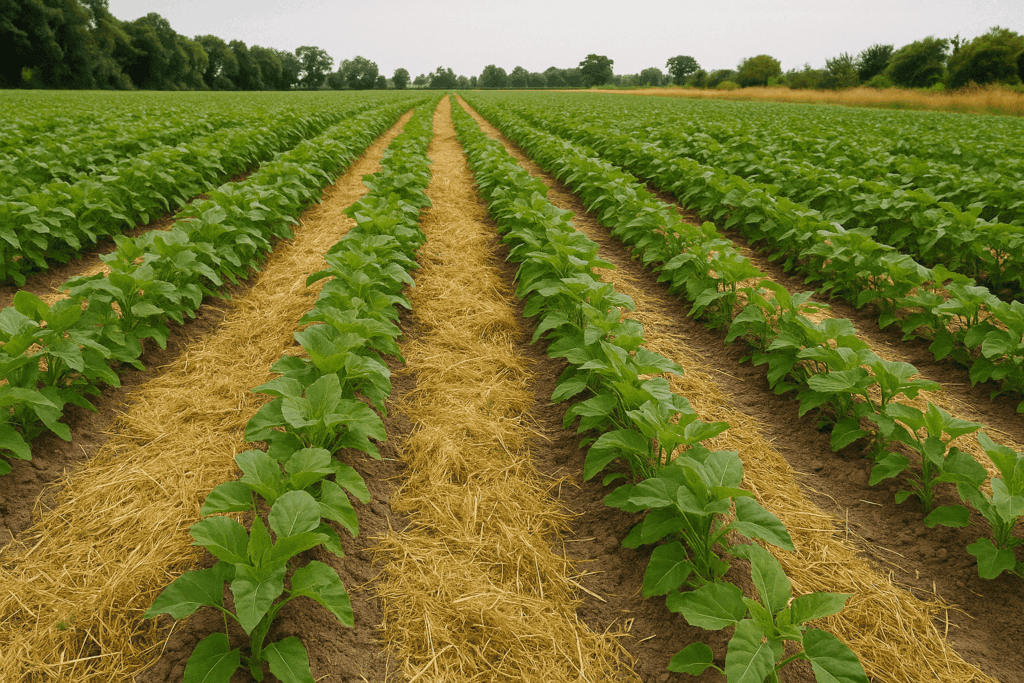
Biological, organic, and ecological fertilizers represent a paradigm shift in plant nutrition. It is not just about replacing chemical inputs with natural ones, but about fostering a regenerative agricultural system where the soil improves with each cycle and biodiversity is an ally of production. Europe and Latin America are advancing on this path, sharing knowledge and experiences that demonstrate that productivity and sustainability can go hand in hand.
Ultimately, adopting these alternatives leads to more alive soils, healthier plants, and balanced agricultural ecosystems. For the farmer, it can mean independence from costly inputs, added value to their products, and the peace of mind of producing responsibly. And for the consumer, safer food and a protected environment.
At Ecoganic.eu, we understand the importance of these sustainable inputs. That is why our mission is to provide high-quality ecological fertilizers that comply with European and Latin American regulations, helping farmers improve their yields without compromising the health of the planet. Organic fertilization is not just a technique; it is a philosophy where nourishing the land today ensures tomorrow’s food.
Ecological Biostimulants: Natural Growth Enhancers for Crops
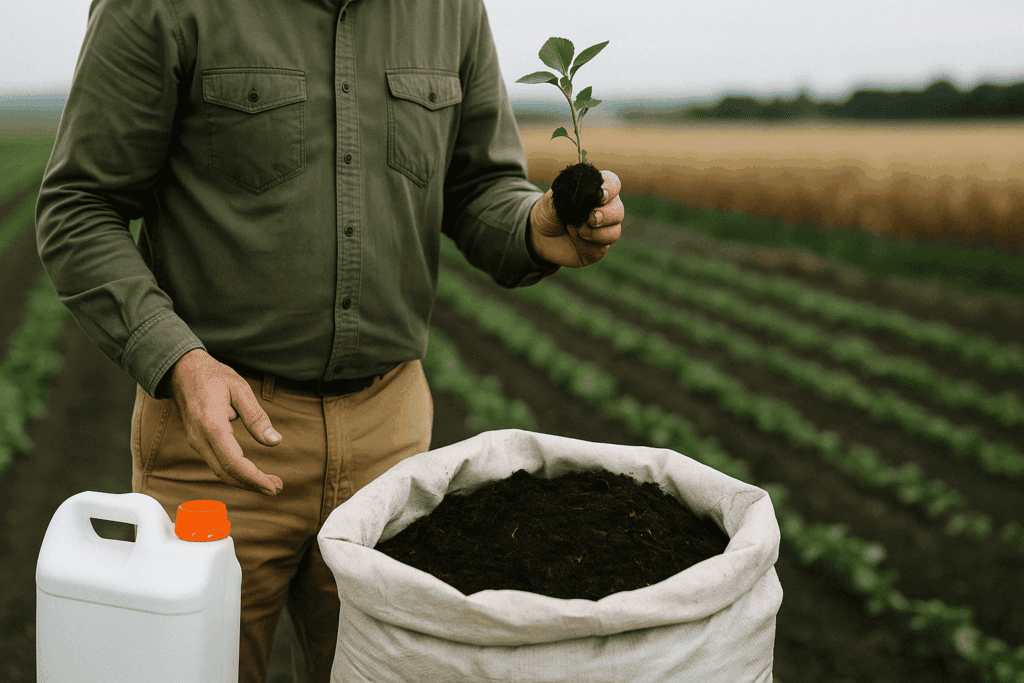
The search for higher agricultural yields with lower environmental impact has led to the growing adoption of ecological biostimulants. These innovative products, made from natural substances or microorganisms, “stimulate plant nutrition processes” to improve their vigor and productivity. Unlike traditional fertilizers that provide nutrients directly, biostimulants act as catalysts for plant growth: they improve the efficiency with which plants use nutrients, increase their resistance to stress (drought, salinity, extreme temperatures), and enhance the quality of the harvests.
In recent years, the use of biostimulants has surged in both Europe and Latin America, reflecting a global trend. The global market for these inputs reached $3 billion in 2023 and is expected to double by the end of the decade. Europe has been a pioneer in their adoption, but it is projected that Asia and Latin America will soon surpass it, with Latin America being the fastest-growing region in this sector. This boom responds to the need for a more efficient and sustainable agriculture, where every drop of fertilizer counts and every plant can reach its genetic potential even under adverse conditions.
👉 Discover our complete program: Biostimulants for Cocoa — technical application guide, phenological phases, and recommended products.
👉 Discover our complete program: Biostimulants for Coffee — technical application guide, phenological phases, and recommended products.
«`